Madhubani and Its Cousins: Folk Painting Traditions Around the World
TL;DR: Madhubani, or Mithila painting, began as wall art made by women in homes in northern Bihar. Two other well-documented traditions grew in a similar everyday setting: Petrykivka painting in a Ukrainian village, inscribed by UNESCO in 2013, and amate painting on bark paper by Nahua artists in Mexico, which draws on an older Indigenous paper tradition. They share themes of nature and protection, but each has its own history and meaning and none is described as a copy of another.
At a glance
Three home-grown painting traditions
- Madhubani Northern Bihar, India. Wall art made by women in homes.
- Petrykivka A village in Ukraine. Inscribed by UNESCO in 2013.
- Amate Mexico. Painting on bark paper by Nahua artists.
- Shared themes Nature and protection
- Copies? None is described as a copy of another
Madhubani: painting for the home
In 1934 a severe earthquake shook northern Bihar and brought down many village houses. Walking through the damage, a British official named William G. Archer saw colourful paintings on the exposed inner walls, and he later wrote about them, publishing in 1949 what the Victoria and Albert Museum calls the first article on the tradition. That is how Madhubani painting, also called Mithila painting after the Mithila region of Bihar, first became widely known outside its villages.
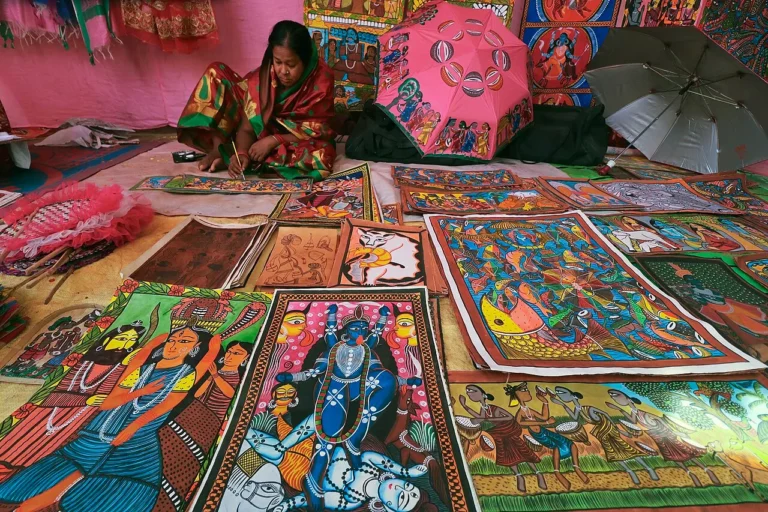
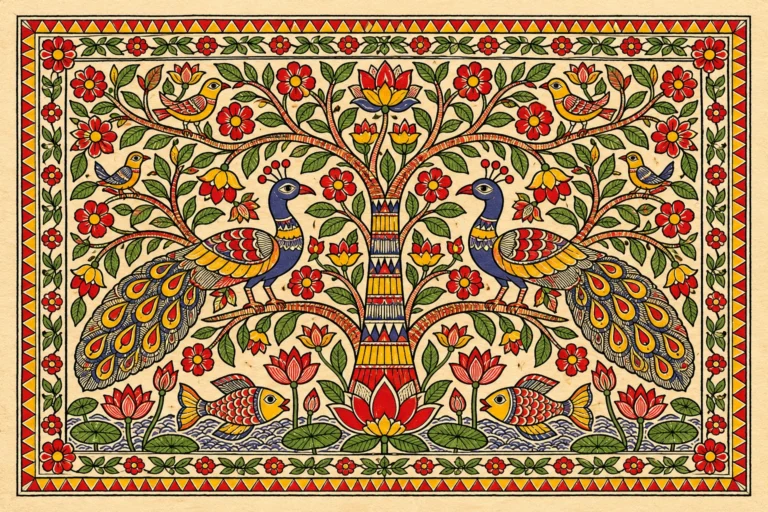
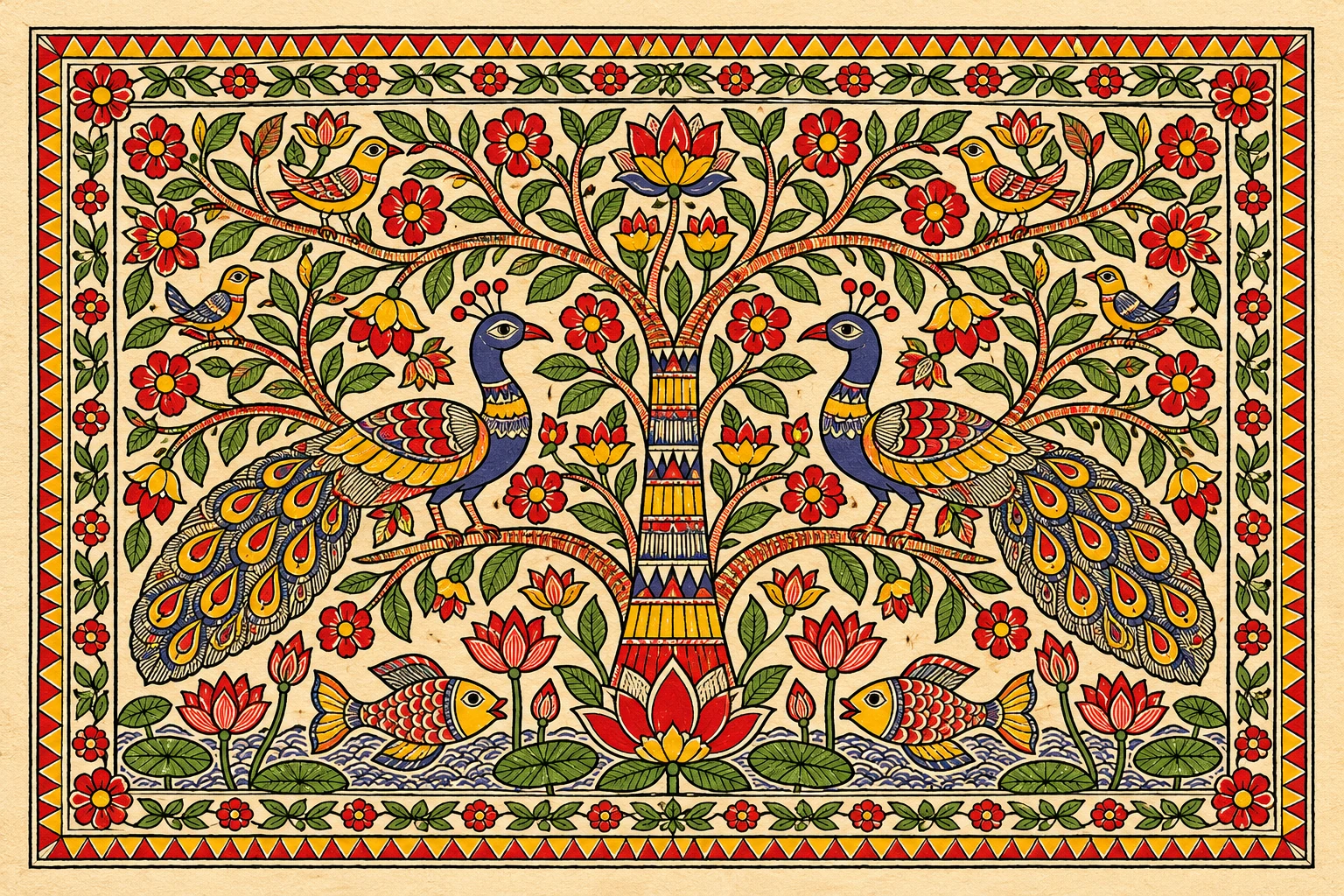
The Victoria and Albert Museum and the folk-art journal Folkartopedia agree on the basics. The paintings were made by women on the walls of village homes, often linked to weddings and seasonal rituals, and were passed down through generations. Folkartopedia describes the kohbar, the room prepared for a newly married couple, as a main setting, with fertility symbols such as lotus, bamboo, fish, birds and snakes. Subjects also include gods and goddesses and scenes from the Ramayana, such as Sita. Where the tradition began is not known exactly, and a popular story ties it to the wedding of Sita and Rama.
The move to paper came later. Folkartopedia says that during a drought in the late 1960s, the All India Handicrafts Board encouraged women in Mithila to transfer their designs to paper so they could earn an income. The Victoria and Albert Museum holds a painting of Krishna with milkmaids on paper, made around 1973 by Bagla Devi, and names Ganga Devi and Sita Devi as artists who became well known in India and abroad.
Petrykivka: a village that paints
Petrykivka is a village in Ukraine, in the farming region around the city of Dnipro, whose decorative painting UNESCO inscribed on its Representative List of the Intangible Cultural Heritage of Humanity in 2013. UNESCO says villagers decorate their homes, household objects and musical instruments with imaginative flowers and other natural forms, based on close observation of local plants and animals. Roosters are linked to fire and spiritual awakening and birds to light, harmony and happiness, and folk belief holds that the paintings protect people from sorrow and evil.
UNESCO adds that women of all ages are the main practitioners, that every family has at least one practitioner, and that schools from pre-school to college teach the basics. Radio Free Europe/Radio Liberty reports that the style is about 300 years old, that professional painters use cat-fur brushes, and that some details are made with a cotton-wrapped matchstick or a single fingertip dab. The same report says that after Russia’s full-scale invasion in 2022 the village museum moved its paintings to a secret location, which is a reminder that this is a living tradition in a difficult time.
Amate: painting on bark paper
Amate is a paper made from the inner bark of trees such as wild fig and mulberry, according to the Metropolitan Museum of Art. Its name comes from amatl, the Nahuatl word for paper. The Mexican Museum in San Francisco says the paper dates to pre-Hispanic times, when it was used for codices that recorded history and the succession of rulers, and also as tribute. It adds that the Spanish crown banned its production after the conquest, but that Otomí people of the Sierra de Puebla kept making it, using it in healing ceremonies. A Mexico-focused magazine, MexConnect, similarly reports that priests treated its use as idolatry and prosecuted papermakers.
Painting on amate in its modern form is usually traced to Nahua communities of the Balsas River region in the state of Guerrero. The museum places this revival in the late 1950s, when painters began putting images like those on their traditional pottery onto the paper; MexConnect says early 1960s, so the exact decade is best treated as approximate. Common subjects are the daily and ceremonial life of their communities, with birds, plants and mythical animals, and different painters developed different styles. The Otomí cut-paper figures of San Pablito, by contrast, are described by the Met as representations of spirit beings used by healers and shamans, and began to be sold to tourists only in the late 1970s. Because these are sacred and Indigenous works, it is respectful to look for each artist’s or community’s own account of what an image means.
What they share, and what they do not
Looked at together, the three traditions share a few threads. All three grew in everyday settings, whether house walls, village objects or family workshops. All three use nature as a visual language: fish and lotus in Mithila, imagined flowers and birds in Petrykivka, animals and plants in amate. Madhubani and Petrykivka are described by the Victoria and Albert Museum and UNESCO as practised largely by women. Madhubani is tied to weddings and fertility, and Petrykivka, in folk belief, to protection from harm.
- Shared: home-based beginnings, nature symbols, and a role in family and community life.
- Shared: each later reached new audiences, Madhubani through paper, amate through painting on bark paper, Petrykivka through museums and schools.
- Different: the surfaces and materials, and the stories behind the images.
- Different: how sacred the imagery is, which varies and is best explained by the artists themselves.
None of the sources I read says that one tradition borrowed from another, and similarity alone is not proof of contact. It is more accurate to say that communities in different places found their own ways to put meaning on a surface.
Compared
What they share, what they do not
- Shared: home beginnings All three grew in everyday settings: house walls, village objects or family workshops.
- Shared: nature Fish and lotus in Mithila, imagined flowers and birds in Petrykivka, animals and plants in amate.
- Shared: new audiences Madhubani reached them through paper, amate through painting on bark paper, Petrykivka through museums and schools.
- Different: surfaces and stories The surfaces, the materials and the stories behind the images differ.
- Different: how sacred How sacred the imagery is varies, and is best explained by the artists themselves.
Where to see them, and how to look
The Victoria and Albert Museum’s Madhubani collection can be explored online and its South Asia holdings are viewable by appointment. UNESCO’s page for Petrykivka and the village museum are the best starting points for Ukraine, though the 2022 report says international visits there had stopped. For amate, the Mexican Museum in San Francisco has held an exhibition of amate paintings, and the Met has published on modern amate manuscripts that include Otomí cut-paper figures. Check each museum’s website for what is currently on display. When looking at any of these works, look for information on the artist and community, and do not rely on a single label to tell you what a picture means.
Related stories
- Exploring the Enchanting World of Maithili Art and Madhubani Painting.
- Venturing the Beauty of Warli Painting: A Cultural Heritage of Maharashtra
- Sohrai and Khovar Paintings
- Aipan – Folk art of Kumaon (Uttarakhand)
Frequently asked questions
What is Madhubani painting?
It is a painting tradition from the Mithila region of northern Bihar, traditionally made by women on the walls of village homes and, since the 1960s, also on paper.
Is Petrykivka on UNESCO’s list?
Yes. Petrykivka decorative painting was inscribed on UNESCO’s Representative List of the Intangible Cultural Heritage of Humanity in 2013.
What is amate?
Amate is a paper made from tree bark, with pre-Hispanic roots in Mexico. Nahua painters began painting on it in the 20th century.
Did these traditions copy each other?
No source I found says so. They are best understood as separate traditions that share some themes, such as nature and protection.
Who brought Madhubani to wider attention?
The Victoria and Albert Museum says the British official W. G. Archer documented the paintings after the 1934 earthquake and published the first article on them in 1949.
Sources and further reading
- Victoria and Albert Museum: Krishna, painting by Bagla Devi, Madhubani
- Folkartopedia: Madhubani Painting, a Historical Context
- UNESCO: Petrykivka decorative painting
- UNESCO: Decision 8.COM 8.29 (Petrykivka)
- Radio Free Europe/Radio Liberty: Petrykivka painters
- The Mexican Museum: Amates, Corteza de Identidad
- MexConnect: Amate Art of Mexico
- The Metropolitan Museum of Art: Power Paper, the Amate Manuscripts of Alfonso Garcia Tellez
Image credit: AI-generated illustration created for Thigma Art, shown for representation in the Madhubani style; it is not a photograph of an actual painting.