Block Printing, Batik and Resist Printing: India, Indonesia and Beyond
TL;DR: Many textile traditions pattern cloth by blocking dye with wax, paste or mud before dyeing. India has hand block printing, including resist-and-indigo work in Rajasthan, and Kalamkari, the painted and printed cotton of Andhra Pradesh. Indonesia’s batik is on UNESCO’s list, Japan’s katazome uses a rice-paste resist through stencils, and Yoruba women in Nigeria make adire with cassava paste. They are separate traditions with their own histories, not copies of each other.
Cloth that travelled the world
In the late 17th or early 18th century, painted cotton was made on India’s Coromandel Coast for the Japanese market, and in the 18th century for Thailand and the Netherlands. The Metropolitan Museum of Art in New York holds examples of each in its collection of what it calls painted and dyed cottons. These cloths show how patterned textile has long moved across oceans, and how makers adapted the same dyeing knowledge for different customers.
The shared idea is resist. If you stop dye from reaching part of a cloth, whether with wax, paste, mud or a physical stencil, that part keeps its colour. Cloth makers in India, Indonesia, Japan and West Africa all use versions of this idea, but they use different resists, tools and cloths, and their histories are documented separately. This article looks at four, with extra care to say only what the sources support.
India: blocks, mud and mordants
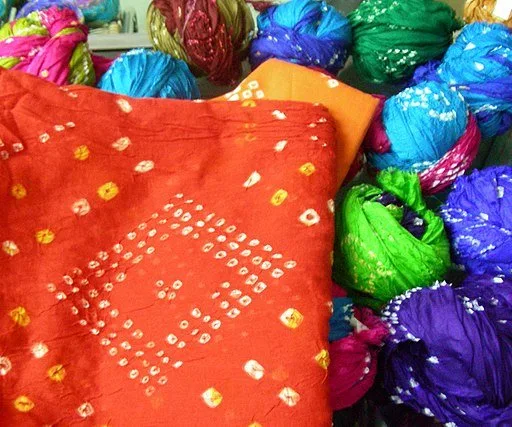
Hand block printing uses carved wooden blocks to stamp patterns. An encyclopedia entry on block-printed textiles says that the block controls where resist and mordant (a metal-salt or tannin substance that helps dye stick to cotton) are placed. Cloth is prepared and washed, mordanted, stamped with a resist of mud, lime or wax, then dyed, with indigo handled in a cold fermented vat. The same entry notes that Sanganer and Bagru in Rajasthan belong to a western Indian belt that uses mud resist, and that the earliest physical evidence of western Indian block-printed cloth it cites was found at Quseir al-Qadim in Egypt, dated 13th to 14th century.
The Victoria and Albert Museum’s description of a workshop in Kaladera, Rajasthan, gives a clear picture: an outline is printed with a block, a second block prints a resist paste made from lime, gum and a sticky pond clay on areas meant to stay white, wheat chaff is dusted on so the layers do not stick, the cloth is dried in the courtyard and dipped in indigo, and the steps repeat to deepen the blue. The Met’s account of painted cottons adds that wax or mud resist was used in historical Indian cloths, and that dyers used locally sourced dyes with metallic mordants.
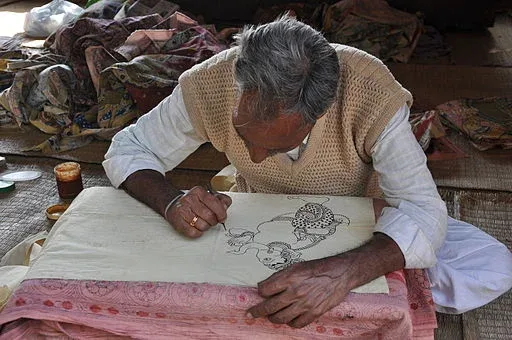
Kalamkari, a name commonly explained as pen work, is painted and printed cotton from the Deccan and Coromandel regions, including Machilipatnam in Andhra Pradesh. The Met describes a Deccan hanging of about 1640 to 1650 painted with an iron-based black dye applied with a bamboo pen, and the Victoria and Albert Museum holds a Kalamkari textile from Machilipatnam of about 1855, made with mordant and resist dyeing. The Met adds that 17th-century production was centred on the Coromandel Coast for export to Europe, East Asia, Southeast Asia, North Africa, Turkey and Iran.
How it’s made
Resist block printing in Kaladera
- Print the outline An outline is printed with a block.
- Resist paste A second block prints a paste of lime, gum and sticky pond clay on areas meant to stay white.
- Dust with chaff Wheat chaff is dusted on so the layers do not stick.
- Dry and dip The cloth is dried in the courtyard and dipped in indigo.
- Repeat The steps repeat to deepen the blue.
Indonesia: batik, drawn with wax
UNESCO inscribed Indonesian batik on the Representative List of the Intangible Cultural Heritage of Humanity in 2009. It says craftspeople draw designs on fabric with dots and lines of hot wax, the wax resists dye, and it is later removed with boiling water; for more colours, the process is repeated. UNESCO notes that batik appears across life, from baby slings to funeral shrouds, and its patterns draw on many influences, including Arabic calligraphy, Chinese phoenixes and Indian or Persian peacocks.
The Art Institute of Chicago says Java is the main source of batik and that Javanese makers developed an especially sophisticated version. It describes the canting, a small tool with a spout and wax reservoir for drawing, and the cap, a stamp introduced in the 19th century that applies wax faster. It also says there is no evidence that today’s batik methods are older than the early 19th century, and that women have traditionally been the main makers. Several pieces of this history are tied to one museum source, so older origin stories are best treated as unproven.
Japan and Nigeria: rice paste and cassava paste
Katazome is a Japanese method that uses a katagami, a paper stencil cut from mulberry paper made water-resistant with persimmon juice. The Fashion Institute of Technology in New York explains that a paste traditionally made from rice flour, rice bran and lime is spread through the stencil, and the cloth is then dyed, usually with indigo on cotton, so the pasted parts keep their colour. The same source says resist paste was used in Japan by the 7th and 8th centuries, stencil printing developed slowly, and the late Edo and Meiji periods were its golden age.
Adire is an indigo-dyed cloth traditionally made by Yoruba women in south-western Nigeria. The Victoria and Albert Museum explains adire eleko, in which cassava starch paste is applied with a brush or feather, either through a metal stencil or freehand. The museum says the origins of adire are unknown, though indigo dyeing has existed across West Africa for centuries, and notes that factories now also mass-produce imitations. The Mingei International Museum’s catalogue likewise records Yoruba adire eleko as a starchy root paste resist from the 20th century. I have kept to what these two museums say and avoided broader claims.
What links them, and what does not
- Resist: wax in batik, mud and lime in Indian resist block printing, rice paste in katazome, cassava paste in adire.
- Tools: carved blocks in India, a canting and a cap in Java, a paper stencil in Japan, a metal stencil or freehand brush in Nigeria.
- Dye: indigo appears in nearly all four, but each tradition uses it in its own way and with its own other colours.
It is tempting to draw lines between these traditions, such as saying one inspired another. The sources I read do not support that, apart from the general fact that Indian painted cottons were exported widely, and that Indonesian batik patterns include influences from many places according to UNESCO. A more careful conclusion is that people in different places found ways to resist dye, and then built their own aesthetics around them. If you want to see these cloths, the Met, the Victoria and Albert Museum, the Art Institute of Chicago and the Mingei International Museum all have online records, and their websites show what is currently on display.
Compared
Resist and tools by tradition
- India Resist: mud and lime (or wax) in resist block printing. Tool: carved blocks.
- Indonesia Resist: hot wax in batik. Tools: a canting, and a cap stamp introduced in the 19th century.
- Japan Resist: rice paste in katazome. Tool: a paper stencil.
- Nigeria Resist: cassava paste in adire. Tool: a metal stencil or a freehand brush.
Related stories
Frequently asked questions
What is a resist in textile printing?
It is a substance such as wax, paste or mud that stops dye from reaching part of the cloth, so that part keeps its original colour.
Is Indonesian batik on UNESCO’s list?
Yes. UNESCO inscribed Indonesian batik on its Representative List of the Intangible Cultural Heritage of Humanity in 2009.
What does Kalamkari mean?
The name is often explained as pen work. The Met describes an early Deccan Kalamkari hanging painted with a bamboo pen and an iron-based black dye.
How is katazome different from batik?
Katazome applies a rice-based paste through a paper stencil, while batik uses hot wax drawn with a canting or stamped with a cap.
Who makes adire?
According to the Victoria and Albert Museum, adire is traditionally made by Yoruba women in south-western Nigeria, and men generally make the stencils.
Sources and further reading
- Encyclopedia.com: Textiles, Block-Printed
- Victoria and Albert Museum: Location scout, resist block printing (Kaladera, Rajasthan)
- The Metropolitan Museum of Art: Painting with Dyes in Early Modern South Asia
- Victoria and Albert Museum: Kalamkari textile, Machilipatnam
- UNESCO: Indonesian Batik
- Art Institute of Chicago: Batik Textiles of Java
- Fashion Institute of Technology: Katazome
- Victoria and Albert Museum: Adire eleko cloth, Nigeria
- Mingei International Museum: Blue and Gold, Contrast, Hues and Mastery of Dye
Image credit: “Kalamkari painting” by Anilbhardwajnoida, via Wikimedia Commons, under the Creative Commons Attribution-Share Alike 3.0 Unported licence.