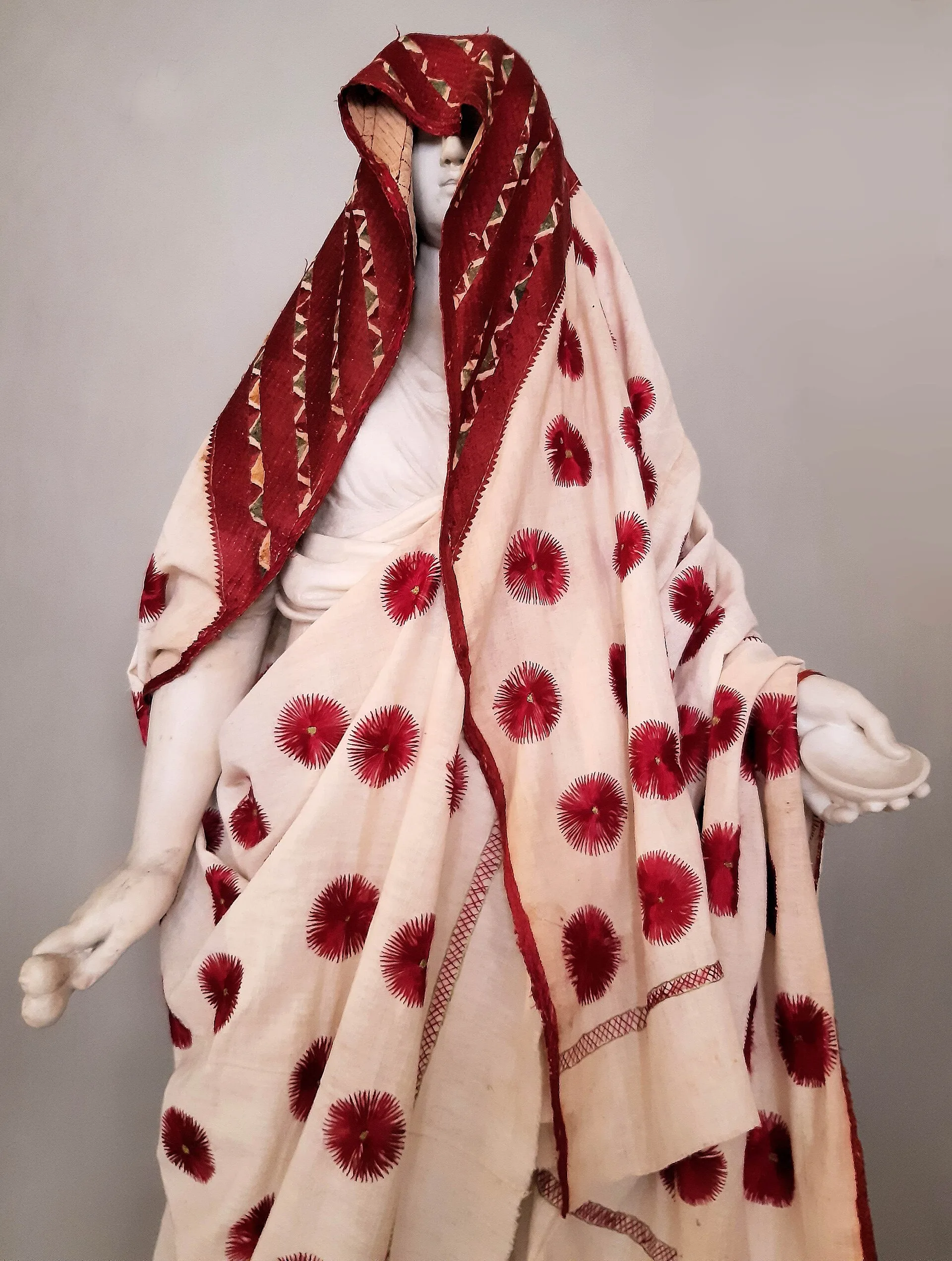
Phulkari of Punjab: Flower-Work Embroidery, Bagh and the Bride’s Trousseau
In short: Phulkari, meaning flower work, is Punjab’s silk embroidery on coarse cotton, worked mainly in darning stitch. When the stitching covers the whole cloth it is called bagh, or garden. Phulkari was traditionally part of a bride’s dowry, and it holds a Geographical Indication shared by Punjab, Haryana and Rajasthan.
A garden stitched onto cloth
In the Victoria and Albert Museum in London there are fragments of a woman’s wedding headcover from Punjab, made in the late 19th or early 20th century. The cloth is a rust-coloured cotton, embroidered all over with yellow silk floss. It is catalogued under the name Vari da Bagh, and it shows how phulkari can turn a plain piece of cloth into something that glows.
Phulkari literally means flower work. It is a hand embroidery from the Punjab region, which today is split between India and Pakistan. Museum texts describe it as silk embroidery on plain-woven cotton. Women wore the large shawls on special occasions and also made blankets, covers and wall hangings from the same kind of work. The designs run from simple geometric patterns to birds, animals and village scenes, in bold colours linked with good fortune.
This article looks at the craft from Punjab’s side. Haryana and Rajasthan share the same Geographical Indication, which is covered below.
The darning stitch on khaddar
Museum records describe the base cloth as khaddar, a coarse cotton that is handspun and handwoven. One museum note says this unbleached, locally spun and dyed cloth was seen as a symbol of purity. The threads used for the embroidery are called pat, an untwisted silk floss. Museum texts say the silk was often imported, with China, Afghanistan and Bengal named as sources.
The main stitch is the darning stitch. The needle carries the silk in straight, parallel stitches that lie flat along the cloth, so the thread’s sheen shows clearly. Other stitches also appear in some pieces, and a Smithsonian record for one bagh lists satin and herringbone stitches. Because the stitches run in lines, the pattern builds up like a woven surface.
- Base cloth: khaddar, handspun and handwoven cotton.
- Thread: pat, an untwisted silk floss.
- Main stitch: darning stitch, in straight parallel lines.
- Learning: girls learned the work from older female relatives and friends.
Bagh and phulkari: what is the difference?
In everyday speech the two words overlap, but in museum language they name different looks. In a phulkari the embroidery is scattered, and the plain cloth shows between the motifs. In a bagh, which means garden, the embroidery covers the cloth so completely that the base barely shows. A Philadelphia Museum of Art note lists bagh as one of several groups sorted by design and background colour, alongside thirma and sainchi.
The Smithsonian’s record for a bagh names yellow, pink and green as traditional colours. A Rhode Island School of Design museum record for a thirma bagh from 1875 to 1900 notes that the embroidery was done by Hindu and Sikh women, and that complete coverage of the cloth is what earns the name bagh. Another Victoria and Albert Museum piece, a sainchi headcover from the early 19th century, shows that figures such as herdsmen and birds could also appear. Its exact place of origin is given only as possibly Kangra, Chamba or Punjab, so details of early history are best treated with care.
Weddings, dowries and the home
Museum sources agree that phulkari was closely tied to marriage. Families often made phulkaris for a bride’s dowry, the goods she took to her new home, and the Smithsonian says embroideries like these were a standard part of it. A Philadelphia museum text describes phulkaris as a major part of a Punjabi woman’s material wealth. The Victoria and Albert Museum’s wedding headcover is one concrete example of a piece made for the occasion.
Beyond weddings, the RISD museum says phulkaris were worn during rituals linked with childbirth, death and marriage. Women of many faiths made them, and the same needlework turned up in everyday items such as blankets and covers. Many accounts also say that young girls began stitching pieces for their own future dowries, which made the craft a way of passing skills across generations of women in a household.
A Geographical Indication shared by three states
The Indian GI Registry lists Phulkari under application number 27, for goods of the class Embroidery, with the geographical area given as India (Punjab, Haryana and Rajasthan). The applicant is the Punjab Small Industries and Export Corporation Ltd, with its registered office in Chandigarh. The entry shows a filing date of 14 March 2005, a certificate date of 22 October 2010, and validity until 13 March 2035. The registry page does not state the exact year of registration separately, so the certificate date is the safest reference.
A Tribune report on GI tags in Punjab and Haryana says the embroidery is made across Punjab and in the Haryana districts of Ambala and Hisar. The same report says awareness of GI tags in both states is low, so artisans have not yet gained the full benefit. A GI protects a name and a place link; it is not a guarantee of quality, and it does not by itself tell you how a given piece was made.
What has changed
Museum texts note that the 1947 Partition split the Punjab region between India and Pakistan. The Philadelphia museum says that afterwards phulkari became a symbol of Punjabi cultural identity, while the RISD record says the older traditions were largely discontinued. These two views are not necessarily in conflict, since the craft changed in different ways in different places, and no single source has been found that measures this.
In the past half century, according to the Philadelphia museum, phulkari has been revived as a commercial art. It appears in popular music and videos, and designers such as Manish Malhotra have drawn on it for fashion. Today the word is used loosely for many embroidered items, so it helps to ask how a piece was made. Hand darning on handspun cloth is slow work, while quicker embroidery is often sold under the same name. For a firm answer about a particular piece, a textile museum, a craft body or an experienced conservator is a better judge than any single visual sign.
Related stories
- Geographical Indication (GI) tags
- Kalamkari – An Ancient India Art Form
- Handloom or Powerloom? How to Tell Handwoven Cloth from Machine-Made
- Hand-Painted or Printed? How to Tell an Original Indian Folk Painting from a Print
Phulkari, bagh, thirma and sainchi at a glance
| Type | How to recognise it | What the museum records say |
|---|---|---|
| Phulkari | Embroidery is scattered in motifs and the plain cloth shows between them | Used in museum language for the scattered look |
| Bagh (“garden”) | Embroidery covers the cloth so completely that the base barely shows | Smithsonian record names yellow, pink and green as traditional colours; Rhode Island School of Design record says full coverage earns the name |
| Thirma | Listed as a separate group, sorted by design and background colour | Philadelphia Museum of Art note; a thirma bagh dated 1875 to 1900 was embroidered by Hindu and Sikh women |
| Sainchi | Can include figures such as herdsmen and birds | Victoria and Albert Museum headcover, early 19th century; origin given only as possibly Kangra, Chamba or Punjab |
Descriptions follow the museum records cited in the sources below.
Frequently asked questions
What does phulkari mean?
It means flower work. It is a Punjabi embroidery in silk thread on plain cotton cloth.
What is the main stitch in phulkari?
The darning stitch, worked in straight parallel lines. Some pieces also use other stitches.
How is bagh different from phulkari?
In bagh, meaning garden, the embroidery covers the whole cloth. In a phulkari the plain base cloth shows between the motifs.
Does phulkari have a GI tag?
Yes. The GI Registry lists Phulkari as embroidery from Punjab, Haryana and Rajasthan, under application number 27.
Why is phulkari linked with weddings?
Museum sources say families often made it for a bride’s dowry, and some pieces were made as wedding headcovers.
Sources and further reading
- Indian GI Registry: Phulkari, application 27
- Philadelphia Museum of Art: Phulkari (curated collection)
- Philadelphia Museum of Art: Phulkari, the Embroidered Textiles of Punjab
- RISD Museum: Thirma Bagh Phulkari
- Smithsonian National Museum of Asian Art: Phulkari bagh
- V and A: Vari Da Bagh, wedding headcover fragments
- V and A: Nilak Sainchi Phulkari
- The Tribune: Punjab, Haryana unable to reap benefits of GI
Image credit: “A Phulkari with traditional flower pattern on unworked background” by Chiswick Chap, via Wikimedia Commons, licensed under CC BY-SA 4.0.