Kalamkari – An Ancient India Art Form
In short: Kalamkari is a traditional Indian textile art, hand-painted with a pen (kalam) or block-printed, mainly in Andhra Pradesh. It uses natural dyes, depicts religious and mythological themes, and is made entirely by hand, so no two pieces are exactly alike. Srikalahasti and Machilipatnam are its main centres.
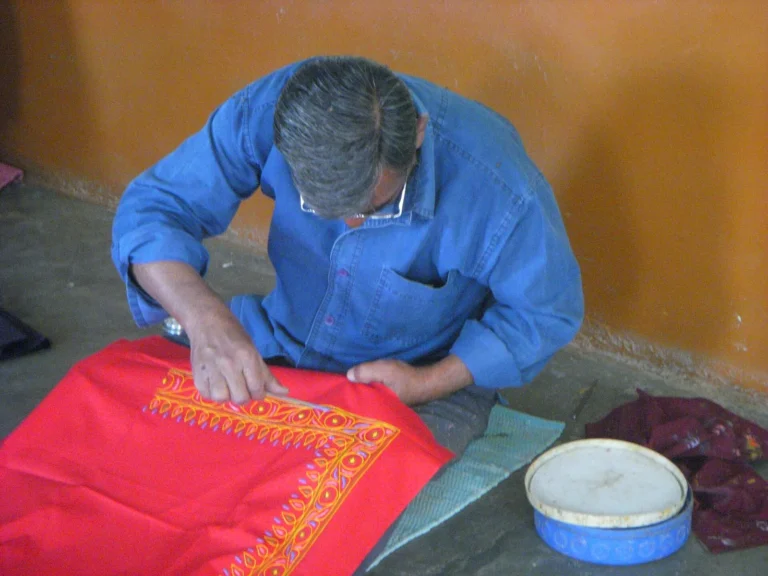
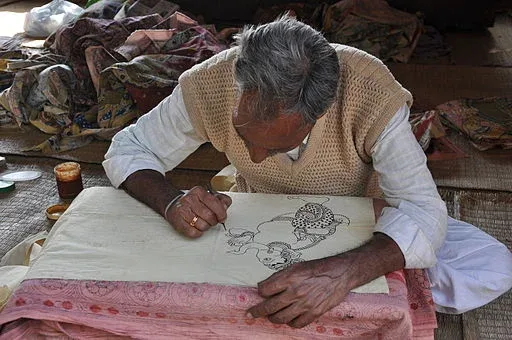
Kalamkari artists draw on cloth with a bamboo stick dipped in dye made from leaves, roots and bark. The name means “decorating with a pen”. It is a hand-painted or block-printed textile art from Andhra Pradesh, often showing scenes from the Ramayana and Mahabharata. You will learn where it began, what makes it special, where it is made, and how it can reach more people.
At a glance
Kalamkari in brief
- Meaning Decorating with a pen
- Region Andhra Pradesh, along the Coromandel Coast
- Main centres Srikalahasti and Machilipatnam
- Pen Bamboo or date palm pen (kalam) dipped in natural dyes
- Dyes Leaves, roots, bark and minerals
- Themes Scenes from the Ramayana and Mahabharata, gods and goddesses
Where does Kalamkari come from?
The word kalamkari is usually explained as ‘pen work’, from the Persian qalam (pen) and kari (craft). The craft grew up along the Coromandel Coast of south-eastern India, and two main styles are recognised today. At Srikalahasti, in Chittoor district, artists paint freehand with a bamboo pen, often showing scenes from the epics. Around Machilipatnam, with block printing centred on Pedana in Krishna district, cloth is stamped with carved wooden blocks in repeating floral patterns. Government craft pages say this second style flourished under Golconda and Mughal patronage, and a Dutch university study describes strong Persian influence on the Golconda-linked designs.
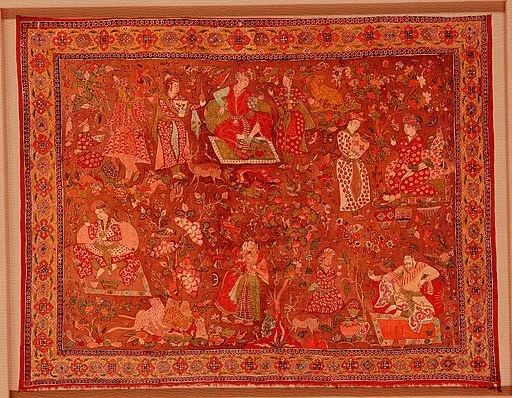
Trade made it famous. Machilipatnam was a busy Coromandel port, and Dutch, English and French traders knew it for its cloth. Scholars describe European trading companies commissioning designs for export from the mid-1600s, and the Metropolitan Museum notes that Coromandel painted cotton, called chintz in Britain, was wildly popular across Europe and also sold in Southeast Asia, Turkey and Iran.
How old is it? Nobody can say exactly. One survey reports that the oldest cloth found from the Coromandel Coast itself dates to about the 13th to 14th century, and a researcher notes that few 17th-century pieces survive. The craft’s roots may well be older, but we have not found firm evidence for very early dates.
What makes Kalamkari special?
Kalamkari is known for fine pen-drawn lines and deep natural colours. Its main features are:
- Natural dyes: Dyes made from leaves, roots, bark and minerals give the fabric soft, deep colours.
- Fine line work: The artist uses the kalam to draw delicate, flowing lines and patterns with great attention to detail.
- Cultural significance: Kalamkari often shows religious and mythological themes, such as scenes from the Ramayana and the Mahabharata, and gods and goddesses.
- Handmade process: Each design and colour is created by hand, so no two pieces are exactly alike.
- Durability: Natural dyes and strong cotton fabric make Kalamkari a durable art form that can be enjoyed for years.
What’s special
What makes Kalamkari special
- Natural dyes Dyes from leaves, roots, bark and minerals give the fabric soft, deep colours.
- Fine line work The artist uses the kalam to draw delicate, flowing lines and patterns.
- Cultural significance Religious and mythological themes, such as scenes from the Ramayana and the Mahabharata.
- Handmade process Each design and colour is made by hand, so no two pieces are exactly alike.
- Durability Natural dyes and strong cotton fabric make it a durable art form.
Where is Kalamkari made?
The towns of Srikalahasti and Machilipatnam are considered the main centres of Kalamkari production. Srikalahasti is known for the hand-painted style, and Machilipatnam for block printing with vegetable dyes. In these regions the art has been passed down from generation to generation, and many skilled artisans still practise the ancient techniques.
In recent years Kalamkari has become popular in other parts of India and around the world.
Two styles
Srikalahasti and Machilipatnam
- Srikalahasti In Chittoor district, artists paint freehand with a bamboo pen, often showing scenes from the epics.
- Machilipatnam Cloth is stamped with carved wooden blocks in repeating floral patterns, with block printing centred on Pedana in Krishna district. Machilipatnam is known for vegetable dyes.
Is there demand for Kalamkari today?
Yes. There is demand for Kalamkari in India and abroad. It is bought for textiles and home decor, and many buyers value its religious themes and the fact that each piece is made by hand. Demand has also grown as people look for traditional and sustainable products, and natural dyes are becoming more popular.
For some Kalamkari artists, being able to practise and earn from their art brings happiness and fulfilment, and they take pride in preserving their heritage. At the same time, the work can be demanding and the income may not always be enough for a stable livelihood. Growing demand and recognition of its cultural value can help support the livelihoods of Kalamkari artists.
How can Kalamkari be made more popular?
Kalamkari can reach more people by raising awareness about the art form, its cultural significance and its traditional techniques. Some ways to do this are:
- Marketing and promotion: Highlighting its natural dyes, handmade process and cultural significance can attract more customers.
- Collaborating with designers and artists: Designers who include Kalamkari in their work can introduce it to a wider audience.
- Supporting artisans: Fair prices and help in promoting their products can help preserve the art form.
- Events and exhibitions: Taking part in events, exhibitions and cultural festivals puts the work in front of new buyers.
- Online resources: Websites and social media accounts that share information about Kalamkari and its history increase its visibility.
Wider sales would keep the craft in practice and give its artists a steadier income.
GI tag record
| GI name | State | Filed | Certificate date | Valid until | Registry |
|---|---|---|---|---|---|
| Srikalahasthi Kalamkari | Andhra Pradesh | 16 March 2005 | 12 January 2006 | 15 March 2035 | App. 28 |
| Machilipatnam Kalamkari | Andhra Pradesh | 16 April 2007 | 10 July 2008 | 15 April 2027 | App. 90 |
Dates are from the official GI Registry record, read on 21 November 2026. See all crafts in our GI tag list.
Frequently asked questions
What does Kalamkari mean?
It means “decorate with a pen”, referring to the bamboo or date palm pen (kalam) dipped in natural dyes that is used to draw the designs.
Where does Kalamkari come from?
Kalamkari grew along India’s south-eastern Coromandel Coast. Srikalahasti is known for freehand pen painting, and Machilipatnam for block printing. In the 1600s European trading companies, including the Dutch and English, helped carry its painted cotton to Europe. Exact beginnings are unknown; early dates are uncertain.
Where is Kalamkari made?
Mainly in Andhra Pradesh. Srikalahasti (hand-painted) and Machilipatnam (block-printed) are the main centres.
What themes does Kalamkari show?
Religious and mythological themes, such as scenes from the Ramayana and the Mahabharata, and gods and goddesses.
Why is Kalamkari considered durable?
It uses natural dyes and strong cotton fabric, so it can be enjoyed for years.
How can Kalamkari be promoted?
Through marketing, collaboration with designers, fair prices for artisans, events and exhibitions, and online resources.
Sources and further reading
Kalamkari: An Introduction, Sahapedia.
Machilipatnam Kalamkari, Development Commissioner (Handicrafts), Government of India.
Painting with Dyes in Early Modern South Asia, The Metropolitan Museum of Art.
Unikkumarath Prajna, thesis on Sits (chintz) and Coromandel trade, Erasmus University Rotterdam.
Related reading
- Block Printing, Batik and Resist Printing: India, Indonesia and Beyond
- Tie and Dye
- Unsung Art of India: 9 Folk and Tribal Painting Styles
Image credit: “Kalamkari painting” by Anilbhardwajnoida, via Wikimedia Commons, under the Creative Commons Attribution-Share Alike 3.0 Unported licence.
Image credit: “Kalamkari Rumal MET TP312”, The Metropolitan Museum of Art, via Wikimedia Commons, under the CC0 1.0 Universal Public Domain Dedication.