Abstract Art: How Shapes, Colours and Emotions Work
In short: Abstract art does not try to show the physical world. It uses shapes, colours and forms to express emotions and ideas, which is why it appeals to people who enjoy mystery and open interpretation. It has been a central stream of modern art since the early 20th century, with works such as Jackson Pollock’s Full Fathom Five (1947).
Abstract art has been a major force since the early 20th century. It uses shapes, colours and forms to express complex feelings and ideas, and many people are drawn to it because it leaves room for mystery and makes them think. Paintings such as Jackson Pollock’s Full Fathom Five (1947) are not for everyone, but they changed the way many people look at a picture.
At a glance
Abstract art in brief
- What it is Art that does not try to depict the physical world accurately
- Built from Shapes, colours and forms
- Expresses Emotions and ideas that are often intangible
- Took shape The early 1900s
- First abstract work Still debated
- Example Jackson Pollock’s Full Fathom Five (1947)
Where does abstract art come from?
Abstract art grew out of the early 1900s, when some painters began to let colour, line and shape carry a picture instead of copying the world. Tate describes abstraction as a central stream of modern art since the early 1900s, and says Cubism and Fauvism had already opened the door to more extreme experiments.
Who made the very first abstract work is still debated. Wassily Kandinsky is traditionally credited with the first purely abstract pictures, around 1910–11, and his book On the Spiritual in Art appeared at the end of 1911. Britannica notes, though, that the Swedish artist Hilma af Klint began her nonobjective Paintings for the Temple in 1906, working privately and with different aims. Tate names Kazimir Malevich and Piet Mondrian as pioneers of “pure” abstract painting between about 1910 and 1920.
Abstraction kept changing as it spread. In the 1940s and 1950s, painters mostly working in New York, among them Jackson Pollock and Mark Rothko, developed what became known as Abstract Expressionism. Some made sweeping, gestural marks, while others used large fields of colour. So abstract art is best seen as many paths, not one single starting point.
Timeline
Many starting points
- 1906 Hilma af Klint began her nonobjective Paintings for the Temple, working privately and with different aims.
- c. 1910-11 Wassily Kandinsky is traditionally credited with the first purely abstract pictures.
- End of 1911 Kandinsky’s book On the Spiritual in Art appeared.
- About 1910 to 1920 According to Tate, Malevich and Mondrian were pioneers of pure abstract painting.
- 1940s and 1950s Painters mostly in New York, including Pollock and Rothko, developed Abstract Expressionism.
Why do people love abstract art?
Abstract art does not follow the usual rules of picture-making. Unlike representational art, which depicts the physical world, it is non-figurative. It lets artists express emotions and ideas that are often intangible, and each viewer can take something different from it.
What is the power of shapes and colours?
Shapes and colours are the basic elements of abstract art, and artists use them as a visual language for emotions and ideas. Geometric forms and strong colours can bring out feelings from joy and excitement to calm and reflection. Because no subject has to be recognised, viewers from different backgrounds can respond to the same work.
How does abstract art evoke mystery and thought?
Many people like abstract pieces that leave something unexplained. These works ask viewers to interpret them and find their own meaning in the composition, so looking at them becomes more active.
Why does abstract art remain popular?
Abstract art stays popular because it can carry complex emotions and ideas. Each piece shows the world as one artist sees it, whether through bold, sweeping brushstrokes or fine, delicate patterns. As long as people look for work that leaves room for their own reading, it is likely to remain an important form of art.
Frequently asked questions
What is abstract art?
It is art that does not try to depict the physical world accurately, and uses shapes, colours and forms to express emotions and ideas.
Where does abstract art come from?
Abstract art took shape in the early 1900s, as painters moved away from copying the visible world. Kandinsky is traditionally credited with the first purely abstract pictures around 1910–11, but Hilma af Klint made abstract works from 1906, so the exact beginning is debated. Abstract Expressionism followed in 1940s–50s New York.
How is abstract art different from representational art?
Representational art depicts the physical world, while abstract art is non-figurative and lets artists express intangible emotions and ideas.
Why are people drawn to abstract art?
Many viewers like pieces that give a sense of mystery and provoke thought, and that let them find their own meaning.
What emotions can shapes and colours evoke in abstract art?
The interplay of geometric forms and vibrant hues can evoke feelings from joy and excitement to contemplation and introspection.
Which painting is mentioned as an example of abstract art?
Jackson Pollock’s Full Fathom Five (1947) is mentioned as a painting that can bring a change in perspective.
Sources and further reading
Related reading
- Negative Space in Art
- Indian Art Auctions: Why Bid Values Keep Rising
- Raja Ravi Varma: The Master of Indian Art
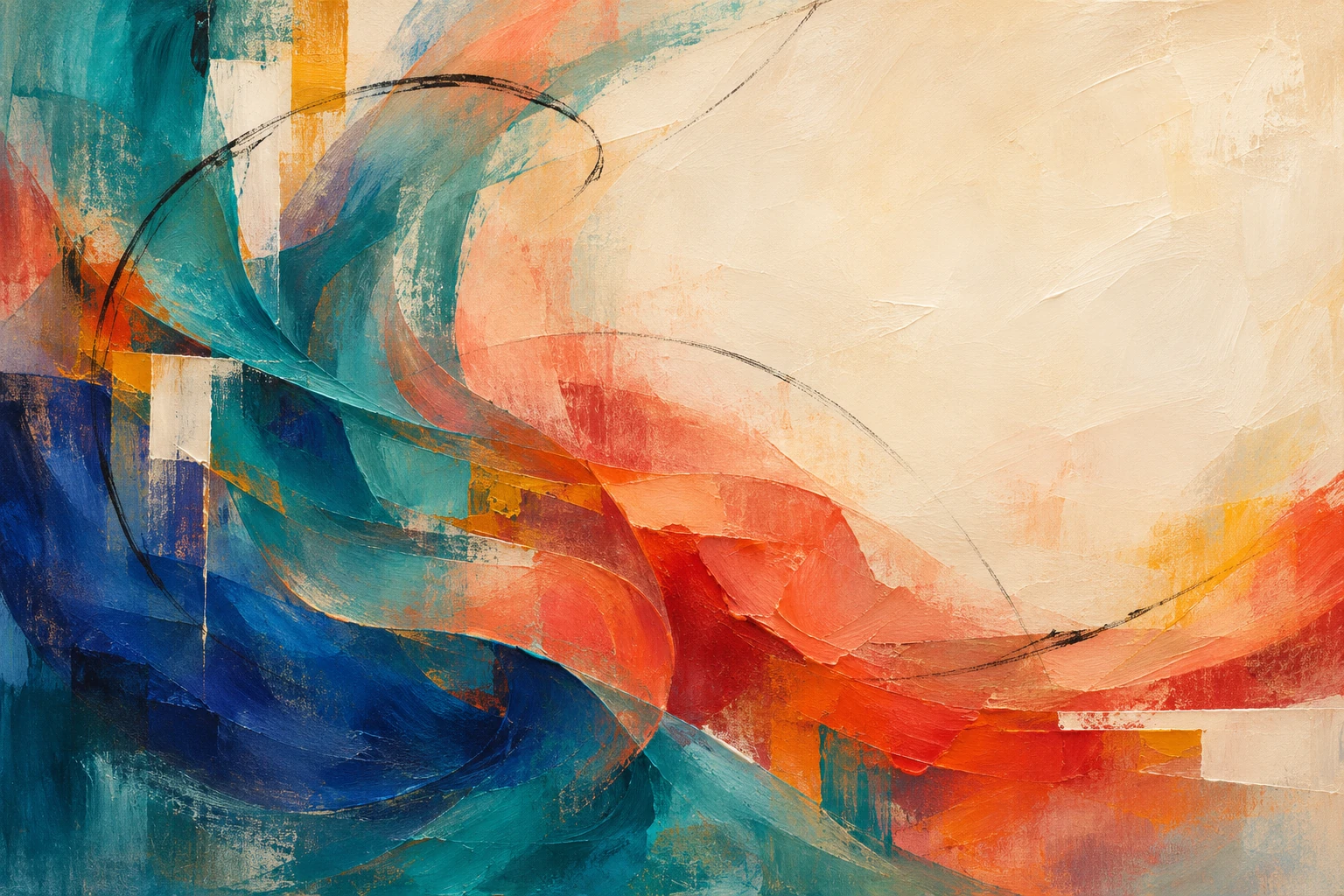
Image credit: AI-generated illustration created for Thigma Art, shown for representation of abstract art; it is not a photograph of an actual artwork.
Abstract art (Art Term), Tate.
Abstract expressionism (Art Term), Tate.
Hilma af Klint, Encyclopaedia Britannica.
The Myth of Abstraction, Introduction: The Many Origins of Abstract Art, Cambridge University Press.
Abstract Expressionist New York, MoMA.
Image created with ChatGPT.
- Abstract art – Tate (in English)
- Jackson Pollock, Full Fathom Five, 1947 – MoMA (in English)