Glassware
In short: Glassware is an art form with a long history in India, with glass documented by archaeologists in India from around 1000 BCE. Glass is made by shaping molten silica and minerals, and it is turned into art by techniques like hand-blowing, etching and fusing. Firozabad, Hyderabad, Saharanpur and Patna are well-known glass centres.
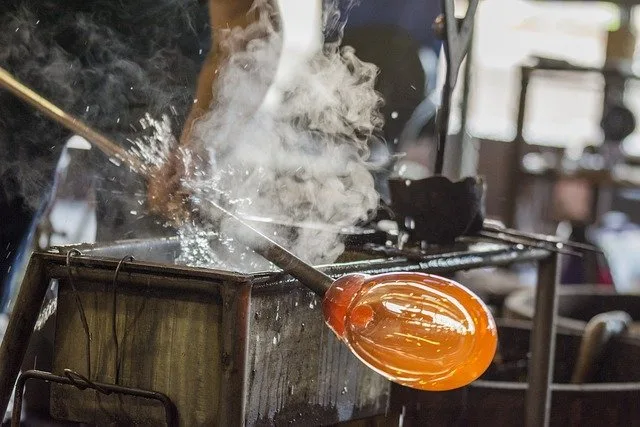
Glass is melted in a furnace kept at very high heat, and a craftsperson shapes it by hand into something no one else will make in exactly the same way. This article covers the history of Indian glass art, centres like Firozabad, Hyderabad, Saharanpur and Patna, and techniques such as hand-blowing, etching and fusing.
What is the history of glassware?
Glassmaking began in the ancient Near East, though the exact origin is uncertain. Britannica says Egypt’s earliest wholly glass objects are beads from after about 2500 BCE, and some Mesopotamian pieces may be slightly older. Glassblowing, which made shaped vessels far cheaper to produce, probably arose in the 1st century BCE, and Britannica credits Syrian glassworkers.
In India, glass is well documented from around 1000 BCE. The Harappan civilisation made a glass-like paste but, according to a Center for Bead Research survey, not true glass. Early finds come from sites such as Baghwanpura in Haryana, though their dates remain uncertain. Researcher Alok Kumar Kanungo of the Corning Museum of Glass says it is still unclear whether the technology came from the West, developed locally, or both. A review of a 2021 book on South Asian glass notes a tentative claim of an even earlier glaze-like material at Harinagar, around 2300 BCE, which still needs confirming.
Excavations at Kopia in Uttar Pradesh suggest a glass-making settlement, but its date is disputed: the 5th century BCE or the 2nd century CE. Arikamedu and Karaikadu in the south traded with Rome from about 50 BCE to 200 CE, and analysis shows their glass was Indian-made. Firozabad, today India’s main glass-producing town, is described in that survey as not an early centre. We could not find two reliable sources linking ancient texts to specific early glass, so we make no claim about them.
Timeline
Glass in the world and in India
- After about 2500 BCE Egypt’s earliest wholly glass objects are beads, according to Britannica. Some Mesopotamian pieces may be slightly older.
- c. 2300 BCE A tentative claim of a glaze-like material at Harinagar in India, which still needs confirming.
- c. 1000 BCE Glass is well documented in India from around this time. Early finds come from sites such as Baghwanpura, though dates remain uncertain.
- Probably 1st century BCE Glassblowing probably arose, making shaped vessels far cheaper. Britannica credits Syrian glassworkers.
- c. 50 BCE to 200 CE Arikamedu and Karaikadu in the south traded with Rome, and analysis shows their glass was Indian-made.
Which are the famous glassware centres in India?
Some of the most famous glassware centres in India are:
- Firozabad, Uttar Pradesh: Known for traditional glassblowing and for products such as glass chandeliers, bangles and beads.
- Chudi Bazaar, Hyderabad: Located in the streets around the Charminar, it is also known as Laad Bazaar, the “Street of Bangles” or the “Bridal Bazaar of Hyderabad”.
- Saharanpur, Uttar Pradesh: Known for glass toys containing coloured liquid, called panchkora.
- Patna, Bihar: Known for Tikuli, a decorative glass ornament. This craft has almost been lost, but there are attempts to revive it.
Centres
Famous glass centres in India
- Firozabad, Uttar Pradesh Known for traditional glassblowing and products such as glass chandeliers, bangles and beads.
- Chudi Bazaar, Hyderabad In the streets around the Charminar, also called Laad Bazaar or the Street of Bangles.
- Saharanpur, Uttar Pradesh Known for glass toys containing coloured liquid, called panchkora.
- Patna, Bihar Known for Tikuli, a decorative glass ornament. The craft has almost been lost, but there are attempts to revive it.
How has glassware become an art form?
Glassware has served practical purposes in households for centuries. In recent years artists and designers have also made one-off pieces meant to be used and looked at.
Much of glass’s appeal as an art material is the way it holds light and colour. Artists work it in many ways, from blowing to etching.
What are the popular glass art techniques?
- Hand-blown glass: A glassblower uses a blowpipe to shape molten glass into the desired form. Hand-blown glassware is prized for its individuality, as no two pieces are exactly alike, and it needs a high level of skill and mastery.
- Etched glass: A diamond or acid is used to carve fine designs into the surface of the glass, so each piece comes out different.
- Fused glass: Several pieces of glass are layered and fused together in a kiln to make a single layered piece.
In all three, the result depends heavily on the maker’s skill.
Techniques
Three glass art techniques
- Hand-blown glass A glassblower uses a blowpipe to shape molten glass. No two pieces are exactly alike, and it needs a high level of skill.
- Etched glass A diamond or acid is used to carve fine designs into the surface of the glass.
- Fused glass Several pieces of glass are layered and fused together in a kiln to make one piece.
Frequently asked questions
How is glass made?
Molten silica and minerals are shaped into different designs, using a furnace that keeps a very high temperature constantly.
Is glassware an old craft in India?
Yes, but exact origins are debated. Archaeologists document glass in India from around 1000 BCE, and a tentative claim goes back to about 2300 BCE. Researchers still debate whether the technique came from the West, developed locally, or both. Early sites include Baghwanpura, Kopia and Arikamedu.
Which places in India are famous for glassware?
Firozabad and Saharanpur in Uttar Pradesh, Chudi Bazaar in Hyderabad and Patna in Bihar.
What is hand-blown glass?
A glassblower uses a blowpipe to shape molten glass into a form. Each piece is unique and needs a high level of skill.
How is etched glass made?
A diamond or acid is used to carve fine designs into the surface of the glass.
Sources and further reading
Glassware, Encyclopaedia Britannica.
Glass Beads of India, Center for Bead Research.
Dr. Alok Kumar Kanungo (profile), Corning Museum of Glass.
Review of Ancient Glass of South Asia (BEADS vol. 34), Society of Bead Researchers / University of Oregon.
Related reading
- How AI is redefining art
- Home decor ideas for your new beginnings
- Raja Ravi Varma: The Master of Indian Art
Image credit: “Glassblower shaping molten glass” by sabinevanerp, via Pixabay, under the Pixabay Content Licence.