Handloom or Powerloom? How to Tell Handwoven Cloth from Machine-Made
TL;DR: Indian law defines a handloom simply as any loom that is not run on power, so how cloth looks and feels can hint at its origin but cannot prove it. Slightly uneven weaving, a telltale selvedge and a price that reflects real labour are commonly given signs. The dependable answer is an official label such as the Handloom Mark or India Handloom Brand, or the opinion of an expert.
What the law means by handloom
Indian law defines a handloom by what it is not. The Handlooms (Reservation of Articles for Production) Act, 1985, says a handloom is any loom other than a power loom, and a power loom is one worked by power. The definition is about the loom, not the yarn, so a handloom cloth can still be woven from mill-spun thread.
The stakes are real. The Fourth All India Handloom Census, carried out in 2019-20, counted about 26.7 lakh (2.67 million) handloom weavers and roughly 8.5 lakh allied workers, such as those who prepare yarn and set up looms. The 1985 Act lets the government reserve certain articles for handlooms alone, and a government release from August 2026 says eleven textile articles are reserved and that powerloom units are inspected to check they do not make them.
A powerloom is not a fraud in itself; it makes honest, useful cloth. The trouble starts only when machine-made cloth is sold as handwoven, or copies a well-known handwoven design and borrows its name.
Signs in the weave and the selvedge
A 2024 paper in Scientific Reports built an image-recognition tool to tell handloom gamucha, the cotton towel-scarf of Assam, from powerloom imitations. In explaining the problem, the authors list the differences that human experts look for. These are the most commonly given signs:
- Weft spacing. The weft is the thread that runs across the cloth. In handloom the pick-ups, meaning each pass of the weft, are uneven and vary from one weaver to another. Powerloom picks are very regular.
- Small lumps. Where a warp thread (the lengthwise thread) breaks and is mended by hand, a tiny lump or knot can remain.
- Yarn. The study says handloom cloth mostly uses twisted yarn, while powerloom cloth often uses single, untwisted yarn, sometimes synthetic.
- Selvedge. This is the finished edge of the cloth. The study reports distinct temple marks, small traces left by the stretcher that holds the cloth to width, on handloom edges, which powerloom cloth lacks.
A museum offers a useful parallel. A conservator at the Cincinnati Art Museum describes eccentric wefts, where weft lines wander up and down to draw curves, and says the effect is unique to hand weaving because the weaver handles each thread rather than throwing a shuttle across the whole row. That shows what hand control can do, but it is not a test you can apply to every cloth.
Be careful with all of these. A skilled weaver can produce very even cloth, and a mill can deliberately choose uneven yarn to look rustic. Irregularity is a hint, never a certificate.
Signs
Common signs in the weave
- Weft spacing On handloom the weft passes are uneven and vary from weaver to weaver. Powerloom passes are very regular.
- Small lumps A warp thread mended by hand can leave a tiny lump or knot.
- Yarn Handloom cloth mostly uses twisted yarn. Powerloom cloth often uses single, untwisted yarn, sometimes synthetic.
- Selvedge Handloom edges show distinct temple marks, small traces left by the stretcher. Powerloom cloth lacks them.
- The catch A skilled weaver can make very even cloth, and a mill can choose uneven yarn on purpose. Irregularity is a hint, never a certificate.
The back of the cloth and the feel
Many buyers are told to turn a patterned cloth over. On a hand-woven piece where motifs are added with extra weft threads, the back is often said to show those threads as loose floats or a faint ghost of the design, while a printed pattern may look paler or different on the reverse. I could not confirm this advice in two reliable sources, so treat it as a common rule of thumb. It also depends on the weave: some hand-woven cloths are finished neatly at the back, and some machine jacquard looks messy.
Feel is the other common clue. The Scientific Reports study says handloom fabric tends to be softer, because of handmade, pure yarns, while powerloom cloth tends to be stiffer, partly where synthetic yarn is used. Remember that starch, finishing and washing change how any cloth feels, and a soft, drapy powerloom cloth is entirely possible.
Price and time logic
Hand weaving is slow, and a powerloom is fast; that is the whole economic difference. A cloth sold as handwoven at a price that would barely cover the yarn and a few days of fair wages for a weaver should make you pause. The 1985 Act itself exists because powerlooms can undercut handloom weavers.
The reverse does not hold: a high price proves nothing, because mark-ups, brand names and packaging all raise it. A better habit is to ask practical questions. How long did this piece take to weave, on what kind of loom, and in which weaving cluster or society? A seller who can answer specifically, and show paperwork, is giving you more than any price tag can.
Official marks: Handloom Mark and India Handloom Brand
India has two government labels. The Handloom Mark was launched on 28 June 2006 and is run by the Textiles Committee under the Ministry of Textiles. According to a 2026 government release, it is meant to assure buyers that a product is genuinely handwoven and to help trace the product or its maker; 29,402 registrations had been issued by 30 June 2026.
The India Handloom Brand was launched on 7 August 2015, the first National Handloom Day. It covers natural-fibre products and, per the Ministry, stands for fast colours, skin-friendly dyes, social compliance and the aim of zero defects and zero environmental impact. By June 2026 it had 2,305 registrations across 184 product categories. Note that it speaks about quality and compliance as well as handweaving, so the two labels are not identical.
Rules are changing. In October 2025 the Textiles Committee published draft Handloom Mark regulations for public comment, and a March 2026 law-firm summary says they propose to make the label compulsory for anything sold as handloom, from 1 October 2026, once notified in the Official Gazette. I could not confirm whether that has happened, so check the current status on the official sites.
Official labels
Two government labels
- Handloom Mark Launched on 28 June 2006 and run by the Textiles Committee. Meant to assure buyers a product is genuinely handwoven. 29,402 registrations by 30 June 2026.
- India Handloom Brand Launched on 7 August 2015. Covers natural-fibre products and speaks about quality and compliance as well as handweaving. 2,305 registrations across 184 product categories by June 2026.
- Draft rules Draft regulations proposed making the Handloom Mark compulsory from 1 October 2026 once notified. The article could not confirm whether that has happened.
Putting the signs together
No single sign settles the question. Look at several together: the weft spacing, the selvedge, the small mends, the feel, and the back if the cloth is patterned. Then weigh them against the seller’s answers and the price. For a costly purchase, ask for the Handloom Mark or India Handloom Brand label, a proper invoice and the weaver’s or society’s details.
Where the money or the stakes are high, such as an heirloom-quality sari or a museum purchase, a textile expert or a laboratory fibre and structure analysis is the real answer. Never cut or burn a piece of cloth to test it. If a test is ever needed, a lab can work from a single loose thread.
Related stories
- Geographical Indication (GI) tags
- Mau Saree
- Puanchei – Mizo Shawl
- Kalamkari – An Ancient India Art Form
Frequently asked questions
Is handloom always better than powerloom?
Not necessarily. They are different products. A powerloom makes good, affordable cloth; the issue is only honest labelling.
Does uneven weaving prove a cloth is handwoven?
No. It is a commonly given hint, but skilled weavers can weave evenly and mills can imitate unevenness.
Who issues the Handloom Mark?
The Textiles Committee, under India’s Ministry of Textiles, runs the Handloom Mark scheme, which began in 2006.
Is the Handloom Mark the same as the India Handloom Brand?
No. The Handloom Mark is about assuring that something is handwoven and traceable. The India Handloom Brand, launched in 2015, also stresses quality, fast colours and environmental standards.
Can I test a cloth by burning it?
Do not burn or cut a whole piece. A lab can examine a single loose thread, and a textile expert can often judge a cloth without damaging it.
Sources and further reading
- The Handlooms (Reservation of Articles for Production) Act, 1985 (India Code)
- Mahanta et al., AI tool to distinguish handloom gamucha from powerloom imitations, Scientific Reports, 2024
- Fourth All India Handloom Census 2019-20 figures (Press Information Bureau document)
- Press Information Bureau release on Handloom Mark, India Handloom Brand and the 1985 Act (August 2026)
- Press Information Bureau: Registration of Handloom Mark
- Business Standard: about 2,000 registrations under India Handloom Brand (2024)
- Textiles Committee notice on draft Handloom Mark regulations (October 2025)
- ELP: New marking requirements for handlooms (March 2026)
- Cincinnati Art Museum: Behind the scenes in conservation, eccentric wefts
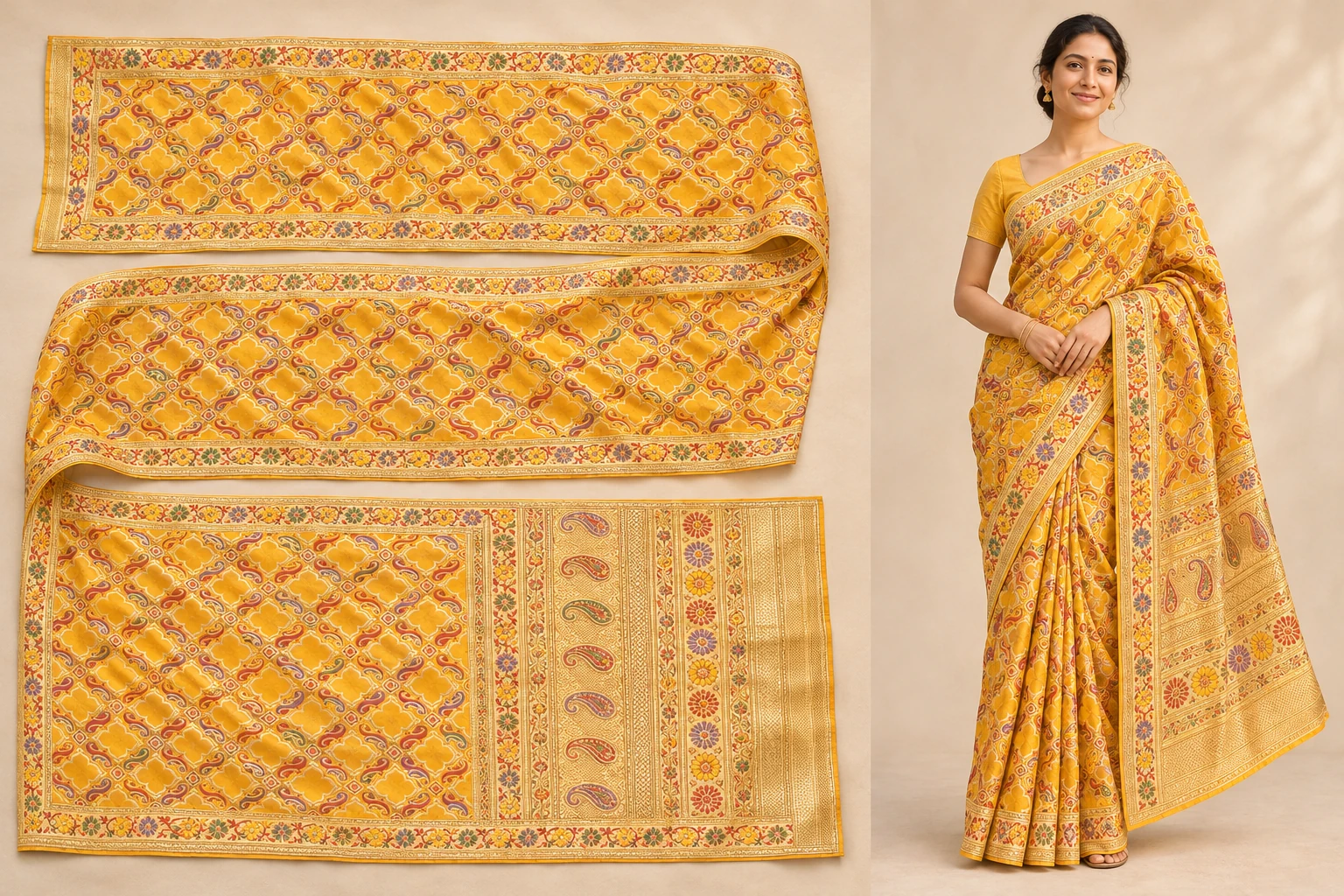
Image credit: AI-generated illustration created for Thigma Art, shown for representation; it is not a photograph of an actual saree.