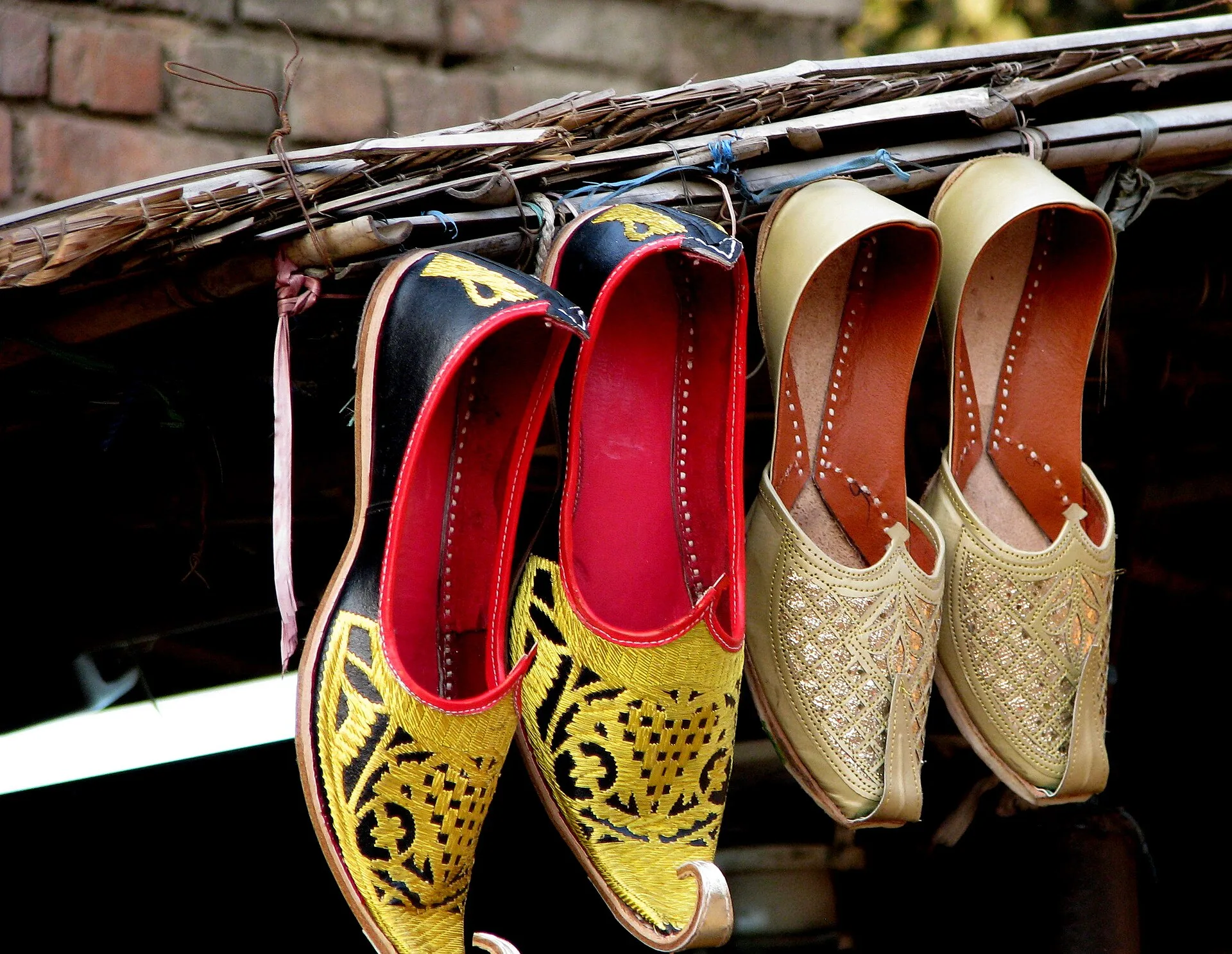
Punjabi Jutti: The Handmade Leather Shoe of Patiala, Muktsar and Fazilka
In short: The Punjabi jutti is a flat, closed-toe leather shoe with no left or right foot, stitched by hand and often embroidered by women with gold or silver-toned tilla thread. Patiala, Muktsar and Fazilka are well-known centres, each with its own style. Today the craft is split between slow handwork and faster, cheaper methods.
A shoe with no left and no right
Slip on a traditional Punjabi jutti and you will find that either shoe fits either foot. Both the Craft Revival Trust’s Global InCH page and a Gaatha craft article note that juttis have no left or right distinction, and that they are flat-soled with a closed upper. With wear, the leather softens and shapes itself to the wearer’s foot, a point made in a Sahapedia study of the shoes made in Fazilka.
Jutti, also spelt juti, is the Punjabi word for this kind of footwear. A related shoe with an upturned toe is called khussa, and Rajasthan’s similar shoe is the mojari. The Sahapedia study notes that the Patiala jutti has affinities with the mojari but has developed a distinct Punjabi identity. The same study says that Patiala’s makers trace their ancestry to Rajasthan, though this comes from fieldwork accounts rather than written records, so it is best read as local tradition. One academic paper in a design journal says the closed-upper jutti style was introduced by the Mughals; no second source for that could be found, so it is only a view, not a settled fact.
Patiala, Muktsar, Fazilka and beyond
Patiala is the best known name and, according to the Gaatha article, the largest jutti market. Global InCH also names Muktsar, Fazilka, Abohar, Malerkotla, Ferozepur, Bathinda, Faridkot and the wider Malwa region. Sahapedia lists Sri Muktsar Sahib and Ludhiana among major centres too. Kapurthala is often mentioned in popular writing, but none of the sources consulted confirm it, so it is left out.
Each town has a recognisable look. Global InCH describes Patiala juttis as decorated with zari (metallic thread), salma (a twisted wire thread), tilla and cotton, and says Muktsar juttis are multicoloured. Abohar juttis are described as lightweight and decorated with embossing, cut-work, appliqué and beads, and Malerkotla is noted for fine, dense work. Fazilka, near the border, is known for tilla embroidery, with check patterns mentioned by Global InCH.
Leather, thread and hand stitching
Global InCH says the uppers are made of cowhide and the soles of buffalo hide. The Gaatha article describes hides that are vegetable-tanned, using tannin from the bark of babool or kikar trees, then coloured with pigments mixed in water. That article lists the main parts as the upper, the back piece and the sole, which it gives with their Punjabi names panna, adda and talla. The Sahapedia study describes Fazilka’s method as slow work in which a thick buffalo-hide sole is joined to a thinner leather layer with hand-applied adhesive.
- The hide is tanned and coloured.
- The leather is cut into upper, back and sole pieces.
- The upper is embroidered or otherwise decorated, often with a stencil to trace the design.
- Pieces are shaped and assembled by hand.
- Cotton thread stitches the upper and back to the sole.
Global InCH adds that juttis are hand-stitched without nails and that the insoles are embroidered too. It is a simple, durable design: stitching, glue and leather hold the shoe together.
Tilla embroidery and decoration
Tilla is gold or silver-toned thread, and the Gaatha article says it was historically made with real metal. The Sahapedia study describes the Fazilka work as dense hand embroidery with an aari, a hooked needle, using tilla and cotton thread, guided by hand-cut paper stencils. Those stencils can stay trapped inside the embroidery. In the same article, Muktsar and nearby Malout are described as using stencils made of rexine, a synthetic leather, to speed production.
Other decoration includes brass nails, cowries (small sea shells), mirrors, bells and ceramic beads, and Global InCH also mentions phulkari embroidery as one of the styles used. Some names come with stories. The Gaatha article says the Salem Shahi style is said to be named after the Mughal prince Salim, and that the khussa’s curled toe is compared to a young man’s twirled moustache. These are local explanations that could not be backed by a second independent source, so treat them as folklore.
Families at work
Jutti making is described by Global InCH as a family-based occupation in which women embroider the uppers and men assemble the shoes. The Sahapedia study names the Mochi community, traditionally leatherworkers, as the men who cut and build the shoes in Fazilka, while women embroider. The Gaatha article adds that other communities take part in earlier steps such as processing and colouring the hides. The Sahapedia author also records a local saying that men prefer brides who can embroider.
Slow handwork and fast production
The Sahapedia study compares two ways of working. In Fazilka, a hand-cut buffalo-hide sole, cowhide upper and hand embroidery make a shoe that is traditionally worn for weddings and festivals and is seen as auspicious. In Patiala, the study describes a more commercial system in which each household does one step, rubber soles and rexine uppers are often used, glue is applied by machine, and embroidery is mostly machine-done with polyester thread. These materials make the shoes cheaper and lighter, but change their weight, flexibility and lifespan.
In Rupana village in the Sri Muktsar Sahib district, a National Herald report describes a maker who works entirely by hand, with cowhide for the upper, buffalo hide for the sole, coarse cotton thread and a steel needle. He names rising leather prices, a growing preference for factory-made footwear and fewer young people entering the trade as pressures. A paper in the Chitrolekha design journal makes similar points: leather is scarce and costly, substitutes such as rexine, canvas and rubber are widely used, and cheap mass-produced pairs compete with handmade ones. These are individual and academic views rather than a count of the whole craft, but they point the same way.
The same study notes that piece-rate pay for single steps is low, and it asks whether a craft whose materials, tools and processes have changed is still the same craft. The Gaatha article, written in 2010, says that new materials, machine embroidery and faster methods have arrived, though some customers still value fully handmade work. No Geographical Indication or other formal recognition for jutti could be confirmed from an official source, so none is claimed here. If a pair matters to you, looking at the sole, the stitching and the inside is more informative than the label, and a craft body or a long-standing maker is the best guide.
Related stories
- Silver Craft
- Geographical Indication (GI) tags
- Handloom or Powerloom? How to Tell Handwoven Cloth from Machine-Made
Frequently asked questions
Why does a Punjabi jutti have no left or right shoe?
Traditional juttis are made flat and symmetrical, and the leather softens with wear to fit the foot. Two sources note the lack of a left-right distinction.
What is tilla?
Tilla is gold or silver-toned thread used for embroidery on juttis. It was historically made with real metal, according to one craft article.
Which Punjab towns are known for jutti?
Patiala, Muktsar and Fazilka are well known, and sources also name Abohar, Malerkotla, Ferozepur and Bathinda.
What are juttis made of?
Traditionally cowhide uppers, buffalo-hide soles and cotton thread, with tilla and other decoration. Faster production often uses rexine and rubber.
Does Punjabi jutti have a GI tag?
No registered GI tag was found. The GI Registry shows an application named “Punjabi Jutti” (number 1812), filed on 28 January 2026 by the Patiala Handicraft Workshop Cooperative Industrial Society and still at the pre-examination stage when read on 26 November 2026. An earlier application (number 414), filed in 2013, was abandoned. See our list of crafts that do have a GI tag.
Sources and further reading
- Sahapedia: Crossing the Borders with the Tille Wali Jutti
- Global InCH (Craft Revival Trust): Leather Embroidered Footwear, Tilla Jutti of Punjab
- Gaatha: The Sole of Punjab, Jutti Making
- National Herald: No one can craft a jutti like I do, says traditional Punjabi shoe maker
- Gurdeep Kour, Versatility in Designs of Punjabi Jutti, Chitrolekha Journal on Art and Design, 2020
Image credit: “Punjabi jutti at Dilli Haat” by Ekabhishek, via Wikimedia Commons, licensed under CC BY-SA 3.0.