Naga Shawls of Nagaland: How Weaving Tells Tribe, Family and Feast
In short: Naga peoples in Nagaland weave shawls, mostly on the loin loom and mostly by women, in which colours, stripes and motifs have traditionally signalled tribe, family, achievement and feasts hosted. The details differ from tribe to tribe and village to village, so the examples here are commonly recorded ones, not universal rules. Today the craft is shifting as yarns, beliefs and markets change.
Cloth that works like a record
In many Naga villages, a person’s shawl once told others where they belonged and what they had done. A writer on Naga textiles says the cloths are not simply fabric but carry a community’s world view, and a Nagaland University scholar notes that Naga societies had no written script, so textiles took on part of the job of recording status and history. This article looks at weaving across several Naga tribes in Nagaland, a hill state in India’s north-east with 17 recognised tribes, as counted in the sources used here.
A caution first. Sources agree that motifs and colour rules differ by tribe, clan and village, and that many meanings come from oral tradition. Where an example is given, treat it as one commonly recorded reading. The GI-registered Chakhesang shawl has its own article on this site, so here the focus is wider.
The loin loom and how a shawl is made
Weaving here is traditionally women’s work, and girls often learn young. The loin loom, also called a back-strap loom, is the traditional tool: the weaver sits on the floor with the warp threads tied to a post or wall at one end and to a strap behind her back at the other, tightening them with her own posture. Academic and museum sources describe it as cheap, portable and workable indoors or out, and say that it is one of the oldest loom types.
Museum documentation from the Indira Gandhi National Centre for the Arts says a typical Naga shawl is woven in three strips stitched together, while children’s shawls and women’s skirts use two. Patterns are often made by lifting chosen warp threads with a stick or a porcupine quill and passing a coloured weft thread through, so the motif is added over the plain cloth. Weaving traditionally began after the first fruits of the new harvest were eaten.
Colours were traditionally from plants. One cultural-history article names Mosak (Strobilanthes) for blue, a creeper root for red and a tree wood for yellow, and says chemical dyes are now often used too. Cotton growing and spinning have nearly stopped in the state, according to a travel-magazine report, so many weavers now buy cotton or wool yarn.
- Set up the loomThe weaver sits on the floor with the warp threads tied to a post or wall at one end and to a strap behind her back at the other, tightening them with her own posture.
- Weave the stripsA typical Naga shawl is woven in three strips; children’s shawls and women’s skirts use two.
- Add the motifsChosen warp threads are lifted with a stick or a porcupine quill and a coloured weft thread is passed through, so the motif sits over the plain cloth.
- Stitch the stripsThe strips are stitched together to make the finished piece.
A few tribes and their shawls
The examples below come from museum documentation and academic papers; spellings of Naga names vary a lot between sources.
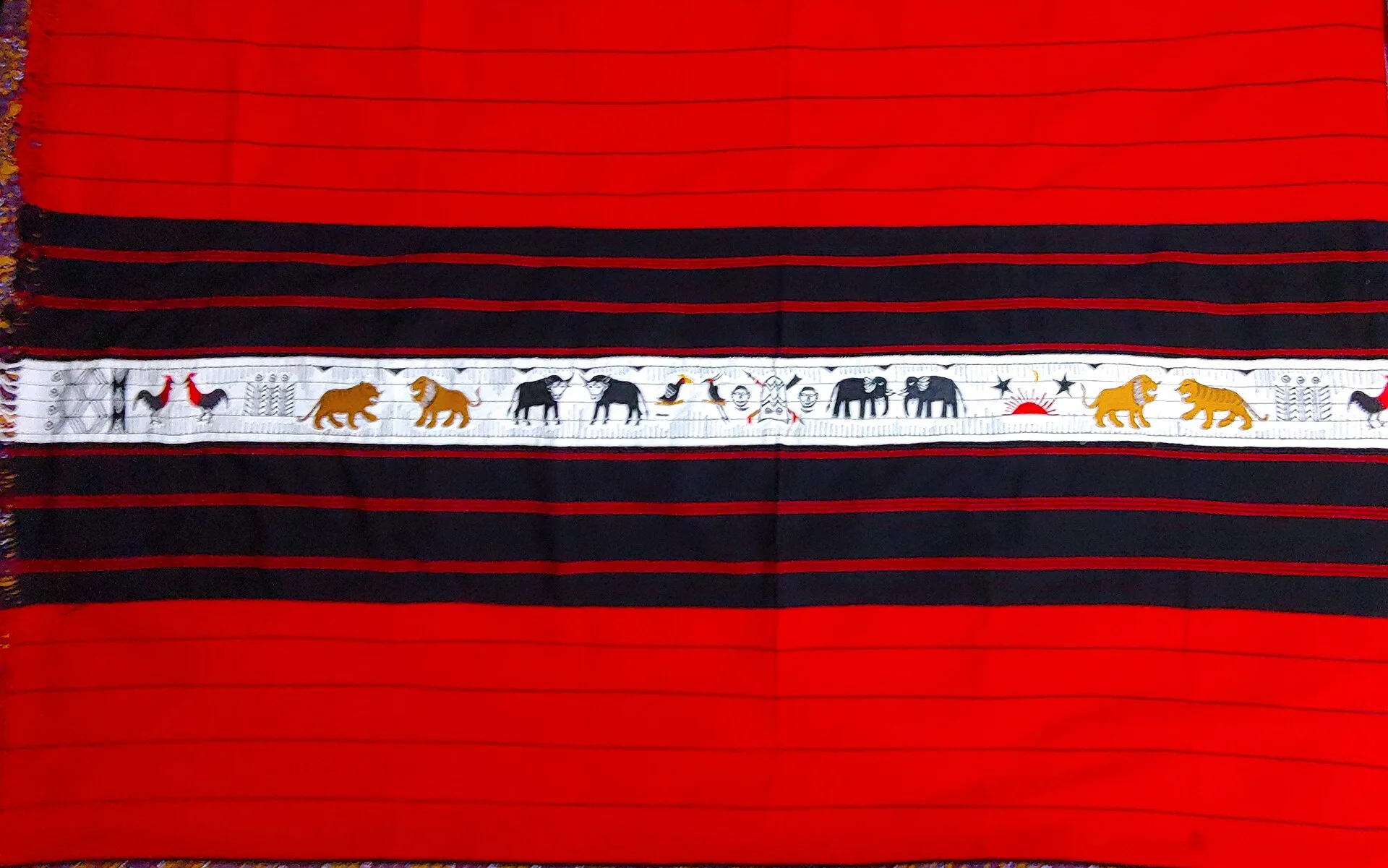
- Ao: the Tsungkotepsu is described as a warrior shawl with black motifs, such as tiger, mithun (a semi-domesticated bovine, state animal of Nagaland), elephant and human head, on a white band over dark blue cloth. Another Ao cloth, the Rongsu, is described as the most decorative and hardest to earn.
- Angami: black shawls with red and other coloured bands are common, and a museum shawl in the RISD collection from the mid-1900s uses small black and red blocks on white, each block patterned in clan-specific ways. Cowrie shells, sewn on by the owner, signal standing, with more rows for more renowned men.
- Lotha: shawls were linked to the number of feasts of merit a man had given, such as the Phangrhup after the first feast. A Lotha woman, according to one account, was not seen as ready for marriage until she could weave a man’s loincloth.
- Sema (also spelled Sumi): one account says weaving is less common in many Sema villages than in neighbouring ones, though women have recently begun making shawls and skirts. The Akhum is black with red bands and is generally worn by wealthy men.
- Chang and Yimchunger: Chang cloths include a cowrie shawl for men who took many heads in war; the Yimchunger Rongkhim, a warrior shawl, is recorded with a set number of designs for reputed warriors.
Feasts of merit, motifs and colour
A feast of merit is a costly, organised feast through which a host shares surplus and earns standing; a magazine essay says each stage could bring rights such as a particular shawl. Sources link mithun motifs with wealth, since sacrificing a mithun was part of these feasts, elephants and tigers with strength or hunting skill, and cowrie shells with martial achievement. Colour readings recorded for the region link red with the blood of enemies, blue with the sky and black with night, though meanings are not identical everywhere.
Many of the older shawls refer to headhunting, a practice of the past that scholars describe in historical terms. Writers also say that a shawl’s rules were strict and that wearing one without earning it was traditionally seen as wrong. A museum label from RISD adds that these textiles are still woven for certain ceremonies and still matter in Angami cultural life.
What is changing today
Several sources describe change rather than loss alone. Warrior culture has faded, and one account says designs have become more elaborate, with newer colour schemes and even Christian symbols such as church bells. Another source says Christianity added a Christmas feast as a qualifying occasion for one prestige shawl, and that modern wearers include lawyers and political figures, while the taboo on wearing it without earning it has persisted.
There are real pressures too. Researchers write that machine-made cloth is cheaper and lighter, younger people may feel less tied to the old meanings, and good yarn is costly or scarce. An IGNCA paper warns that some original textiles are now rare, and notes that the old craftsman behind a Rengma band pattern has died and no one has replaced him, while elsewhere a craftsman is keeping the tradition going with new designs.
If you want to learn more, museum collections and community-run cooperatives and festivals, such as the annual Hornbill Festival at Kisama Heritage Village near Kohima, are good places to see how Naga communities present their own textiles.
Related stories
- Puanchei – Mizo Shawl
- Handloom or Powerloom? How to Tell Handwoven Cloth from Machine-Made
- Tie and Dye
- Unsung Art of India: 9 Folk and Tribal Painting Styles
Frequently asked questions
Who makes Naga shawls?
Traditionally women weave them, usually on the loin loom, and girls learn young. Older men sometimes paint motifs on certain cloths, according to one report.
Do all Naga tribes use the same patterns?
No. Colours, stripes and motifs differ by tribe, clan and village, and some tribes weave far more than others. Examples in this article are common records, not rules for everyone.
What is a feast of merit?
It is a large, costly feast through which a host shares wealth and earns prestige. In several Naga communities it was tied to the right to wear certain shawls.
Can an outsider wear a Naga shawl?
Some designs carry earned meaning, and communities may feel strongly about it. It is polite to ask a community source before wearing or copying a pattern.
Is the craft disappearing?
Researchers describe both pressure and adaptation. Some forms are rare, while other weavers keep the craft alive and develop new designs.
Sources and further reading
- Documenting Intangible Heritage Through Tangible Artifacts: A Case Study of Nagaland (IGNCA, ICOM CIDOC 2015)
- Weaving Memoirs among the Naga Tribals: A Sociological Overview (EPRA journal, 2017)
- Woman’s wrapper or shawl, Angami Naga (RISD Museum)
- Weaving A Story: The Handloom Shawls Of Nagaland (Outlook India)
- Naga Weaves: An Assertion of Identity (Live History India)
- How the Chakhesang Naga community weaves a world of meaning into a shawl (Scroll.in, Kamayani Sharma, 2023)
- Handlooms of Nagaland and Arunachal Pradesh (eSamskriti)
Image credit: “Naga shawl” by Atcelsius, via Wikimedia Commons, licensed under CC BY-SA 4.0.