Dancing Girl From Mohenjodaro
In short: The Dancing Girl is a small bronze statuette, about 10.5 cm tall, found at Mohenjo-daro and generally dated to around 2500 BCE. It was made by lost wax casting and is now in the National Museum, New Delhi. It is one of the most famous works of Indus Valley art, and most sources read it as a dancer.
A metalworker of the Indus Valley Civilisation cast the Dancing Girl in bronze, using the lost wax method, around 2500 BCE.
It is one of the most famous sculptures from ancient India.
How was the Dancing Girl of Mohenjo-daro found?
The Dancing Girl is a small bronze figure from Mohenjo-daro, one of the two main cities of the Indus civilisation, which Britannica dates to roughly 2500 to 1700 BCE. Two sources, Google Arts & Culture and Live Science, say it was found during excavations in 1926. Google Arts & Culture credits the discovery to the British archaeologist Ernest Mackay. The site had first been recognised as important in 1922, and John Marshall is listed by Britannica as a key figure in its study.
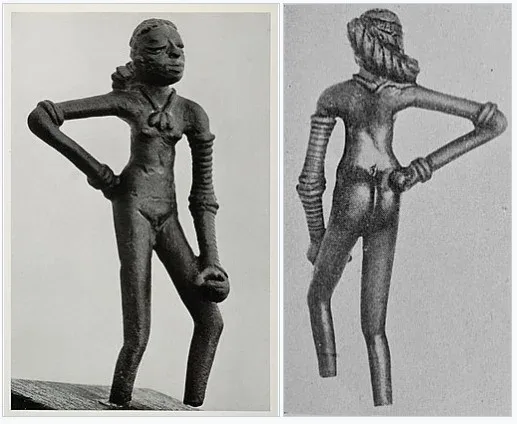
The figure stands only about 10.5 cm (roughly 4 inches) tall. It shows a slim young figure with one arm covered in bangles or armlets, and Britannica calls it the most aesthetically notable figurative work from the city. It was made by lost-wax casting in a copper alloy. Dates vary a little between sources: NCERT and Live Science say about 2500 BCE, while Google Arts & Culture gives a range of roughly 2700 to 2100 BCE.
Who made it is unknown. The name ‘Dancing Girl’ is a modern label, and what the figure meant to the people who made it, or who it was meant to show, cannot be known from the object itself. The most we can safely say is that it is a skilled piece of early metalwork.
What is the Dancing Girl of Mohenjo-daro?
The Dancing Girl is a prehistoric bronze statue made in Mohenjo-daro, a city of the Indus Valley Civilisation. It was excavated by the British archaeologist Ernest Mackay in 1926, and it is now in the National Museum, New Delhi.
The statuette is generally dated to around 2500 BCE. It is about 10.5 cm (4.1 inches) tall.
How was the Dancing Girl made?
The statue was made by lost wax casting. A wax model is made first, a mould is built around it, and the wax is melted and drained away. Molten metal then fills the cavity to give the final shape.
What does the statue look like?
It shows a young woman or girl with ornaments. She has many bangles on her left arm and a few on her right, a necklace, and one hand resting on her hip. She is widely recognised for the fluidity and realism of her form, and she is considered one of the finest examples of Indus Valley art.
What does the Dancing Girl mean?
Most sources, including the National Museum, see the figure as a dancer, often pointing to the relaxed stance with one hand on the hip. Not everyone agrees, however. The archaeologist Jonathan Kenoyer has argued that she may instead be carrying an offering. Its exact purpose is not known.
Frequently asked questions
Where was the Dancing Girl found?
At Mohenjo-daro, a city of the Indus Valley Civilisation, in what is now Pakistan. Ernest Mackay excavated it in 1926.
How was the Dancing Girl of Mohenjo-daro found?
The small bronze Dancing Girl, about 10.5 cm tall, was found during excavations at Mohenjo-daro in 1926, according to Google Arts & Culture and Live Science. One account credits the British archaeologist Ernest Mackay. It was made by lost-wax casting around 2500 BCE, give or take a few centuries. Its maker is unknown.
How tall is it?
About 10.5 cm (4.1 inches).
How was it made?
By lost wax casting in bronze.
Where is the Dancing Girl now?
In the National Museum, New Delhi.
Sources and further reading
Dancing to Her Own Tune: Discover the Harappan Dancing Girl, Google Arts & Culture.
Dancing Girl: A pint-size statue from the Indus Valley Civilization, Live Science.
Mohenjo-daro, Encyclopaedia Britannica.
Chapter 7: Indian Bronze Sculpture, An Introduction to Indian Art, Class XI, NCERT.
- Dancing Girl (Mohenjo-daro) – Wikipedia (in English)
- Lost-wax casting – Wikipedia (in English)
Related reading
- Lost Wax Metal Casting Technique
- Dhokra Art: India’s 4,000-Year-Old Lost-Wax Metal Casting
- Negative Space in Art
Image credits: The Dancing Girl, photogravure by Alfred Nawrath, 1938, and Bronze dancing girl (back view). Both are in the public domain in India because their term of copyright has expired.