Chakhesang Shawl of Nagaland: Loin-Loom Weaving, Symbols and GI Status
In short: The Chakhesang shawl is a handwoven cloth of the Chakhesang Naga people of Phek district, Nagaland, and it holds a Geographical Indication (GI) registration from 2017. It is woven mostly by women on a simple loin loom, and its colours and motifs have traditionally carried messages about bravery, family and standing. Meanings differ between villages, so the details below are best read as common accounts, not fixed rules.
A shawl that ended up in a courtroom
In September 2020, a civil suit was filed in the district court at Phek, in the hill state of Nagaland in north-east India. The plaintiff was not a company but a women’s society: the Chakhesang Women Welfare Society. Local press reported that it objected to the way Chakhesang shawls had been shown at a crafts fair near Delhi earlier that year, and that the court asked the defendants to respond. Few textiles have had their identity argued over in a courtroom, and the case shows how seriously the community treats these cloths.
This article explains what the Chakhesang shawl is, who makes it, how it is woven, what its symbols are commonly said to mean, and what its GI status does and does not do. Chakhesang is one of the Naga peoples; Naga communities live mainly in Nagaland and neighbouring areas, and each has its own textile traditions.
The Chakhesang people and the Phek hills
Government records place the Chakhesang shawl in Phek district of Nagaland. The GI Registry entry lists the applicant’s address at Pfutsero, a town in Phek, and a published summary of the application, prepared by a consultancy, also names Phek as the area of production. The same summary says about 200 families are involved, though that figure rests on a single source and should be treated as approximate.
Writers on Naga textiles describe the Chakhesang as closely related to the Angami, so much so that their shawls look alike; one account calls the Chakhesang Eastern Angami. Shawl names recorded for the Chakhesang include Khonoma, Mozaluo, Loramhoushu, Lohe and a shawl of merit called Chi pi khwu, according to a paper from Nagaland University. Spellings vary between sources, so treat them as approximate.
How the shawl is woven
Weaving among the Naga peoples is traditionally women’s work, and the usual tool is the loin loom, also called a back-strap loom. One end of the warp, the set of lengthwise threads, is fixed to a post or wall and the other is tied to a strap around the weaver’s back, so her own body keeps the threads taut. A paper from Nagaland University notes that it is cheap, portable and needs no permanent fixture, so one woman can work it indoors or out.
Museum documentation from India’s Indira Gandhi National Centre for the Arts describes how patterns are made. In the extra-weft method, the weaver lifts selected warp threads with a stick or a porcupine quill and passes a coloured thread through the gap, so the design sits on top of the plain cloth. A typical Naga shawl is woven in three narrow pieces that are then stitched together. The Chakhesang application summary also mentions porcupine-quill work.
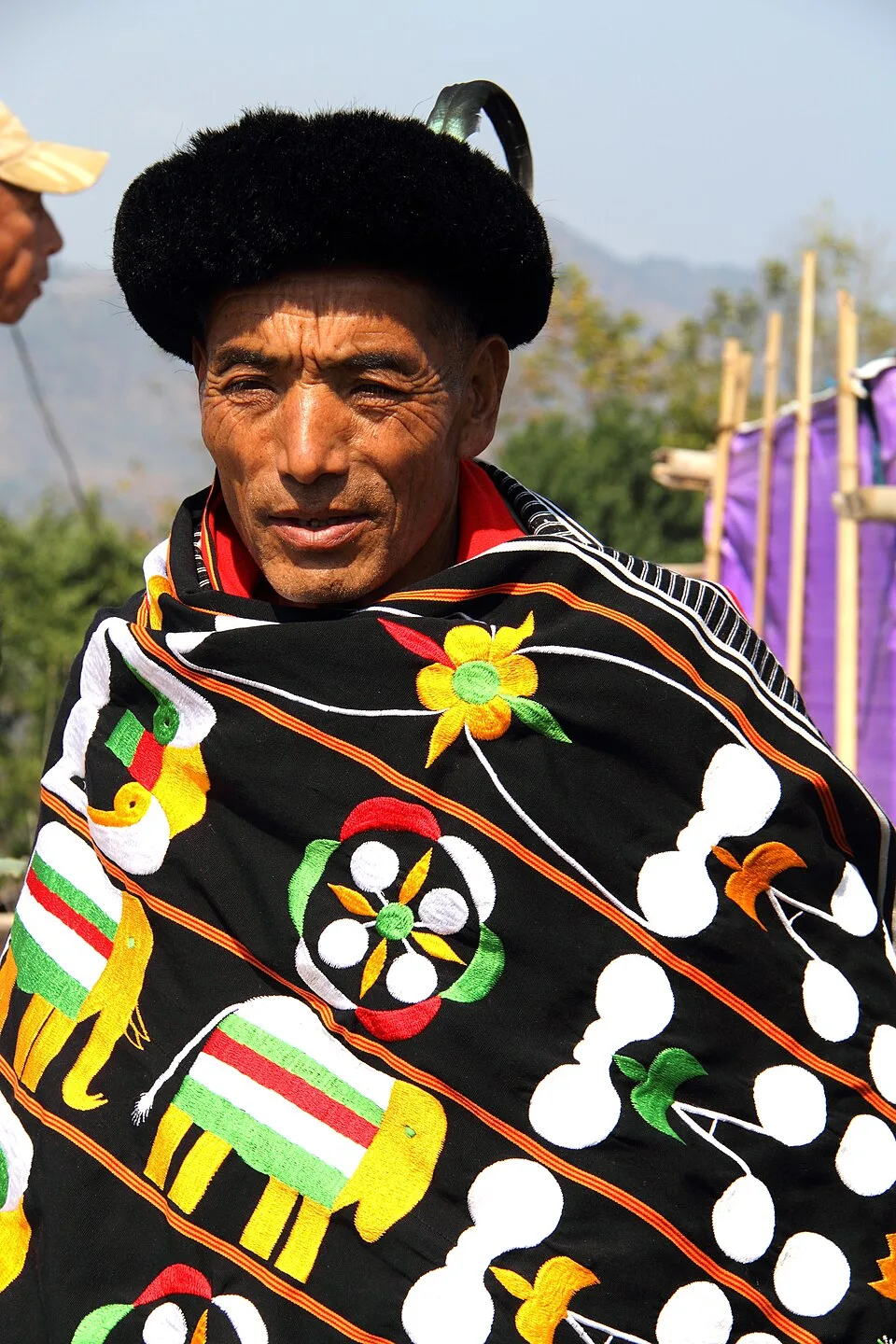
On dyes, accounts say the Chakhesang traditionally use red, black, white, green and yellow, coloured by the women themselves. Some Naga dye plants are named in published sources, and chemical dyes are now often used alongside natural ones. The application summary also lists nettle and other plant fibres among the materials, but only that one source mentions it, so that detail is offered cautiously. Many weavers today use shop-bought cotton or wool yarn.
- Set up the loomOne end of the warp is fixed to a post or wall and the other is tied to a strap around the weaver’s back, so her own body keeps the threads taut.
- Weave three piecesA typical Naga shawl is woven in three narrow pieces.
- Add the patternIn the extra-weft method, the weaver lifts selected warp threads with a stick or a porcupine quill and passes a coloured thread through the gap.
- Stitch them togetherThe three pieces are then stitched together into one shawl.
Motifs and colours: what they are said to mean
Chakhesang shawl motifs are geometric and are usually described with set meanings. Please remember that these come from writers recording oral tradition, and a clan or village may read a pattern differently.
- Spear: said to stand for bravery in war, so traditionally linked to warriors. The Khonoma shawl, with a spear motif, is described as worn by Chakhesang warrior men.
- Diamond: commonly linked with beauty and good fortune.
- V-shape: described as an arrow-shooting weapon.
- Colours: across Naga cloths, red is often tied to the blood of enemies, blue to the sky and black to night; Chakhesang bands use these in their own arrangements.
The RIPA summary says the shawl’s designs are not found in other tribal shawls. Since Angami and Chakhesang cloths resemble each other, it is safer to say the Chakhesang have their own named shawls and arrangements than to claim every single motif is unique to them.
Shawls and standing in the community
Across Naga societies, scholars describe shawls as a way of showing clan, seniority and achievement. Rank traditionally rested on things such as success in war and on feasts of merit, large feasts through which a host shared wealth and earned prestige. Some shawls were reserved for people who had met those conditions, and wearing one without the right was widely seen as improper.
The Chakhesang shawl of merit, Chi pi khwu, fits this pattern, though the sources consulted give little detail on exactly who may wear it. Times have also changed: Christianity has become widespread, warfare is long past, and writers note that dress no longer reads as strictly as before. Many Chakhesang shawls are now worn at weddings, festivals and formal events as a mark of identity.
GI status and the craft today
A Geographical Indication, or GI, is a legal tag that ties a product to a place and a community. According to the Indian GI Registry, the application (number 542) for Chakhesang Shawls was filed on 1 January 2016 by the Chakhesang Women Welfare Society, listed as a handicraft from Nagaland in classes 24, 25 and 27, and the certificate was issued on 24 October 2017, valid until 31 December 2035. The Registry also lists authorised users: the Chakhesang Woman Multipurpose Cooperative Society and TRIFED, a body under the Ministry of Tribal Affairs. A news report in Scroll says the registration covers 14 types of shawls; the registry page consulted did not state this, so it is treated here as reported, not confirmed.
The challenges are practical. Papers on Naga weaving say machine-made cloth is cheaper and lighter, younger people may feel less tied to the old meanings, and good yarn is costly or hard to find because home cotton growing and spinning have nearly stopped. Even so, a GI tag mainly gives the community a legal basis to object to misuse of the name; it does not by itself prove that any particular shawl in a shop is authentic. For that, the community society, its authorised users or a trusted museum or craft body are the right sources.
Related stories
- Geographical Indication (GI) tags
- Puanchei – Mizo Shawl
- Handloom or Powerloom? How to Tell Handwoven Cloth from Machine-Made
- Mau Saree
Frequently asked questions
Who weaves the Chakhesang shawl?
Weaving among the Naga peoples is traditionally done by women, and the Chakhesang Women Welfare Society, a women’s group, is the registered GI applicant.
Where is it made?
The registry and other sources place it in Phek district, Nagaland, with the applicant based at Pfutsero.
What is a loin loom?
It is a simple loom where one end of the threads is tied to a fixed post and the other to a strap around the weaver’s back. She tightens or loosens the threads by leaning her body.
Does the GI tag prove a shawl is genuine?
No. It protects the name and links it to a community and region, but it does not authenticate any single piece. Check with the community society or its authorised users.
Can anyone wear a Chakhesang shawl?
Traditionally some designs were linked to particular achievements, and communities may still hold views about this. If you are unsure, it is polite to ask a Chakhesang source about the pattern first.
Sources and further reading
- Chakhesang Shawls, GI Registry application 542 (Intellectual Property India)
- Chakhesang Shawl gets Geographical Indication tag (Morung Express)
- Chakhesang women file lawsuit against Trifed and designer Ritu Beri (Eastern Mirror)
- Weaving Memoirs among the Naga Tribals: A Sociological Overview (Nagaland University scholar, EPRA journal)
- Documenting Intangible Heritage Through Tangible Artifacts: A Case Study of Nagaland (IGNCA, ICOM CIDOC 2015)
- Weaving A Story: The Handloom Shawls Of Nagaland (Outlook India)
- Scroll.in magazine article on Naga textiles and the Chakhesang GI
- Chakhesang Shawls GI summary (RIPA)
- Handlooms of Nagaland and Arunachal Pradesh (eSamskriti)
Image credit: Chakhesang Naga man, “Chakhesang 1883b.jpg” by Yves Picq, via Wikimedia Commons, licensed under CC BY-SA 3.0. Resized and converted to WebP.