Mau Saree
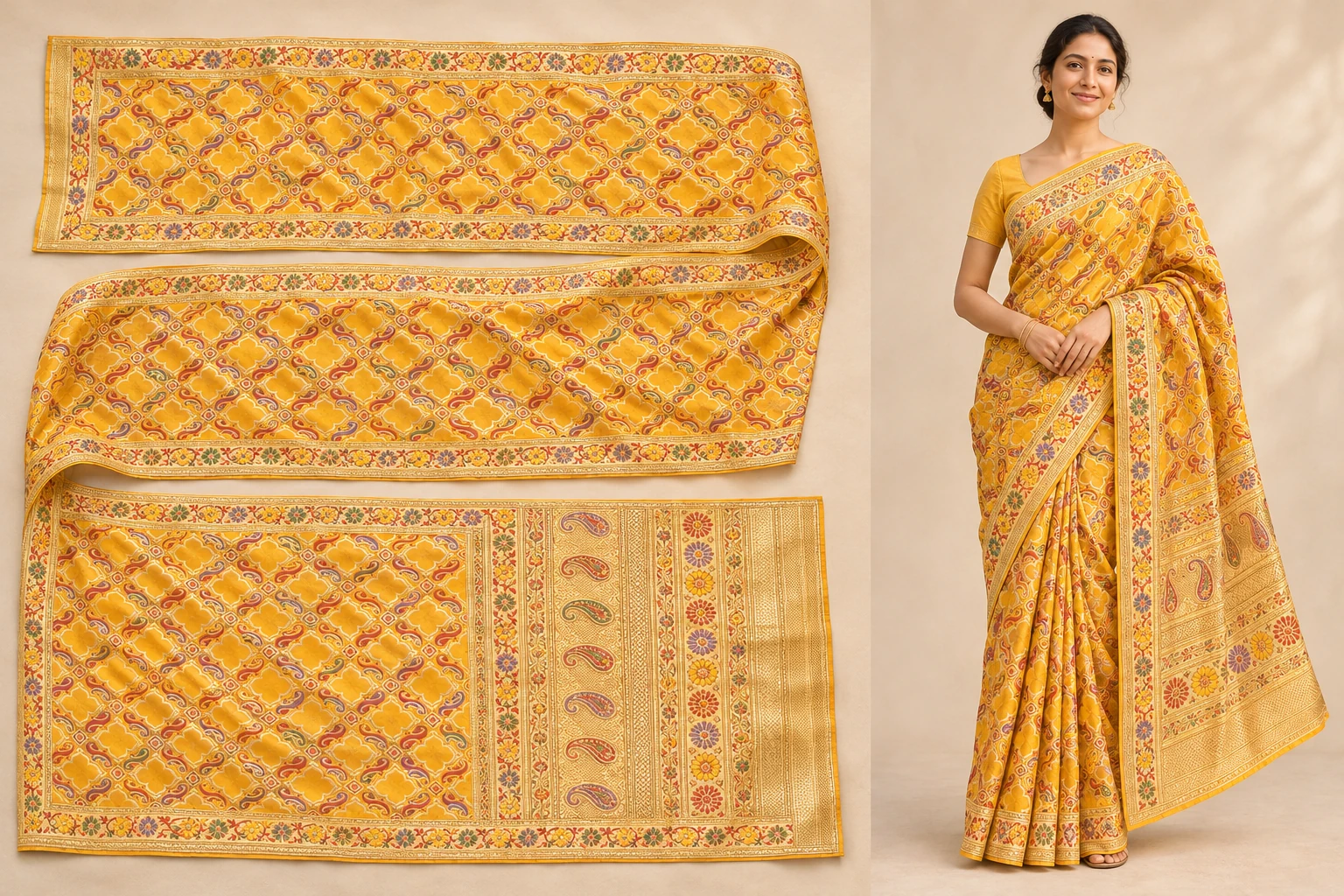
In short: The Mau saree is a traditional silk saree from the town of Mau in eastern Uttar Pradesh, known for its rich colours and fine zari embroidery. It is traditionally described as a Mughal-era craft, though the exact beginning is not documented. Several skilled artisans work together on each piece, and it is a popular choice for weddings and festivals.
Many looms in Mau run day and night to make these sarees.
The Mau saree is named after the town of Mau in Uttar Pradesh, where it is believed to have originated. It has become much more popular in recent years.
At a glance
Mau saree in brief
- Place Town of Mau, eastern Uttar Pradesh
- Material High-quality silk
- Decoration Zari, a metallic thread embroidery
- Dyes Natural dyes, then dried in the sun
- Origin Traditionally called a Mughal-era craft; the exact beginning is not documented
- Worn at Weddings and religious ceremonies
What is the history of the Mau saree?
Nobody can say exactly when weaving began in Mau, a town in eastern Uttar Pradesh. Official descriptions agree that it is an old tradition from the Mughal era, but they differ on the details, and none of them rests on firm documents.
The Incredible India tourism page traces the saree to the Mughal period of the 16th century. The Mau district website gives two versions: one places the start of weaving in the time of the emperor Jahangir, the other in the 16th century, naming a weaver called Tansen who is said to have made fine cloth on his loom. These are local traditions, so treat the dates as rough.
The district website also says handloom weaving in eastern Uttar Pradesh spread outwards from Mau, and describes weaving as central to local life. Mau sarees are known for their embroidery and are often compared with Banarasi sarees while staying more affordable.
A tourism page adds that the craft was patronised by Jahanara Begum, Shah Jahan’s eldest daughter. That sits awkwardly with a 16th-century start, since Shah Jahan ruled in the 17th century, so it is best read as a belief rather than established history.
Origin accounts
Accounts that do not quite agree
- Incredible India Traces the saree to the Mughal period of the 16th century.
- Mau district site, version one Places the start of weaving in the time of the emperor Jahangir.
- Mau district site, version two Places it in the 16th century, with a weaver called Tansen said to have made fine cloth on his loom.
- Jahanara Begum A tourism page says Shah Jahan’s eldest daughter patronised the craft. Read it as a belief, since it sits awkwardly with a 16th-century start.
What is a Mau saree made of?
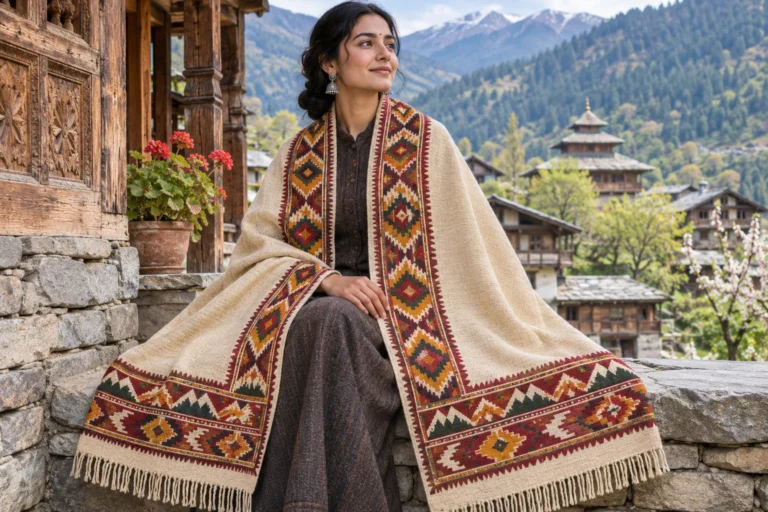
Mau sarees are made of high-quality silk in strong colour combinations and are finished with zari work, a form of metallic thread embroidery.
How is a Mau saree made?
Making a Mau saree is a long process in which several skilled artisans work together.
- Selecting the silk: The finest quality silk is chosen and woven into fabric.
- Dyeing: The fabric is immersed in a solution of natural dyes to achieve the desired shade, then left to dry in the sun.
- Embellishment: The dried fabric goes on for further decoration. Zari work is done with a special needle that weaves metallic thread into fine patterns. The artisans who specialise in this work are highly skilled and often spend years perfecting their craft.
How it’s made
From silk to finished saree
- Select the silk The finest quality silk is chosen and woven into fabric.
- Dye the fabric The fabric is immersed in a solution of natural dyes to get the desired shade.
- Dry in the sun After dyeing, the fabric is left to dry in the sun.
- Add zari Artisans use a special needle to weave metallic thread into detailed patterns.
When is a Mau saree worn?
Mau sarees are often worn for special occasions like weddings and religious ceremonies. They are popular with brides, who often choose them for their wedding day. Its strong colours and zari patterns make the saree a favourite among women of all ages, and it is often passed down from generation to generation as a family heirloom.
People wear the Mau saree to weddings and religious ceremonies, and some keep one simply as a good saree for other occasions.
GI tag record
| GI name | State | Filed | Certificate date | Valid until | Registry |
|---|---|---|---|---|---|
| Mau Saree | Uttar Pradesh | 4 March 2019 | 14 September 2021 | 3 March 2029 | App. 645 |
Dates are from the official GI Registry record, read on 21 November 2026. See all crafts in our GI tag list.
Frequently asked questions
Where does the Mau saree come from?
It is named after the town of Mau in Uttar Pradesh, where it is believed to have originated.
What is the history of the Mau saree?
The exact beginning is not documented. Official accounts call it a Mughal-era tradition: one places it in the 16th century, another in the time of Jahangir, with a weaver named Tansen mentioned in local tradition. Treat these dates as approximate; no firm records are cited.
What is a Mau saree made of?
It is made of high-quality silk and decorated with zari, a metallic thread embroidery.
How is the fabric dyed?
The woven silk is immersed in a solution of natural dyes to get the desired shade and then dried in the sun.
When do women wear Mau sarees?
They are often worn at weddings and religious ceremonies, and are popular with brides.
Who is said to have patronised the craft?
It is believed to have been patronised by Jahanara Begum, the eldest daughter of Shah Jahan, though this rests on tradition.
Sources and further reading
Mau Saree, Incredible India (Ministry of Tourism, Govt of India).
Culture & Heritage, Mau District Administration (NIC).
- Mau Saree: Elegance of Uttar Pradesh, Incredible India (in English)
- Mau (Maunath Bhanjan), Wikipedia (in English)
Related reading
- Bandhani and Shibori: India’s and Japan’s Tie-Dye Traditions Compared
- Block Printing, Batik and Resist Printing: India, Indonesia and Beyond
- Real Bandhani or Printed? How to Spot Hand-Tied Tie-Dye
Image credit: AI-generated illustration created for Thigma Art, shown for representation; it is not a photograph of an actual saree.