Sohrai and Khovar Paintings
In short: Sohrai and Khovar are tribal wall-painting traditions of Jharkhand, made mostly by women. Sohrai is painted around the harvest festival after Diwali, while Khovar paintings mark the wedding season. Both use natural pigments, both are believed to bring good luck to the household, and both have been given a Geographical Indication (GI) tag.
Around the harvest festival after Diwali, mostly women in Jharkhand paint walls with natural pigments, and they paint again in the wedding season. These are Sohrai and Khovar, tribal wall paintings that are believed to bring good luck to the household. This article explains what each one is, when it is painted and what it means.
At a glance
Sohrai and Khovar in brief
- Region Jharkhand, with Hazaribagh district as a main centre
- Made by Mostly women of tribal communities
- Surface Walls of mud houses; also floors and household items such as pots
- Sohrai season Around the harvest festival, a day after Diwali, roughly October to January
- Khovar season The wedding season, in the room prepared for the bridal couple
- GI tag Application filed in August 2019; reported in 2020; registry certificate dated 14 September 2021
How old are Sohrai and Khovar paintings?
Sohrai and Khovar are wall-painting traditions of village women in Jharkhand, with Hazaribagh district as a main centre. Sohrai is painted on the walls of mud houses around the harvest season, roughly October to January. Khovar is painted for weddings, in the room prepared for the bridal couple. Both use local clays, mostly a black clay rich in manganese and white kaolin.
No written record gives a start date for either tradition, so any age is an estimate. The researcher Bulu Imam has compared the motifs on these walls with prehistoric rock art found around Hazaribagh and suggests a long continuity in the region. Visiting archaeologists are reported to have dated nearby rock-art sites to roughly 9,000 and 4,000 years ago. These dates belong to the rock sites. Whether the house paintings are directly descended from them is an interpretation, not a settled fact. The name Khovar is often linked to a word for cave or shelter, which fits the idea but does not prove it.
In recent decades the paintings have reached wider audiences through exhibitions and projects that brought women artists together. On paper, the Geographical Indications Registry lists an application for Sohrai-Khovar painting filed in August 2019 by a Hazaribagh-based women’s society, the GI tag was widely reported in 2020, and the registry’s certificate carries the date 14 September 2021. Researchers also note that Sohrai and Khovar are broad terms covering several styles, and that mural making has been declining.
Timeline
Dating the tradition
- About 9,000 and 4,000 years ago Archaeologists are reported to have dated nearby rock-art sites to roughly these times. These dates belong to the rock sites, not the house paintings.
- No start date No written record gives a start date for either tradition, so any age is an estimate.
- August 2019 A Hazaribagh-based women’s society filed the Sohrai-Khovar GI application.
- 2020 The GI tag was widely reported.
- September 2021 The registry certificate is dated 14 September 2021.
What are Sohrai and Khovar paintings?
Sohrai and Khovar paintings are made by the tribal communities of Jharkhand to celebrate different aspects of life. Sohrai is celebrated in October-November, a day after Diwali. Khovar paintings are made during the wedding season. Both art forms have been given a Geographical Indication (GI) tag by the Government of India.
Two traditions
Sohrai and Khovar compared
- Sohrai Celebrated in October-November, a day after Diwali. Painted by women with natural pigments and plant extracts, often with a strong mother-child theme.
- Khovar Made in the wedding season. The room where the groom stays at the bride’s home is decorated with murals by women on the bride’s side.
- Shared materials Local clays, mostly a black clay rich in manganese and white kaolin. Sohrai tones are typically red, yellow and black, applied with chewed twigs of the Sal tree.
How are Sohrai paintings made?
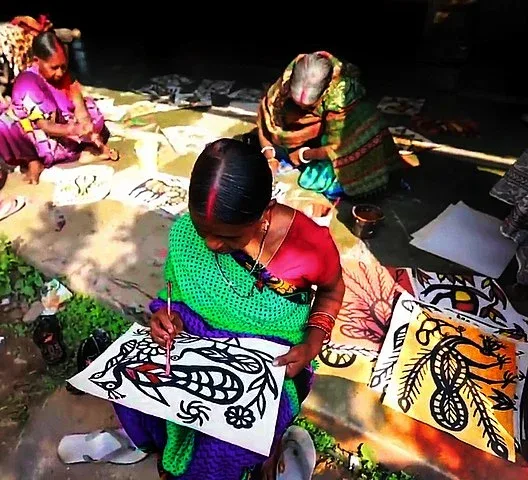
Sohrai paintings are created by the women of the community using natural pigments and plant extracts. They have a strong tone of the mother-child bond but may also show scenes from everyday life, as well as religious and mythological themes.
- Colours: Earthy tones such as red, yellow and black are typical.
- Tools: Chewed twigs of the Sal tree are used as brushes.
- Surfaces: The paintings are made on the walls and floors of homes, and on pots and other household items.
- Tradition: The art is passed from mother to daughter, so different approaches blend over time as daughters marry into other villages. Sohrai paintings show strong matriarchal elements.
What are Khovar paintings and what does the name mean?
Khovar paintings celebrate the wedding season. The name Khovar is often explained as combining a word for cave or shelter with a word for a married couple, though this is a popular explanation.
Some researchers compare Khovar motifs with prehistoric rock paintings found in the hills near the Karanpura valley, but a direct link is an interpretation rather than a proven fact.
What is the Khovar wedding tradition?
As part of the marriage custom, the groom traditionally spends the night at the bride’s home. To mark the occasion, the room in which he stays is decorated with murals made by the women on the bride’s side.
Why do these paintings matter?
Sohrai and Khovar paintings are believed to bring good luck and prosperity to the household and are seen as a way to honour the deities associated with the harvest. They are also a way for the community to express its cultural identity and to pass traditions and beliefs to future generations.
In recent years, the paintings have gained recognition beyond the tribal communities of Jharkhand and have become increasingly popular as a form of folk art. They have been exhibited in galleries and museums in India and abroad, which has made them better known outside the state.
GI tag record
| GI name | State | Filed | Certificate date | Valid until | Registry |
|---|---|---|---|---|---|
| Sohrai-Khovar Painting | Jharkhand | 23 August 2019 | 14 September 2021 | 22 August 2029 | App. 658 |
Dates are from the official GI Registry record, read on 21 November 2026. See all crafts in our GI tag list.
Frequently asked questions
Who makes Sohrai and Khovar paintings?
They are made by tribal communities of Jharkhand, mostly by the women of the community.
How old are Sohrai and Khovar paintings?
Nobody knows exactly. No written record gives a start date. Some researchers compare the motifs with prehistoric rock art near Hazaribagh, and nearby sites are reported to be thousands of years old, but a direct link to today’s house paintings is an interpretation. The Sohrai-Khovar GI application was filed in 2019.
When is Sohrai celebrated?
Sohrai is celebrated in October-November, a day after Diwali.
What does the word Khovar mean?
The name is often explained as combining a word for cave or shelter with a word for a married couple, though this is a popular explanation.
What colours and tools are used in Sohrai paintings?
Natural pigments and plant extracts in earthy red, yellow and black, applied with chewed twigs of the Sal tree.
Why are the paintings important?
They are believed to bring good luck and prosperity, honour harvest deities, and carry the community’s cultural identity to future generations.
Sources and further reading
Mural Traditions of Jharkhand, Sahapedia.
Bulu Imam: A Lifetime of Working with Adivasi Art and the Environment, Sahapedia.
Sohrai-Khovar Painting, GI Application No. 658, Geographical Indications Registry, Government of India.
- Sohrai and Khovar painting, Wikipedia (in English)
- Sohrai-Khovar painting, GI compilation (Origin-GI) (in English)
Related reading
- Madhubani and Its Cousins: Folk Painting Traditions Around the World
- Hand-Painted or Printed? How to Tell an Original Indian Folk Painting from a Print
- Unsung Art of India: 9 Folk and Tribal Painting Styles
Image credit: “Sohrai painting, Jharkhand” by Shreyashprashu, via Wikimedia Commons, licensed under CC BY-SA 4.0.