Kalighat Painting: Bengal’s 19th-Century Temple and Satire Art
In short: Kalighat painting is a bold, colourful style that grew up around the Kalighat Kali Temple in 19th-century Calcutta (Kolkata). Patua scroll painters made quick, affordable pictures of gods for pilgrims, and soon added sharp satire of city life. Cheap printed lithographs pushed it into decline in the early 1900s, but it shaped modern Indian art, from Jamini Roy to today’s cartoons and design.
Kalighat paintings were made and sold near the Kalighat Kali Temple in 19th-century Kolkata. Besides gods and goddesses, they show the social, cultural and political changes of the time, drawn with bold lines, bright colours and a good deal of wit.
At a glance
Kalighat painting in brief
- Place Calcutta (today’s Kolkata), around the Kalighat temple
- Made by Patuas, painters from rural Bengal who once made painted scrolls
- Format Single sheets with one or two figures, plain backgrounds, bold outlines
- First subjects Gods, especially Kali, Durga and Krishna; satire of city life came later
- Sold to Pilgrims and visitors, cheaply
- Legacy Shaped modern Indian art, from Jamini Roy to later cartoons and graphic art
Where does Kalighat painting come from?
Kalighat painting grew up in Calcutta (today’s Kolkata) in the 19th century. It takes its name from the area around the Kalighat temple, where the pictures were sold to pilgrims and visitors. The artists were patuas, a community of painters from rural Bengal who had traditionally made long painted scrolls and sung the stories shown on them. As Calcutta grew into a busy port city, many patuas moved there to find work.
In the city, their way of painting changed. Instead of scrolls, they made single sheets with one or two figures, plain backgrounds and bold outlines, which could be finished quickly and sold cheaply. Mill-made paper and ready-made imported paints made the work faster still. Gods came first, and the range of subjects widened later. Museums date surviving works from roughly the 1830s to the 1930s, and one museum notes that the style was at its most popular around 1870.
By the early 20th century the style was fading. Cheap printed pictures, including imported lithographs, competed with hand-painted ones, and many patua families left the city. Scholars still discuss how much Western art shaped the Kalighat look, and that question is not settled. Museum collecting began in the late 1800s: London’s Victoria and Albert Museum acquired its first Kalighat works in 1879. Painters in Bengal’s villages still carry on related work today.
Timeline
Rise and fade of Kalighat painting
- 19th century The style grew up in Calcutta; exact dates for its start are not known.
- Roughly 1830s to 1930s The span museums give for surviving works.
- Around 1870 One museum notes the style was at its most popular.
- 1879 London’s Victoria and Albert Museum acquired its first Kalighat works.
- Early 20th century Cheap printed pictures, including imported lithographs, competed with hand-painted ones and many patua families left the city.
What do Kalighat paintings show?
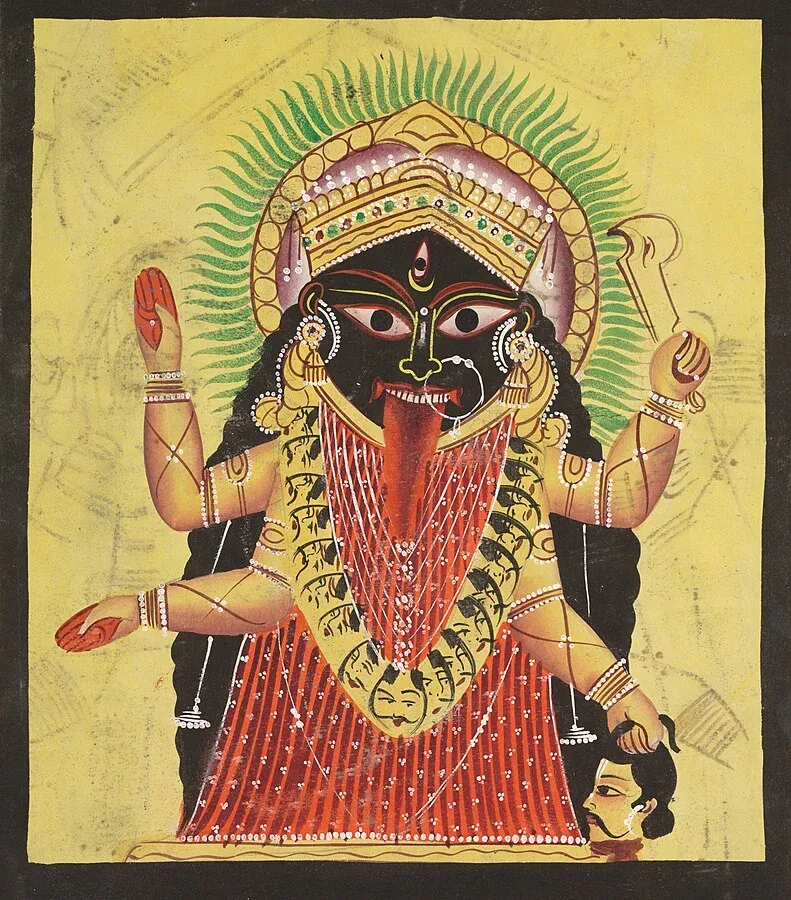
- Gods and goddesses: The Patuas first painted Hindu deities, especially Kali, Durga and Krishna, for devotees. They also painted Christian subjects such as the Virgin Mary, reflecting Kolkata’s mixed culture.
- Social satire: Kalighat artists cleverly mocked the fashions of their day. A famous motif is a cat holding a fish or prawn, often read as a jab at hypocrisy. They poked fun at the babu culture of Westernised elites, at relations between men and women, and at people copying colonial ways.
- Current events: From scandals to new technology like trains, these paintings recorded India’s fast-changing world and worked almost like early political cartoons.
How can you recognise a Kalighat painting?
Kalighat paintings are instantly recognisable for their:
- Bold, flowing outlines that give clarity and impact.
- Flat, bright colours applied in washes. Early painters made colours from natural materials, such as turmeric for yellow and soot for black; later, many used cheaper imported watercolours.
- Minimal detail: elongated limbs, exaggerated expressions and little or no background, keeping attention on the story.
- No perspective: a deliberate choice that puts storytelling ahead of realism.
Spot the style
How to recognise a Kalighat painting
- Bold outlines Flowing lines that give clarity and impact.
- Flat, bright colours Applied in washes. Early painters used turmeric for yellow and soot for black; later many used cheaper imported watercolours.
- Minimal detail Elongated limbs, exaggerated expressions and little or no background, keeping attention on the story.
- No perspective A deliberate choice that puts storytelling ahead of realism.
Why did Kalighat painting decline, and how was it revived?
By the early 20th century, Kalighat painting was fading, as cheap mass-printed lithographs, many of them printed in Germany, flooded the market. Yet its legacy survived. Museums such as the Victoria and Albert Museum in London, which began acquiring Kalighat paintings in 1879, helped preserve the tradition. Modern artists like Jamini Roy drew on the style, blending folk motifs with modernist simplicity and sparking new interest.
What is the legacy of Kalighat painting?
Kalighat painting helped lay the groundwork for India’s modern art movement. Its influence shows in Jamini Roy’s work, which borrowed heavily from the Kalighat look, and in the satirical edge of later graphic art and political cartoons. Today these paintings are celebrated in museums around the world and continue to inspire designers.
Most of the Patuas who made these pictures are unknown by name. Their work, first sold cheaply near a temple, now hangs in museums and still mixes old religious subjects with comment on city life.
Frequently asked questions
What is Kalighat painting?
Kalighat painting is a style of painting from Kolkata that grew up around the Kalighat Kali Temple in the 19th century. Patua artists made bold, colourful pictures of gods and scenes of city life on paper and sold them cheaply to pilgrims.
Where does Kalighat painting come from?
Kalighat painting developed in 19th-century Calcutta (Kolkata), around the Kalighat temple. Patua painters from rural Bengal, who had made long storytelling scrolls, moved to the city and began selling cheap single-sheet pictures to pilgrims and visitors. The style faded in the early 1900s as printed pictures became common. Exact dates for its start are not known.
Who made Kalighat paintings?
They were made by Patuas, traditional scroll painters from rural Bengal who moved to Kolkata and adapted their craft for temple visitors.
What are the main features of Kalighat painting?
Bold, flowing outlines, flat bright colours, little or no background and no perspective, so that all the attention goes to the story.
Why did Kalighat painting decline?
In the early 20th century, cheap mass-printed lithographs replaced hand-painted pictures, so demand for the Patuas’ work fell.
Where can I see Kalighat paintings today?
Major museums hold them, including the Victoria and Albert Museum in London, which began collecting them in 1879. The featured image in this article is from the Cleveland Museum of Art in the United States.
Sources and further reading
Kalighat painting, Victoria and Albert Museum.
Kalighat Icons: Paintings from 19th-century Calcutta, Amgueddfa Cymru – Museum Wales.
The Rise and Fall of Kalighat Paintings, Sahapedia.
Kalighat painting, Victoria and Albert Museum, London.
Related reading
- Unsung Art of India: 9 Folk and Tribal Painting Styles
- Underrated Indian Arts: 13 Paintings and Crafts You Should Know
- Bengali Patachitra: Scroll Painting and Song of West Bengal
Featured image: Two Aspects of Kali: Kali Enshrined, Kalighat painting, 19th century, Cleveland Museum of Art, via Wikimedia Commons.
Image credit: “Two Aspects of Kali: Kali Enshrined” (Kalighat painting, 19th century), Cleveland Museum of Art, via Wikimedia Commons, licensed under CC0.