Venturing the Beauty of Warli Painting: A Cultural Heritage of Maharashtra
TL;DR: Warli painting is a tribal art form from Maharashtra, made by the Warli community of the Sahyadri region. Simple white shapes (circles, triangles and squares) are drawn on mud walls to show daily life, farming, festivals and dance. Once limited to village walls, it now appears on paper, canvas and clothing around the world.
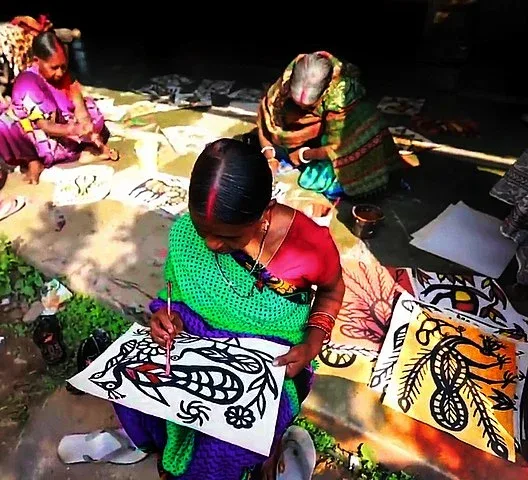
This eye-catching art form from Maharashtra brings a lot to our lives. It was once limited to walls, but today it appears on canvas, paper and even dresses, and it has travelled all over the world.
Warli painting is often mixed up with other religious art traditions of Maharashtra, but it is the art of the Warli tribe and is rooted in nature and everyday village life.
At a glance
Warli painting in brief
- Made by The Warli community of the Sahyadri region, Maharashtra
- Found in Dahanu, Talasari, Jawhar, Palghar and Mokhada
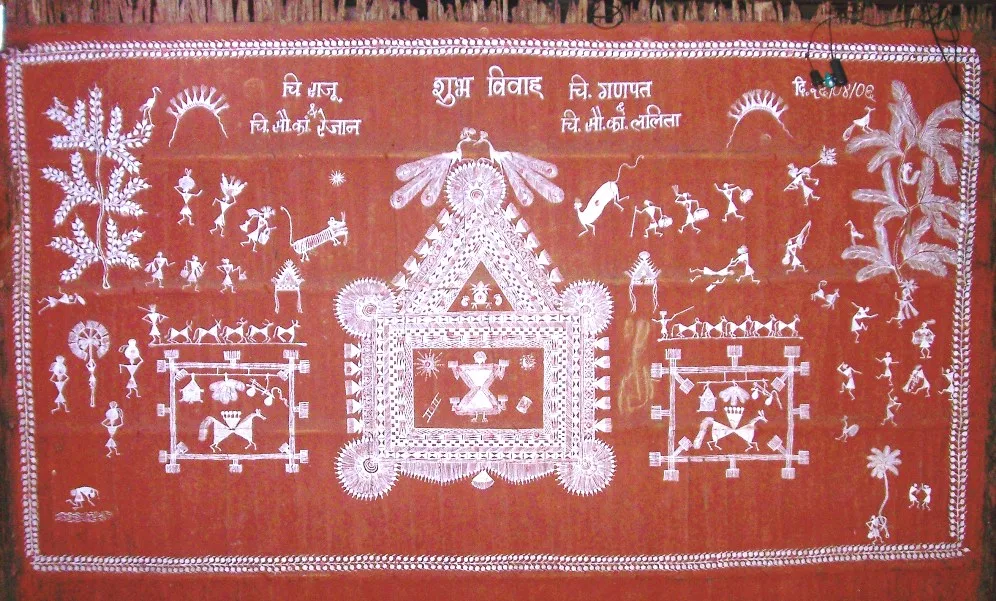
- Surface Inside mud walls of village huts, with a red ochre background
- Pigment White, from rice flour, water and gum
- Brush A chewed bamboo stick
- Legal status Registered as a geographical indication in India
What is the history of Warli painting?
Warli painting comes from the Warli people, an indigenous community living in Thane district and nearby parts of western India, roughly 50 to 150 kilometres from Mumbai. For a long time the paintings were made on the mud walls of village homes, mostly by married women, for ceremonies tied to weddings and the harvest. They were part of a ritual and were not meant to last.
How old the tradition is cannot be said exactly. Some writers link it to very ancient rock art, and you will see claims of a specific century online, but no reliable source I could find gives a firm date, so it is best described as a long-standing local practice that changed little for generations.
The big change came in the early 1970s. Around 1971 India’s All India Handicrafts Board began encouraging Warli artists to move from walls to paper, and the artist Bhaskar Kulkarni visited the community. Jivya Soma Mashe (1934 to 2018), from the Warli community, became the first man known to take up this women’s art, and the first Warli artist to paint on canvas. He kept the traditional white geometric style and simple figures and focused on farming, harvest and fishing. His work was collected by museums and galleries in India and abroad, and later artists carried the style onto cloth, walls and many modern products. Today women are again prominent in the art, and the Warli style is also widely copied by people outside the community.
Timeline
From village walls to canvas
- Long-standing, age unknown Painted on mud walls, mostly by married women, for weddings and the harvest. No reliable source gives a firm date.
- Around 1971 The All India Handicrafts Board begins encouraging Warli artists to move from walls to paper.
- Early 1970s Jivya Soma Mashe becomes the first man known to take up this women’s art, and the first Warli artist to paint on canvas.
- Today Women are again prominent in the art, and the style also appears on cloth, walls and many modern products.
What is Warli painting?
Warli painting is a tribal art form practised by the Warli, one of the largest tribes of the northern Sahyadri range in Maharashtra. It is found in places such as Dahanu, Talasari, Jawhar, Palghar and Mokhada.
Traditionally, it is painted on the inside walls of village huts, which have a red ochre background. The pigment is white, made from rice flour, water and gum, and a chewed bamboo stick is used as a brush.
What are the characteristics of Warli painting?
- Simple shapes: Circles stand for the sun and moon, triangles for mountains and conical trees, and squares (chauk) for sacred enclosures.
- Human figures: People are drawn as two triangles joined at their tips, with a larger upper triangle for a man and a wider lower triangle for a woman.
- Natural elements: Trees, animals and rivers are important, because the Warli see nature as a source of food and resources.
- Scenes of daily life: Farming, hunting, fishing, festivals and the tarpa dance are common themes.
- Limited palette: Traditional work uses white on a red ochre background, which keeps the art simple and folk in style.
Shapes
Reading a Warli painting
- Circle Stands for the sun and moon.
- Triangle Stands for mountains and conical trees.
- Square (chauk) Marks a sacred enclosure.
- Human figure Two triangles joined at their tips: a larger upper triangle for a man, a wider lower triangle for a woman.
- Themes Farming, hunting, fishing, festivals and the tarpa dance.
Why is Warli painting significant?
Warli painting is not merely an art form; it is a cultural treasure. Its simplicity and its close link with nature make it a unique and cherished tradition. When we appreciate Warli art, we also honour the cultural diversity and artistic expression that enrich our world.
- Preserving tradition: It keeps the customs, rituals and beliefs of the Warli community alive.
- Artistic heritage: It is an important part of the artistic heritage of Maharashtra and is celebrated in cultural events and festivals.
- Legal protection: Warli painting is registered as a geographical indication in India, which protects it as traditional cultural knowledge.
Frequently asked questions
Who makes Warli paintings?
Warli paintings are made by the Warli tribe of the Sahyadri region in Maharashtra, and traditionally the art is created by women.
Who brought Warli art to paper and canvas?
Jivya Soma Mashe (1934 to 2018) from Thane district is credited as the first man to take up this traditionally women’s wall art, from the early 1970s. Around the same time the All India Handicrafts Board encouraged artists to move from mud walls to paper. How old the wall tradition is remains unknown.
What materials are used in Warli painting?
Traditionally, white pigment made from rice flour, water and gum is painted with a chewed bamboo stick on mud walls with a red ochre background.
What do the shapes in Warli art mean?
Circles represent the sun and moon, triangles represent mountains and conical trees, and squares (chauk) mark sacred enclosures. Human figures are drawn as two triangles joined at their tips.
What are the common themes of Warli painting?
Daily life, farming, animals, trees, hunting, fishing, festivals and dance, especially the tarpa dance.
Who brought Warli art to canvas and the wider world?
Jivya Soma Mashe, an artist from Thane district, began painting Warli art on paper and canvas in the 1970s and is regarded as its modern father.
Sources and further reading
Jivya Soma Mashe, Fondation Cartier pour l’art contemporain.
Untitled I (Warli), object record, Seattle Art Museum.
It’s the Warlis who make these paintings, People’s Archive of Rural India (PARI).
The remarkable story of Warli art, Societe Generale Collection.
Related reading
- Hidden Gems: Indian Underrated Arts You Should Know
- Exploring the Enchanting World of Maithili Art and Madhubani Painting.
- Sohrai and Khovar Paintings
Image credit: “Warli painting in Warli” by Joy1963, via Wikimedia Commons, licensed under CC BY-SA 3.0.