The Exquisite Taste of Banarasi Paan
TL;DR: Banarasi paan is a famous paan from Varanasi: a betel leaf filled with areca nut, slaked lime, catechu and sweet or aromatic additions, and folded into a triangular gilori. It carries a Geographical Indication (GI) tag, granted in 2023. Paan is a gesture of hospitality in India, but areca nut and especially tobacco carry health risks, so it should be enjoyed with care.
Khaike paan Banaraswala, khul jaaye band akal ka tala. Banarasi paan is one of India’s best-loved treats, linked to the ancient city of Varanasi and passed down through generations, and it now comes in a variety of flavours and ingredients.
Banarasi paan also has a Geographical Indication (GI) tag.
At a glance
Banarasi paan in brief
- Place Varanasi
- What it is A betel leaf filled with areca nut, slaked lime, catechu and sweet or aromatic additions
- Shape Folded into a triangular gilori
- GI tag Granted in 2023 (certificate on 31 March 2023)
- Role in society A gesture of hospitality, respect and warmth; also taken after meals as a mouth freshener
- Health note Areca nut and tobacco are linked to cancer, so enjoy in moderation
Where does paan come from?
Paan, a betel leaf folded around areca nut and other fillings, is part of a chewing habit that is several thousand years old, but where and when it began is debated. Scholars who have reviewed the evidence think the betel plant and areca palm had a limited natural range in Southeast Asia and were then carried across Asia by people. Reported traces of areca-nut chewing from a burial site in Thailand are about 4,000 years old, though outside researchers have asked for more dating. A scholarly review of the wider evidence, from South India to Papua New Guinea, also questions some of the earliest dates that have been claimed.
One museum-library article suggests betel chewing reached northern India around 500 BCE, carried along with trade and migration. Across the region, offering betel to guests became a way of showing respect, and refusing it was considered rude. We did not find a reliable source that tells us when Varanasi became known for its paan, so that part of the story is best told as local reputation rather than dated history.
What can be dated is the recognition. Banarasi Paan was among 33 products given a Geographical Indication certificate on 31 March 2023, according to press reports of the registry’s announcement. Because areca nut and tobacco are linked to cancer, health bodies advise caution about chewing it.
Timeline
Betel chewing and the GI tag
- About 4,000 years ago Reported traces of areca-nut chewing at a burial site in Thailand are about this old, though outside researchers have asked for more dating.
- c. 500 BCE One museum-library article suggests betel chewing reached northern India around then, carried with trade and migration.
- 31 March 2023 Banarasi Paan was among 33 products given a GI certificate, according to press reports of the registry’s announcement.
Why is paan important in Indian society?
Paan is enjoyed by people from all walks of life. Offering paan to guests is a gesture of hospitality, respect and warmth, and in many parts of India it is also taken after meals as a mouth freshener.
What goes into a Banarasi paan?
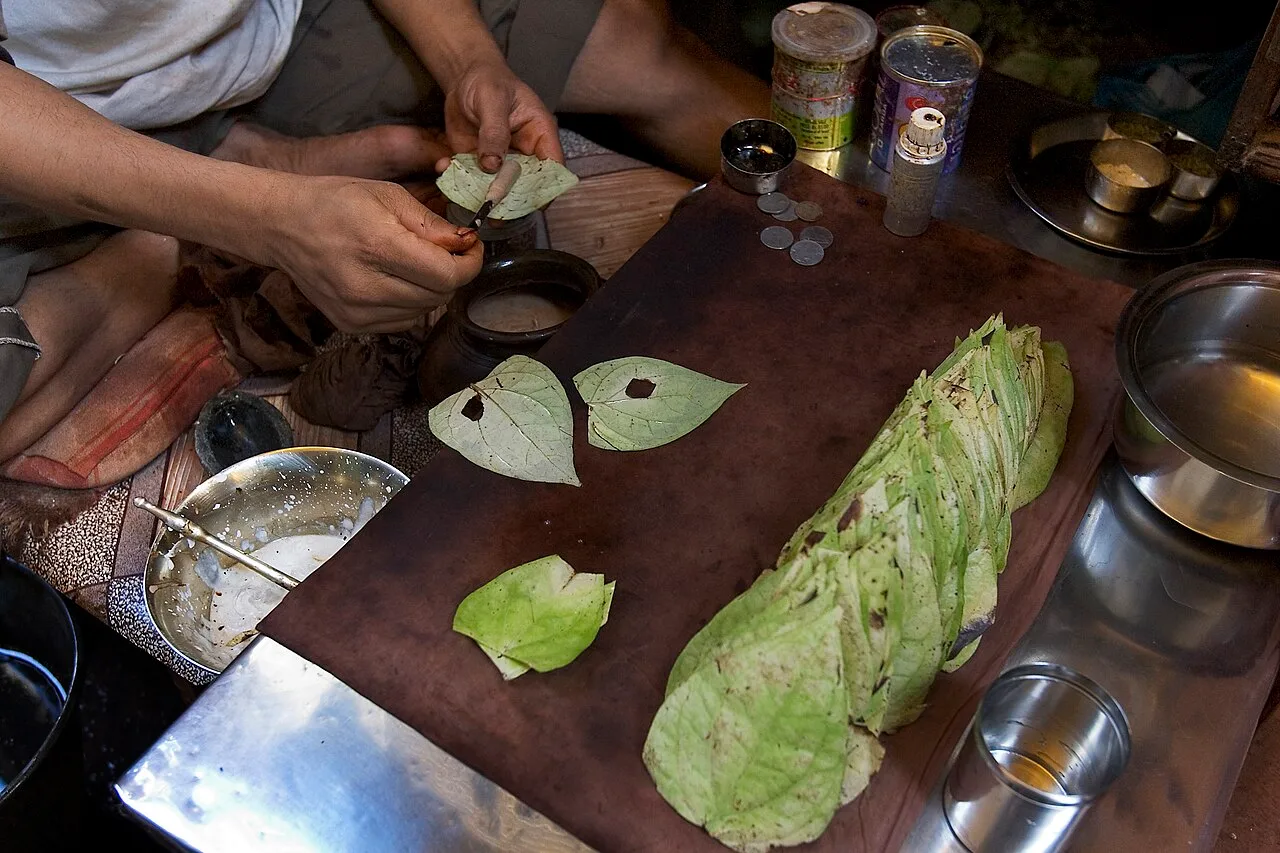
Banarasi paan is a blend of flavours and textures. The key ingredients are betel leaves, areca nut (supari), slaked lime (chuna) and catechu (kattha). A betel leaf is smeared with slaked lime and catechu and then filled with finely chopped areca nut, spices and sweeteners. Some paan also contains tobacco.
The art lies in the choice and balance of ingredients. Popular additions include:
- Cardamom
- Saffron
- Rose petal preserve (gulkand)
- Desiccated coconut
- Sweeteners
What goes in
Inside a Banarasi paan
- Betel leaf The base, smeared with slaked lime and catechu and then filled.
- Areca nut (supari) Finely chopped and added as a filling.
- Slaked lime (chuna) One of the key ingredients, smeared on the leaf.
- Catechu (kattha) One of the key ingredients, smeared on the leaf.
- Popular additions Cardamom, saffron, rose petal preserve (gulkand), desiccated coconut and sweeteners.
- Tobacco Some paan also contains tobacco, which raises the health risks further.
How is paan served and eaten?
Paan is usually folded into a triangular shape called a gilori. It is placed in the mouth and slowly chewed, releasing a mix of flavours and juices.
Is paan safe to eat?
Paan should be consumed in moderation. Chewing areca nut is addictive and has been linked to oral and oesophageal cancers, and adding tobacco raises the risks further. Paan varieties without tobacco or areca nut are available, so ask your paanwala which type suits you.
Why are paan shops important?
Paan shops are meeting places where people from different walks of life socialise, discuss news and current events and share stories. They bring people from different backgrounds together and help build a sense of community.
Frequently asked questions
What is Banarasi paan?
Banarasi paan is a famous paan from Varanasi, made with a betel leaf filled with areca nut, slaked lime, catechu and sweet or aromatic additions, and folded into a gilori.
Where does paan come from?
Betel chewing is thousands of years old and probably began in Southeast Asia, then spread across Asia with trade and migration. Experts disagree on the earliest dates. When Varanasi became famous for its paan is not documented. Banarasi Paan received its GI certificate in March 2023.
What does the word paan mean?
Paan means the betel leaf and the chew made with it, in Hindi and several other Indian languages.
Does Banarasi paan have a GI tag?
Yes. Banarasi paan received a Geographical Indication (GI) tag in 2023.
What popular additions are used in paan?
Cardamom, saffron, rose petal preserve (gulkand), desiccated coconut and various sweeteners.
Is paan harmful to health?
Chewing areca nut is linked to oral and oesophageal cancers, and tobacco adds to the risk. Tobacco-free varieties are available, and paan should be consumed in moderation.
Sources and further reading
The origin and diffusion of betel chewing: a synthesis of evidence from South Asia, Southeast Asia and beyond, eJournal of Indian Medicine, University of Groningen.
Were humans in Thailand getting high off betel nuts 4,000 years ago?, Smithsonian Magazine.
Betel chewing (BiblioAsia, vol. 16, issue 3), National Library Board, Singapore.
Banarasi langda mango, Banarasi paan are latest entrants to GI tag club, Business Today.
Related reading
- Exploring the Delectable Mangoes of India
- Jaipur Spices Festival: A Flavorful Odyssey
- Red chilies of India
Image credit: “India – Varanasi leaves – 0487” by Jorge Royan, via Wikimedia Commons, licensed under CC BY-SA 3.0.