Puanchei – Mizo Shawl
In short: Puanchei is the most colourful and best-known puan (traditional cloth) of the Mizo people of Mizoram. Women wrap it around the waist on weddings, festivals and ceremonies. It is handwoven on a loin loom, carries designs inspired by nature and tribal motifs, and received a Geographical Indication (GI) tag in 2019.
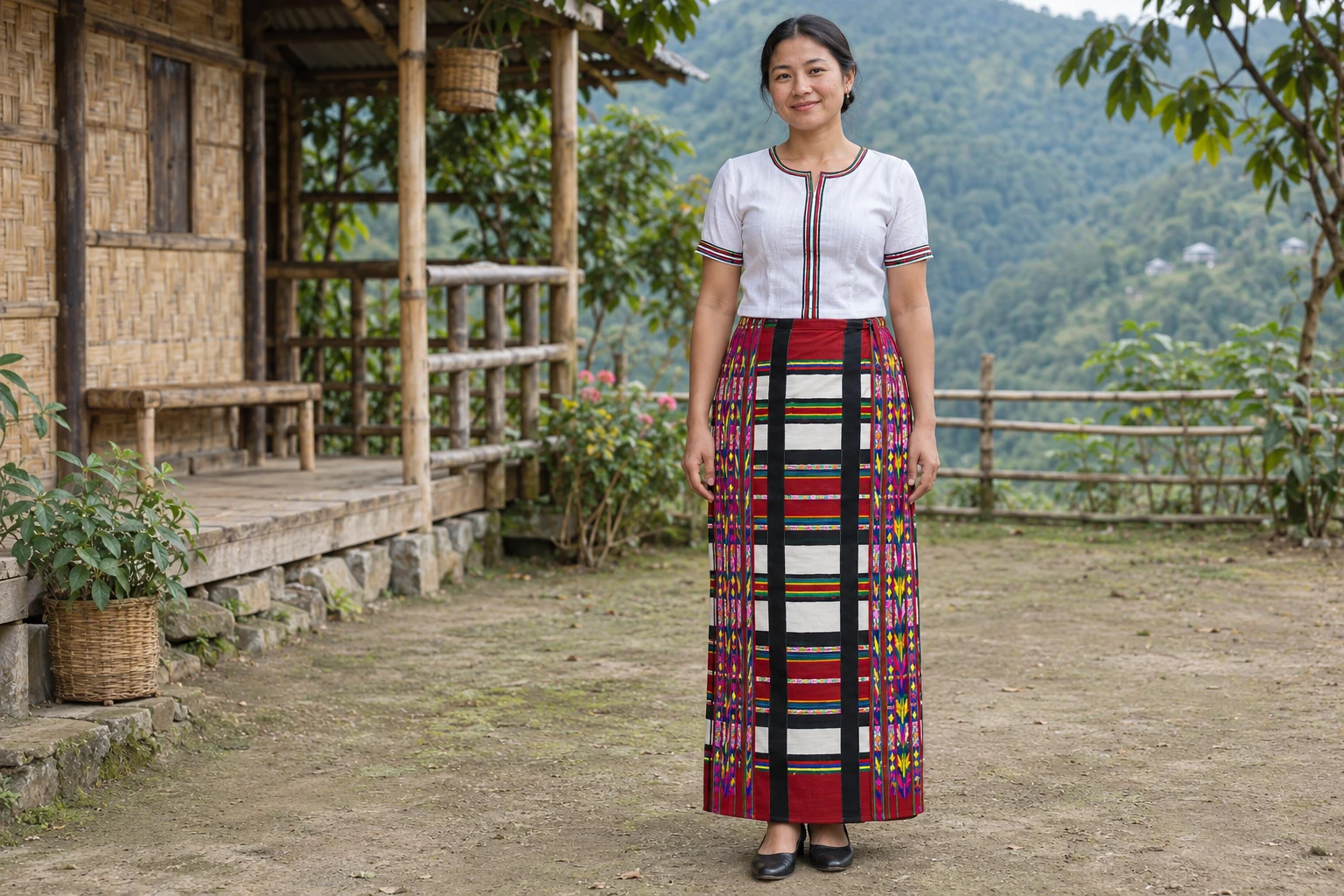
Puanchei, often called the Mizo shawl, is worn by Mizo women on special occasions such as weddings, festivals and ceremonies. Strictly speaking, it is a wrap-around cloth tied at the waist rather than a shawl worn over the shoulders.
At a glance
Puanchei in brief
- Region Mizoram, northeast India
- What it is The most ornate puan (traditional cloth) of the Mizo people, tied around the waist
- Name Puan means cloth and chei means to decorate
- Loom Traditional loin (backstrap) loom
- Worn at Weddings, festivals such as Chapchar Kut, and the Cheraw dance
- GI tag Registered in August 2019 (no. 583)
Where does the Puanchei come from?
The Puanchei is the best-loved ceremonial cloth of Mizo women in Mizoram, northeast India. Its name joins “puan” (cloth) and “chei” (to decorate). It is worn wrapped around the waist at festivals such as Chapchar Kut, for the Cheraw dance, and at weddings, and it stands as a symbol of Mizo identity and weaving skill. It is woven on a traditional loin loom in three lengthwise panels, with the narrowest in the middle, then joined into one cloth.
How old is it? Honestly, nobody knows for certain. The Mizoram government’s own heritage application says it is not known when the Puanchei first came into use. Some writers suggest the design reached the Lushai Hills around the middle of the 1800s, possibly through weavers across the border in Burma, but this is an estimate, not a firmly documented fact. Tradition holds that it grew out of a simpler striped cloth called Puanlaisen, with its deep red central stripe, and that the motifs were added over time.
Early cloths were made from homespun cotton and natural dyes, while factory-spun yarn is common today. In August 2019 the Puanchei was registered as a Geographical Indication of Mizoram (no. 583), which protects its name and craft heritage for the weavers who make it.
Timeline
What is known about its past
- Tradition holds Puanchei grew out of a simpler striped cloth called Puanlaisen, with a deep red central stripe, and the motifs were added over time.
- c. mid-1800s (estimate) Some writers suggest the design reached the Lushai Hills, possibly through weavers in Burma. This is an estimate, not a documented fact.
- August 2019 Puanchei was registered as a Geographical Indication of Mizoram (no. 583).
- Today Factory-spun yarn is common, where early cloths used homespun cotton and natural dyes.
What is puanchei?
Puanchei is the most ornate of the Mizo puan, or traditional cloths. It is a prized possession in a Mizo woman’s wardrobe and is often part of a bride’s trousseau. It is usually worn with a handwoven blouse and is a common sight at festive dances and traditional ceremonies.
Puanchei has received a Geographical Indication (GI) tag, registered in August 2019, which recognises it as a product of Mizoram.
How is puanchei woven?
Weaving puanchei is slow work that needs a skilled hand. It is traditionally woven on a loin (backstrap) loom, and the weaver inserts the designs and motifs during weaving itself.
- Yarn: The shawl is traditionally made from cotton, though synthetic yarns are also used these days.
- Dyes: Cotton yarn was traditionally dyed in bright colours using natural dyes from plants, fruits and flowers.
- Construction: It is usually woven in narrow lengthwise panels that are joined together.
How it’s woven
From yarn to finished cloth
- Choose the yarn Traditionally cotton, though synthetic yarns are also used these days.
- Dye it Cotton yarn was traditionally dyed with natural dyes from plants, fruits and flowers.
- Weave the panels On a loin loom, the weaver inserts the designs and motifs during weaving itself.
- Join the panels The narrow lengthwise panels, with the narrowest in the middle, are joined into one cloth.
What do the designs of puanchei mean?
Puanchei is known for its detailed, colourful designs, which are inspired by nature, folklore and tribal motifs. The cloth may feature flowers, animals, birds and geometric shapes. Many of the designs have symbolic meanings for the Mizo people.
Why is puanchei important in Mizo culture?
Among the Mizo, puanchei is seen as a sign of identity and status, and families treasure their pieces. It is also used in the ceremonial dress worn at weddings and festivals.
Puanchei and modern fashion
Puanchei has also been taken up by the fashion industry, and the traditional Mizo textile is now available in the market in Mizoram and other parts of the country.
However, commercialisation has raised concerns about authenticity. Imitation and mass production can undermine the value and craftsmanship of the traditional handwoven cloth. Buyers who want the real thing should look for handwoven puanchei made by local weavers.
GI tag record
| GI name | State | Filed | Certificate date | Valid until | Registry |
|---|---|---|---|---|---|
| Mizo Puanchei | Mizoram | 20 June 2017 | 14 August 2019 | 19 June 2027 | App. 583 |
Dates are from the official GI Registry record, read on 21 November 2026. See all crafts in our GI tag list.
Frequently asked questions
What is puanchei?
Puanchei is the most colourful and well-known puan, or traditional handwoven cloth, of the Mizo people of Mizoram. It is worn by women on special occasions.
Where does the Puanchei come from?
The Puanchei is a hand-woven Mizo women’s cloth from Mizoram, northeast India, made on a loin loom. Its exact origin is unrecorded. Some sources estimate its design arrived in the mid-1800s, and tradition holds it grew from a striped cloth called Puanlaisen. It earned GI status in 2019.
When do Mizo women wear puanchei?
Women wear puanchei on special occasions such as weddings, festivals and ceremonies.
What is puanchei made of and how is it woven?
It is traditionally made of cotton dyed with natural dyes, although synthetic yarns are also used now. It is woven on a loin loom, with designs inserted during weaving.
What do the designs on puanchei show?
The designs are inspired by nature, folklore and tribal motifs, such as flowers, animals, birds and geometric shapes, and often carry symbolic meaning.
Does puanchei have a GI tag?
Yes. Puanchei has received a Geographical Indication (GI) tag, registered in 2019.
Sources and further reading
Mizo Puanchei, GI Application No. 583, Art and Culture Department, Government of Mizoram.
Mizo Puanchei, G.I. No. 583, Art and Culture Department, Government of Mizoram.
Mizo Puanchei: Resplendent Textiles of Mizoram, Incredible India, Ministry of Tourism, Government of India.
Mizo Traditional Cloth (Puan) and Protection through Geographical Indication, I. L. Hnamte, International Journal of Legal Science and Innovation, 2020.
- Puanchei – Wikipedia (in English)
- Mizo traditional shawls get GI tag – EastMojo (in English)
Related reading
- Evolution of Rakhi designs from Traditional to Trendy.
- Himachali Shawls: Kullu and Kinnauri Weaving, Patterns and GI Tags
- Pokharan Pottery: Desert Clay Craft of Rajasthan.
Image credit: AI-generated illustration created for Thigma Art, shown for representation; it is not a photograph of a real person or an actual Puanchei.