Wooden Mask of Kushmandi
In short: The wooden mask of Kushmandi, also called the Gomira mask or Mukha, is a hand-carved, brightly painted folk mask from Kushmandi in Dakshin Dinajpur, West Bengal. It is worn in the Gomira dance, a ritual meant to invite good forces and drive away evil ones. The craft holds a Geographical Indication (GI) tag.
“Man is least himself when he talks in his own person. Give him a mask, and he will tell you the truth.” This line, attributed to Oscar Wilde, suits the Kushmandi mask well.
Kushmandi masks (Mukha) are brightly coloured wooden masks. They take their name from Kushmandi, a small town in the Dakshin Dinajpur district of West Bengal, India, and they are also known as Gomira masks.
At a glance
Kushmandi mask in brief
- Place Kushmandi, Dakshin Dinajpur district, West Bengal
- Also called Gomira mask or Mukha
- Worn in The Gomira dance, also called Mukha Khel
- Wood Traditionally light gamhar; mahogany and mango also used
- GI tag Yes, handicrafts category (application filed in 2016)
- Look Hand-carved, brightly painted, usually large
What is the history of the Kushmandi wooden mask?
The exact beginning of Kushmandi’s masks is not recorded. They belong to the Gomira dance of the Dinajpur region of northern West Bengal, and the GI application itself says the dance’s origins cannot be traced.
Sources describe the tradition as rooted in local folk worship. The name Gomira is linked to Gram-Chandi, a local deity, and one source suggests it could instead come from the gamar wood used for the masks. Tradition holds that villagers promise a mask to a deity if a wish is granted, and this vow, called manat, is said to be how mask-making began. The masks are called mukha, and the dance is performed by local communities such as the Rajbangshi, Desi and Poliya groups.
The modern craft is better documented. The GI application records that in 1990 Paresh Chandra Sarkar and Sankar Sarkar began training local youth in mask-making, and a craftspeople’s cooperative was formed in 1995. In 2013 the West Bengal MSME department and UNESCO named Kushmandi a Rural Craft Hub, and the first Mukha Mela fair was held in December 2014.
Today the masks are also sold as collectors’ items. A GI application was filed in 2016, and the applicant said the goods had been in continuous use for about 300 years, though the application does not clearly prove that figure.
Timeline
How the modern craft developed
- 1990 Paresh Chandra Sarkar and Sankar Sarkar began training local youth in mask-making, according to the GI application.
- 1995 A craftspeople’s cooperative was formed.
- 2013 The West Bengal MSME department and UNESCO named Kushmandi a Rural Craft Hub.
- December 2014 The first Mukha Mela fair was held.
- 2016 A GI application was filed.
What is the wooden mask of Kushmandi?
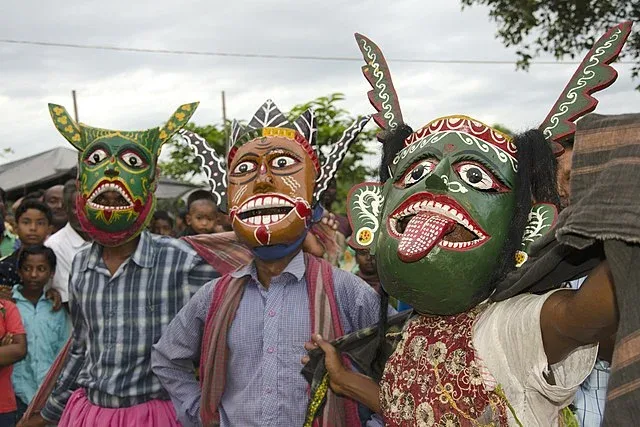
The Kushmandi mask is a ritual mask from the Dinajpur region. It is worn during the Gomira dance, also called Mukha Khel, and the masks are said to represent various characters, including forms of Goddess Kali and Lord Hanuman.
The craft holds a Geographical Indication (GI) tag in the handicrafts category; the GI application was filed in 2016.
What do the masks look like?
The masks are hand-carved from wood by skilled artisans and painted in bright colours with detailed patterns. They are generally large and cover the wearer’s face completely. Some carry extra decoration on top of the paint.
How are the masks made?
Kushmandi masks were traditionally made from the light wood of the gamhar tree. Mahogany and mango wood are also used.
- Seasoning: the wood is soaked and dried over several cycles to make it crack resistant.
- Treatment: it is treated to resist termites and other insects.
- Carving: the artisan carves the design into the block of wood.
- Painting: finally, the mask is painted in bright colours.
How it’s made
From wood block to painted mask
- Seasoning The wood is soaked and dried over several cycles to make it crack resistant.
- Treatment It is treated to resist termites and other insects.
- Carving The artisan carves the design into the block of wood.
- Painting Finally, the mask is painted in bright colours.
How are the masks used in festivals today?
The masks are worn by local people in festivals and processions, with music, dance and local food. The tradition celebrates the victory of good over evil.
Why are Kushmandi masks collected today?
Outside the dance, collectors buy the masks for their carving and painting. The cooperative, the Rural Craft Hub and the Mukha Mela fair have all helped promote the craft and support the artisans who make the masks.
GI tag record
| GI name | State | Filed | Certificate date | Valid until | Registry |
|---|---|---|---|---|---|
| Wooden Mask of Kushmandi | West Bengal | 17 August 2016 | 28 March 2018 | 16 August 2036 | App. 566 |
Dates are from the official GI Registry record, read on 21 November 2026. See all crafts in our GI tag list.
Frequently asked questions
Where do Kushmandi masks come from?
From Kushmandi, a small town in the Dakshin Dinajpur district of West Bengal, India.
What is the history of the Kushmandi wooden mask?
The exact origin is not recorded. The masks belong to the Gomira dance of the Dinajpur region and are linked to local folk worship; the dance’s origins cannot be traced. The craft is better documented from 1990, and Kushmandi became a Rural Craft Hub in 2013. A GI application was filed in 2016.
What is the Gomira dance?
A ritual dance, also called Mukha Khel, in which performers wear the wooden masks to invite good forces and drive away evil ones.
What wood is used for Kushmandi masks?
Traditionally the light gamhar wood. Mahogany and mango wood are also used.
How is the wood prepared?
It is seasoned by soaking and drying, treated against termites, carved and then painted.
Do Kushmandi masks have a GI tag?
Yes, the craft holds a Geographical Indication tag in the handicrafts category.
Sources and further reading
Wooden Mask of Kushmani, GI application no. 566, Geographical Indications Registry, Govt of India (application document).
Gamira Masks, IGNCA, Ministry of Culture, Govt of India.
Gomira Mask Dance of North Bengal, Sahapedia.
Gomira dance mask of Kali, artist from Kushmandi, Google Arts & Culture.
- Wooden Mask of Kushmandi – Wikipedia (in English)
- Masks of West Bengal – Wikipedia (in English)
Related reading
- Puanchei – Mizo Shawl
- Allagadda Stone Carving
- Srinagar – UNESCO creative city for Crafts and Folk Arts
Image credit: “Wood Mask of Gomira” by Palashkd, via Wikimedia Commons, licensed under CC BY-SA 4.0.