Evolution of Rakhi designs from Traditional to Trendy.
In short: Rakhi, the sacred thread tied by sisters on Raksha Bandhan, has changed from simple cotton and silk threads to designer, eco-friendly and even digital versions, while the bond it celebrates stays the same. Many stories are told about the festival, but they are accounts of belief rather than documented history.
A rakhi can now be a simple cotton or silk thread, a designer piece, an eco-friendly one or even a digital one, yet the bond it celebrates stays the same. This article follows how rakhi designs have changed on Raksha Bandhan, when a sister ties the thread and a brother gives her a gift.
At a glance
Rakhi in brief
- Festival Raksha Bandhan
- When Full-moon day of the month of Shravana, usually in August
- The ritual A sister ties a rakhi on her brother’s wrist; he gives a gift and promises to look after her
- What a rakhi is A protective thread or bracelet
- Origins No firm start date is known; the stories told are accounts of belief, not documented history
- Designs today Plain threads to designer, eco-friendly, virtual and smart rakhis
Where does the rakhi tradition come from?
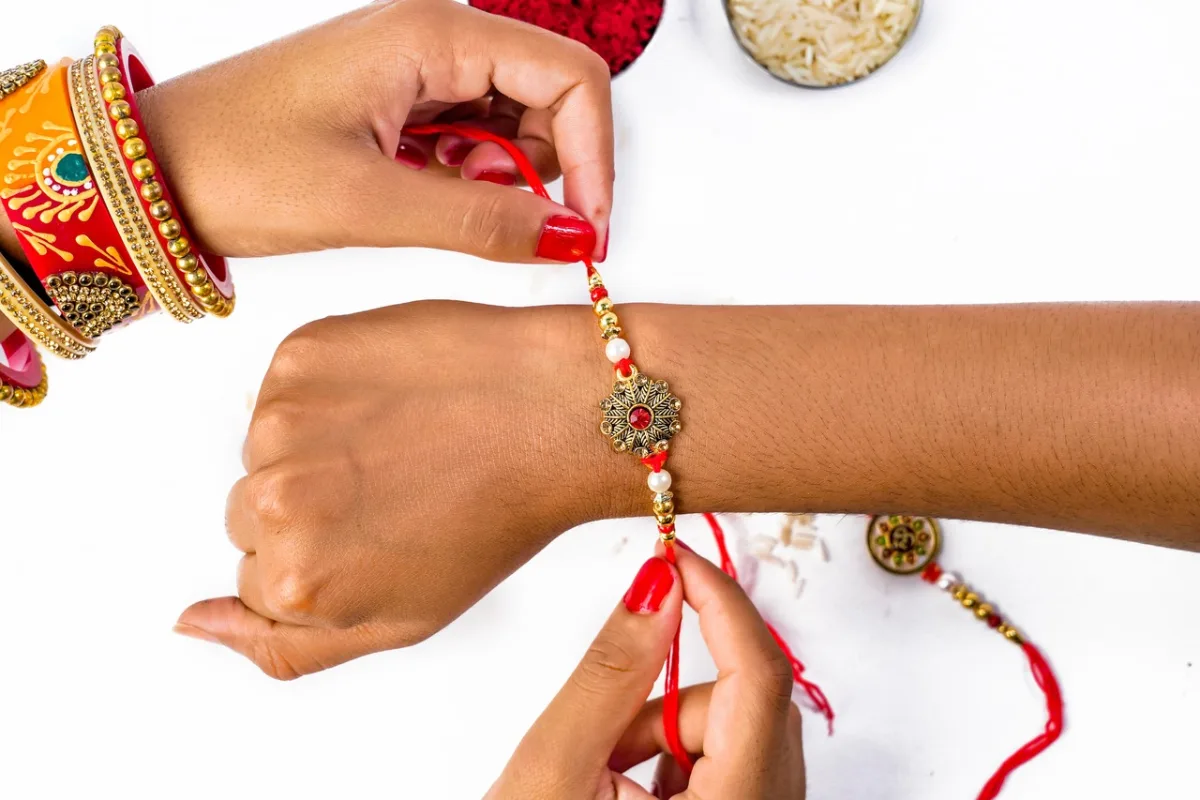
Raksha Bandhan falls on the full-moon day of the month of Shravana, usually in August. On that day a sister ties a rakhi, a protective thread or bracelet, on her brother’s wrist, and he promises to look after her. Nobody can give a firm start date for the festival. Writers describe the rakhi as growing out of an older Indian idea of a protective thread or amulet, and ancient texts mention protective threads used in ritual.
Several stories are told about the festival’s beginnings. Tradition holds, for example, that Indrani tied a protective thread on the wrist of Indra before he went to fight demons, a story linked to the Bhavishya Purana. These are accounts of belief rather than documented history, and families and regions tell different ones. Some popular tales have no supporting records at all, so we leave them aside here.
What we can follow is how the thread itself has changed. A rakhi can still be a plain thread, but it can also be an elaborate decorated bracelet, and today many are bright and set with beads or rhinestones. The practice has widened too: close friends who are not related sometimes tie rakhis on each other, treating one another as siblings in the ritual sense.
What is the story behind Rakhi?
Many mythological and historical tales are told about this festival. These are traditional stories, and historians do not all agree on them.
Krishna and Draupadi
One tale says that Lord Krishna hurt his finger, and Draupadi, wife of the Pandavas, was distressed to see him bleeding. She tore a piece of cloth from her saree and tied it around his finger. Krishna was moved by the gesture and promised to protect her, and the story of how he protected Draupadi is well known.
Rani Karnavati and Emperor Humayun
According to a popular account, when Chittor was under attack by Bahadur Shah of Gujarat in 1535, Rani Karnavati sent a rakhi to the Mughal Emperor Humayun, asking for his protection. Touched by the gesture, Humayun set out with his troops, but he arrived too late and the queen had already committed jauhar. The story symbolises protection and brotherhood, but contemporary sources do not mention it, and some historians doubt that it happened.
Santoshi Maa
A popular tale links the birth of the goddess Santoshi Maa to Raksha Bandhan. Ganesha’s sons, Shubha and Labha, wanted a sister and asked their father for one on Raksha Bandhan. After persuasion by the sage Narada, Ganesha created Santoshi Maa from divine flames that emerged from his consorts, Riddhi and Siddhi. This version of the story became widely known through the 1975 film Jai Santoshi Maa.
Yama and Yamuna
Another legend is about Yama, the god of death, and his sister Yamuna. Yamuna tied a rakhi on Yama’s wrist, and in return he granted her immortality. Touched by her love, Yama declared that any brother who has a rakhi tied by his sister and protects her will have a long life.
Alexander the Great and King Porus
A popular legend says that when Alexander the Great invaded India, his wife Roxana sent a sacred thread to King Porus, asking him not to harm her husband. In battle, when Porus was about to strike Alexander, he saw the rakhi on his wrist and held back. This is a modern popular story: researchers have not traced it to any ancient source.
Sisters often fast for their brothers’ long and happy life, and the festival is considered auspicious and holy. The sacred thread is a thin bundle of threads, but it carries a lot of meaning.
Stories
Tales told about Rakhi
- Krishna and Draupadi One tale says Draupadi tied a strip of her saree around Krishna’s bleeding finger, and he promised to protect her.
- Rani Karnavati and Humayun According to a popular account, she sent a rakhi in 1535 asking for help. Contemporary sources do not mention it, and some historians doubt it happened.
- Santoshi Maa A popular tale links the goddess’s birth to Raksha Bandhan; it became widely known through the 1975 film Jai Santoshi Maa.
- Yama and Yamuna Yamuna tied a rakhi on Yama’s wrist, and in return he granted her immortality.
- Alexander and Porus A modern popular story; researchers have not traced it to any ancient source.
How have Rakhi designs changed over time?
Rakhis have changed along with fashions and the materials people could get. Here is how the designs have shifted over time.
Traditional rakhis
- Simple threads: early rakhis were made of cotton, silk or plain red and yellow threads, symbolising purity and protection. They were more about sentiment than looks.
- Religious symbols: rakhis often carried symbols like the Swastika, Om or images of deities, stressing the spiritual meaning of the festival.
Beads, stones, zari and silk
- Beads and stones: over time rakhis added beads, semi-precious stones and small mirrors, which made them more decorative.
- Zari and silk: zari (gold and silver thread) and silk became popular, especially in royal families and among wealthier sections of society.
Regional and cultural influences
- Diversity in designs: different regions developed their own styles. Marwari rakhis of Rajasthan are known for elaborate designs, while Bengali rakhis may have fine handwoven patterns.
- Traditional crafts: Kundan work, Meenakari and embroidery, borrowed from jewellery and textiles, started to appear on rakhis.
Modern and contemporary designs
- Personalised rakhis: in recent decades rakhis with the siblings’ names, initials or even photos have become popular.
- Theme-based rakhis: with pop culture, rakhis began to feature cartoons, movies and favourite characters, especially for children. Superhero rakhis are a hit among young boys.
- Eco-friendly rakhis: responding to environmental concerns, rakhis made from biodegradable materials like paper, seeds or clay are a growing trend. Some can even be planted after use.
Designer, fusion and digital rakhis
- Designer rakhis: created by well-known jewellers or fashion designers, they may feature real gold, diamonds or other precious materials.
- Fusion styles: global influence has produced rakhis that blend traditional Indian craftsmanship with modern, minimalist design, appealing also to the diaspora.
- Virtual rakhis: they can be sent through apps or social media when physical presence is not possible.
- Smart rakhis: some tech-savvy versions include QR codes that show a message, a video or a digital greeting from the sister to her brother.
Design change
How rakhi designs changed
- Traditional Plain cotton, silk or red and yellow threads, sometimes with symbols like the Swastika, Om or deities.
- Beads, stones, zari, silk Rakhis added beads, semi-precious stones, small mirrors, zari and silk, especially among royal and wealthier families.
- Regional styles Marwari rakhis of Rajasthan are known for elaborate designs; Bengali ones may feature handwoven patterns. Kundan, Meenakari and embroidery came in.
- Modern Personalised rakhis with names or photos, theme-based ones with cartoons and superheroes, and eco-friendly ones from paper, seeds or clay.
- Designer, fusion, digital Designer pieces by jewellers, fusion styles, virtual rakhis sent via apps, and smart rakhis with QR codes.
Does the meaning of Rakhi stay the same?
Rakhi may have changed in its design, but the sacred bond between brother and sister remains what it has always been.
Frequently asked questions
What is Rakhi or Raksha Bandhan?
It is the festival of brothers and sisters, when a sister ties a thread on her brother’s wrist, and he gives her a gift and promises to protect her.
Where does the rakhi tradition come from?
No firm date is known. The rakhi seems to grow from the older Indian idea of a protective thread, which ancient ritual texts mention. Tradition holds several stories about the festival, such as Indrani tying a thread on Indra, but these are matters of belief, not documented history. Over time rakhis have gone from plain threads to decorated bracelets.
What is the story of Krishna and Draupadi?
Draupadi tore a piece of her saree and tied it on Krishna’s bleeding finger. Moved by this, Krishna promised to protect her.
How did rakhi designs change over time?
Rakhis moved from simple cotton and silk threads to beads, zari, regional crafts, personalised and eco-friendly designs, and finally designer, virtual and smart rakhis.
What are eco-friendly rakhis?
They are rakhis made from biodegradable materials like paper, seeds or clay, and some can be planted after use.
Sources and further reading
Raksha Bandhan, Encyclopaedia Britannica.
Explaining Rakshabandan, a Hindu festival that celebrates the brother-sister bond, The Conversation (scholar-written).
Raksha Bandhan (entry in The Illustrated Encyclopedia of Hinduism, J. G. Lochtefeld), Rosen Publishing (online copy of entry).
- Raksha Bandhan – Wikipedia (in English)
- Raksha Bandhan – Britannica (in English)
Related reading
- Puanchei – Mizo Shawl
- Block Printing, Batik and Resist Printing: India, Indonesia and Beyond
- Bandhani and Shibori: India’s and Japan’s Tie-Dye Traditions Compared
Image credit: “Raksha Bandhan wrist ritual” by GraphicGearsCom, via Pixabay, under the Pixabay Content Licence.