Pokharan Pottery: Desert Clay Craft of Rajasthan
In short: Pokhran pottery is a traditional craft of Pokhran, a town near Jaisalmer in Rajasthan’s Thar Desert. Potters shape a fine, pinkish clay by hand, sun-dry it and fire it in a kiln to make tough pots, vases, diyas and decorative pieces, often with geometric patterns. The craft has a GI tag and is supported by organisations that train artisans and find markets for their work.
Pokhran, a town in Rajasthan’s Thar Desert, is known for its old fort and its nuclear test site. It also has a pottery tradition that potters have passed down through generations.
The potters work with a pinkish, almost white clay, and the craft has also received a Geographical Indication (GI) tag.
At a glance
Pokhran pottery in brief
- Place Pokhran, a town in Jaisalmer district, Thar Desert, Rajasthan
- Clay Pinkish, almost white, beaten, ground and sieved fine
- Method Shaped by hand, sun-dried, fired in a kiln
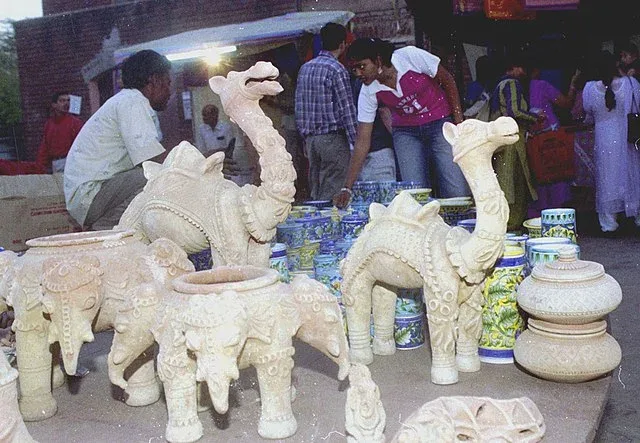
- Products Pots, vases, bowls, plates, surahis, jars, diyas and animal figurines
- Designs Geometric patterns, floral motifs and carved or incised decoration
- GI tag Yes, registered in 2018
How old is Pokhran pottery?
Pokhran (also spelled Pokaran) is a town in Jaisalmer district, in the Thar Desert of Rajasthan. Potters here have worked with a pale, pinkish clay for a very long time, but nobody can give a firm start date. The state tourism page calls the craft centuries old, and the GI application calls it ancient without naming a year, so “centuries” is the safest way to put it.
The GI application, filed by a local potters’ craft society, gives some detail in its own words. It says the clay comes from a patch called Rind, about 5 km from town, where rainwater collects. The clay is beaten, ground and sieved until it is fine, and it fires to a light pink, almost white colour. The application also says families first made everyday things such as water pots (matka) and small cups (kulhar), and later added decorative pieces like vases and figurines. These are the applicants’ own statements, so treat them as the craft’s own account rather than proven history.
Formal recognition is easier to date. The GI application was filed on 19 January 2015 and the craft was registered in 2018. In June 2020 the Khadi and Village Industries Commission handed 80 electric wheels to potter families in Pokhran, and a news report of the event said over 300 families there work in pottery.
Timeline
Recognition of Pokhran pottery
- 19 January 2015 The GI application was filed by a local potters’ craft society.
- 2018 The craft was registered with a Geographical Indication tag.
- June 2020 The Khadi and Village Industries Commission handed 80 electric wheels to potter families in Pokhran.
How is Pokhran pottery made?
Making Pokhran pottery is a labour-intensive process that starts with the careful selection and preparation of clay. Unlike the deep red clay used elsewhere, Pokhran potters use a pinkish, almost white clay, which is collected locally, beaten, ground and sieved to a fine texture.
- Shaping: The potter shapes the clay by hand, using a traditional wheel and simple tools to carve patterns and designs.
- Drying: The pieces are left to dry in the sun for several days.
- Firing: They are then fired in a kiln at high temperatures, which makes them strong and durable.
How it’s made
From pink clay to fired pot
- Prepare the clay Pinkish, almost white clay is collected locally, then beaten, ground and sieved to a fine texture.
- Shape by hand The potter shapes the clay by hand with a traditional wheel and simple tools, carving patterns and designs.
- Dry in the sun The pieces are left to dry in the sun for several days.
- Fire in a kiln They are fired in a kiln at high temperatures, which makes them strong and durable.
What are the designs and products of Pokhran pottery?
Pokhran pottery is recognised for designs and motifs inspired by the culture and traditions of Rajasthan. They often include geometric patterns, floral motifs and carved or incised decoration.
The range of products includes pots, vases, bowls, plates, surahis (pitchers), jars, and decorative items such as diyas (oil lamps) and animal figurines. Each piece reflects the skill, creativity and dedication of the potter.
Why does Pokhran pottery need support today?
Pokhran pottery now competes with mass-produced goods, and potters struggle to keep it economically viable. Organisations and NGOs are stepping up to promote the art form, provide training and support to artisans, and help build a market for their creations.
Visitors to Rajasthan can help preserve this art by buying genuine Pokhran pottery and spreading awareness of its cultural importance.
Pokaran pottery: GI registry record
| Fact | Detail | Source |
|---|---|---|
| GI name and state | Pokaran Pottery, Rajasthan | GI Registry, application 519 |
| GI application filed | 19 January 2015 | GI Registry |
| GI certificate date | 28 March 2018 | GI Registry |
| Registration term on the registry | Valid up to 18 January 2025; a renewal notice dated 26 November 2024 is listed and the status still reads “Registered” (read 21 November 2026) | GI Registry |
Registry details were read from the official record on 21 November 2026. Check the live record for the current renewal status.
Frequently asked questions
Where is Pokhran pottery made?
In Pokhran, a town in the Thar Desert of Rajasthan, near Jaisalmer.
How old is Pokhran pottery?
Nobody knows the exact date. Government sources describe it as a centuries-old craft of Pokhran in Jaisalmer, Rajasthan, but none gives a year. What is documented is more recent: the GI application was filed in January 2015 and the craft was registered in 2018.
What clay is used for Pokhran pottery?
A pinkish, almost white clay that is beaten, ground and sieved to a fine texture, unlike the deep red clay used in many other places.
How is Pokhran pottery made?
The clay is shaped by hand, dried in the sun for several days and then fired in a kiln at high temperatures.
What products are made in Pokhran pottery?
Pots, vases, bowls, plates, surahis, jars, diyas (oil lamps) and animal figurines.
Does Pokhran pottery have a GI tag?
Yes, Pokhran pottery has a Geographical Indication (GI) tag, which recognises it as a craft of the region.
Sources and further reading
Pokaran Pottery, GI Application No. 519, Geographical Indications Registry, India.
GI application text for Pokaran Pottery, Geographical Indications Registry (copy hosted on origin-gi.com).
Pokhran Pottery, Incredible India, Ministry of Tourism.
KVIC seeks to restore ancient glory of Pokhran potteries, KNN India (report on a KVIC event, 22 June 2020).
Related reading
Image credit: “Terracotta figurines from Pokhran, Rajasthan, on display at Basant Saras, Dilli Haat (2005)” by the President’s Secretariat, Government of India, published via the Press Information Bureau, via Wikimedia Commons, licensed under the Government Open Data License – India (GODL-India).