Hand-Painted or Printed? How to Tell an Original Indian Folk Painting from a Print
TL;DR: Genuine Indian folk paintings are built from brush, pigment and a prepared surface, so a magnifier usually shows ridges and wobbly lines, while a print shows a flat, regular dot pattern. Natural pigments, handmade paper or cloth, and GI registration are useful clues, but modern artists often use ready-made colours, and a signature can be copied, so none of them settles the question alone.
In this article
Five traditions, five sets of materials
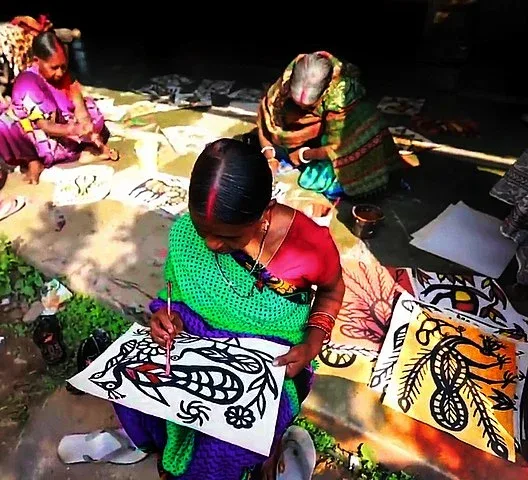
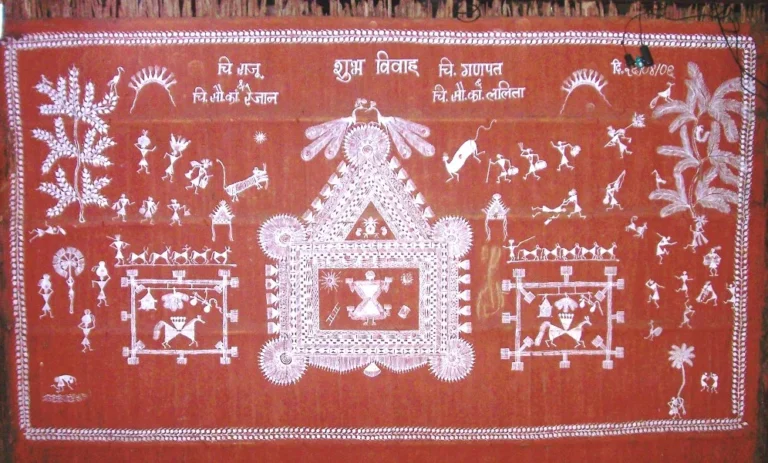
Warli paintings from Maharashtra are traditionally made with a paint of rice flour and water, with gum as a binder, applied with a bamboo stick whose end has been chewed into a brush. India’s National Crafts Museum records this, and Sahapedia, an open online archive of Indian culture, adds that the walls of the village huts are coated with clay and cow dung and finished in red clay, so the white lines stand out. That detail matters, because it shows how a real painting is built layer by layer, and why a flat printed copy cannot repeat it.
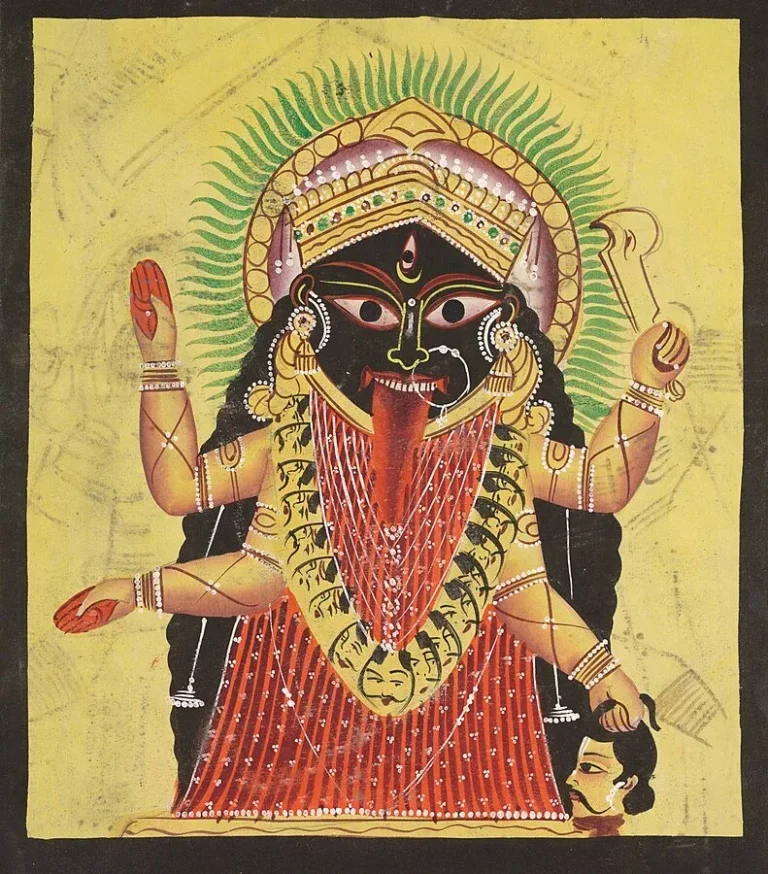
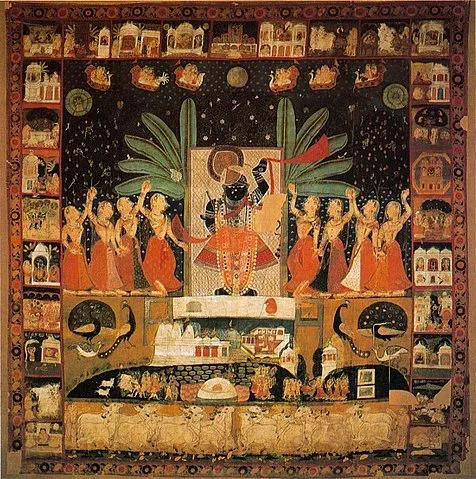
Madhubani, also called Mithila painting, comes from Bihar. It was first done on mud walls and floors and today is also made on handmade paper and cloth. Pattachitra, from Odisha, is painted on layered, prepared cloth. Kalighat painting, which grew in 19th-century Kolkata, was done on mill-made paper. Pichwai, from Nathdwara in Rajasthan, is a painted cloth hanging that serves as a backdrop for the deity Shrinathji, a form of Krishna.
Knowing the base material of each tradition is the first test, because a print on glossy poster paper or digital canvas will usually miss it.
Types
Five traditions, five bases
- Warli Maharashtra. Rice flour and water paint with gum, applied with a chewed bamboo stick, on clay and cow dung walls finished in red clay.
- Madhubani Bihar. First done on mud walls and floors, today also on handmade paper and cloth.
- Pattachitra Odisha. Painted on layered, prepared cloth.
- Kalighat Grew in 19th-century Kolkata. Done on mill-made paper.
- Pichwai Nathdwara, Rajasthan. A painted cloth hanging that serves as a backdrop for Shrinathji, a form of Krishna.
Brush marks, texture and the magnifier check
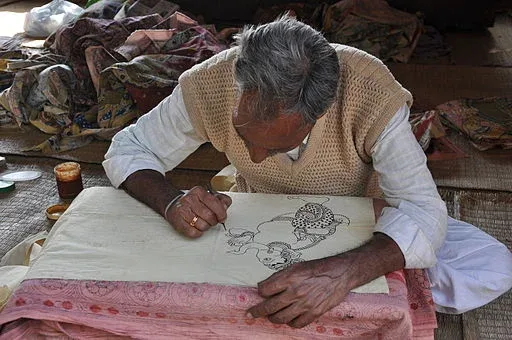
Hand-painted work is made of strokes. The Victoria and Albert Museum in London, which holds about 645 Kalighat works, describes bold outlines and bright colours, and MAP Academy says the colours were dabbed on with a big brush or a rag, with outlines drawn in squirrel or goat hair brushes and paint then added again at the edges for shading. In Pattachitra, a government-published article describes brushes of squirrel or buffalo hair tied to bamboo, and a final coat of lac, a natural resin, over the colours. In Pichwai, the government craft portal mentions burnishing stones that add texture and depth.
Now take a magnifier or a phone macro lens. A printed reproduction is often described as being made of a regular dot or pixel pattern, with no real brushwork, and the surface lacks the ridges that brush strokes leave. That is the advice of the auction house Skinner, which also warns that high-quality inkjet prints called giclées are harder to spot. On a hand-painted piece you would expect to see:
- Lines that waver slightly, start with more pigment and thin out at the end of a stroke.
- Pigment that sits on the surface, with small ridges, pooled edges or cracks, and where one colour overlaps another, a visible edge.
- Fine details, such as the outlines in a Madhubani figure or Warli bodies built from two triangles, that differ a little from one figure to the next.
- A back that shows the paint or, on cloth, a coloured stain through the weave, rather than a plain unprinted reverse.
One caution: print is not always modern or dishonest. The Victoria and Albert Museum lists hand-coloured lithographs among its Kalighat holdings, and says cheaper commercially produced images helped push the hand-painted pats into decline in the early 20th century. Old prints can be genuine historical objects in their own right; the question is whether a seller is describing them accurately.
Paper or cloth: the prepared surface
Many folk painters prepare their own surface, and the preparation leaves marks. For Madhubani, the newspaper Deccan Herald says artists today use handmade paper coated with cow dung, and also cloth; I found only this one source I could open, so treat it as indicative. For Pattachitra, an Odisha government magazine says several layers of old cotton cloth are pasted together with tamarind-seed gum, coated with a gum and chalk mix and polished with agate stones; an academic paper describes the same kind of preparation with stone powder. The craft portal says Pichwai cotton is stretched and coated with a white paste called kharia. MAP Academy says Kalighat paper was treated with a lime paste.
In practice, ask whether the surface feels right for the tradition. A Pattachitra on thin photo paper, or a Pichwai on a smooth synthetic canvas, deserves questions. A stiff, polished, slightly uneven cloth surface, a hand-made paper with deckled edges or visible fibres, or a rough lime-washed paper is consistent with real work, though not proof, because print-makers can also choose handmade paper.
Natural pigments, and why they prove less than you think
Traditional colours come from nature. For Madhubani, the Deccan Herald lists soot or charcoal for black, turmeric for yellow, indigo for blue and sandalwood for red. For Pattachitra, one scholarly article names lamp soot, powdered conch shell, and stone-based reds and blues bound with wood-apple gum. For Pichwai, the craft portal lists mineral pigments bound with gum arabic and mentions gold leaf. These pigments often have a matte, slightly granular look.
But natural pigment alone is not a verdict. The Deccan Herald notes that many Madhubani artists now use powdered synthetic colours, because natural ones take so long to make, and the Pattachitra paper says some folk artisans use ready-made market colours. A painting made with synthetic paint can be fully hand-painted and original. Only a conservator or a laboratory, using tools such as spectroscopy, can say what a pigment really is, so for a costly piece that is the proper route.
Signatures and GI tags
Signatures vary by tradition. Kalighat work was often a family affair, with different members completing different steps, according to MAP Academy, and many traditional works carried no artist name. Individual names became prominent in some traditions later: the Warli artist Jivya Soma Mashe, who began painting non-ritual scenes in the 1970s and won a National Award in 1976, is a well-known example. I found no authoritative rule that a genuine piece must be signed. A signature is easy to print or copy, so check whether it was painted in the same way, and with the same ink, as the rest of the work.
A Geographical Indication, or GI, is a legal tag that links goods to a place. India’s GI Registry lists Madhubani Paintings (Bihar, application 37), Warli Painting (application 239), Orissa Pattachitra (application 88), Bengal Patachitra (application 564) and Nathdwara Pichhwai Painting (application 748). The registry’s own compilation groups Madhubani with registrations of around 2007-08. I did not find Kalighat in the registry list I checked, so I cannot say it has a GI tag.
Remember what a GI does and does not do. It protects a name and a registered group of users; it does not guarantee that a specific print is not a copy. Many working artists may not be registered users, so a missing tag does not mean a painting is fake either.
A short routine, and when to ask an expert
- Look at the surface with a magnifier for brush ridges, not a regular dot pattern.
- Check that the base (paper, prepared cloth, lime-washed sheet) suits the tradition.
- Look for hand variation in lines and figures.
- Treat colour and signature as hints, not proof.
- Ask for the maker’s name, village or cooperative, and any GI authorised-user details.
For old or expensive works, a museum curator, conservator or an accredited laboratory is the real answer. Never scrape, wet or cut a painting to test it.
Quick check
A short routine
- Magnify Look at the surface with a magnifier for brush ridges, not a regular dot pattern.
- Check the base See that the paper, prepared cloth or lime-washed sheet suits the tradition.
- Look for variation Look for hand variation in lines and figures.
- Colour and signature Treat colour and signature as hints, not proof.
- Ask questions Ask for the maker’s name, village or cooperative, and any GI authorised-user details.
Related stories
- Venturing the Beauty of Warli Painting: A Cultural Heritage of Maharashtra
- Exploring the Enchanting World of Maithili Art and Madhubani Painting.
- Bengali Patachitra: The Vibrant World of Folk Art
- Kalighat Painting: The Vibrant Storytelling Art of Bengal
Frequently asked questions
How can a magnifier help tell a print from a painting?
Prints are commonly described as showing a regular dot or pixel pattern, while paintings show brush ridges and uneven pigment. High-quality inkjet prints can be hard to separate.
Does a synthetic paint mean the painting is fake?
No. Many working artists now use ready-made colours because natural ones take long to prepare. Only a lab can say what a pigment is.
Which of these art forms have GI tags?
India’s GI Registry lists Madhubani, Warli, Orissa Pattachitra, Bengal Patachitra and Nathdwara Pichhwai. I did not find Kalighat in the list I checked.
Is a signed painting always original?
No. Many traditional works were not signed, and a signature can be printed or copied. It is only one clue among several.
Are all Kalighat prints fake?
No. The Victoria and Albert Museum holds hand-coloured lithographs of the period as historical objects. What matters is whether a piece is described honestly.
Sources and further reading
- National Crafts Museum: Warli Painting
- Sahapedia: Warli Painting
- Deccan Herald: Madhubani, a natural beauty
- Orissa Review: Pattachitra, an Indigenous Technique (Government of Odisha)
- Dr Kiran Pradeep: article on Pattachitra (Anu Books)
- Victoria and Albert Museum: Kalighat painting
- MAP Academy: Kalighat painting
- Government of India handicrafts portal: Nathdwara Pichhwai painting
- Skinner auction house: How to recognize a photo reproduction
- Geographical Indications Registry, India: state-wise list of registered GIs
Image credit: Krishna with Dancing Gopis, Pichhavai from the Temple of Nathdwara, Staatliche Museen, Berlin. Public domain.