Real Bandhani or Printed? How to Spot Hand-Tied Tie-Dye
TL;DR: Every dot on genuine Bandhani, a tie-dye from Gujarat and Rajasthan, is a tiny knot tied by hand, so the cloth tends to be crinkled, slightly uneven and dyed through to the back. Printed imitations usually look flat and crisp. These are commonly given signs, not proof, and a registered GI tag such as Kutch Bandhani or an expert opinion is the stronger answer.
How a real Bandhani is made
Each dot on a Bandhani cloth is a knot. Bandhani, from a Sanskrit root meaning to tie, is a resist-dye method from Gujarat, Rajasthan and nearby regions. The Penn Museum explains that small sections of cloth are tied with waxed thread, so the dye cannot reach them, and that the knots are untied and retied for every new colour. The thread can be reused ten to fifteen times.
Colours go on from light to dark. The Jamnagari Bandhani application in the GI Registry describes the process step by step: the design is marked on the cloth, workers, mostly women, pluck up tiny points of fabric with their nails and bind them, and the cloth is dyed first in the lightest colour, retied, and dyed again in darker shades. The whole process is manual, and the same document says one sari can take from months to several years, which I treat as the applicant’s claim.
This process explains almost every sign below. The dots, the soft edges and the layered colours are all consequences of knots, thread and dye, not of a design printed on top.
How it’s made
How Bandhani is made
- Mark the design The design is marked on the cloth.
- Tie the points Workers, mostly women, pluck up tiny points of fabric with their nails and bind them with waxed thread.
- Dye light first The cloth is dyed first in the lightest colour.
- Retie and repeat The knots are untied and retied, and the cloth is dyed again in darker shades.
- Open the knots Untying the threads leaves dots, soft edges and layered colours.
The dots: raised, crinkled and irregular
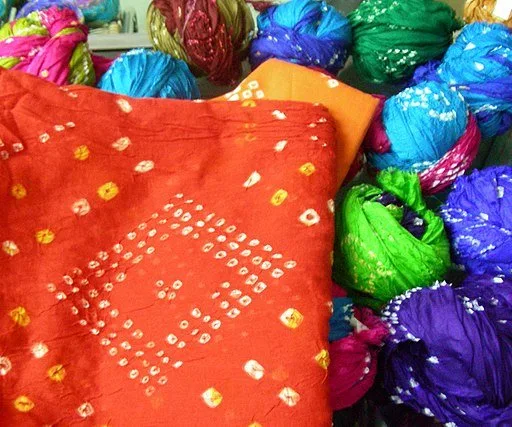
Because the cloth was bunched and bound before dyeing, a Bandhani piece is often described as textured. The Rhode Island School of Design Museum calls a Bandhani head scarf in its collection highly textured, light and vividly coloured. Run your fingertip across a dotted area: on hand-tied work the tied points often leave small puckers, ridges or crinkles that stay even after the thread is removed, and the Jamnagari GI document notes that knots are often left in place when the cloth is sold, which shows it is tie-dyed rather than printed.
- Spacing and size. Each dot is tied by hand, so size, shape and distance vary slightly. Perfectly identical dots in rigid rows point towards a machine or a repeating print block.
- Finer is harder. The GI document says finer, closer dots are regarded as better quality, so very small, dense dots take real skill.
- Dots as a pattern. On hand-tied cloth several dots are grouped into larger motifs, such as flowers, so their outlines can look a little wobbly.
The limit: a very skilled worker can tie neat, even dots, and a printed fabric can be embossed or finished to look crinkled. Texture and irregularity raise confidence; they do not prove origin.
Colour on the back, soft edges, smell and feel
Turn the cloth over. In resist dyeing the whole cloth sits in the dye bath, so the colour normally goes through, and the pattern should appear on the back almost as clearly as on the front. A surface print often looks paler or blank on the reverse. This follows from the method described by the museums and the GI document, but I did not find a source that tests it on printed fabrics, so treat it as a sensible check rather than a rule. Some prints are dyed through, so the back can mislead in both directions.
Look at the edges of the dots. Where dye creeps slightly towards a knot, the boundary between the tied spot and the coloured ground can look soft or slightly blurred, and where two dye baths overlap you may see a third, blended tone. A printed dot usually has a clean, sharp edge. Again, this is a commonly given sign: a careful dyer can get quite crisp edges.
Smell and feel are weaker clues. Cloth, dye chemicals and finishing all leave smells, and I found no reliable source that links smell to how a cloth was made, so I would not use it. Feel is better: the base is typically light, such as silk, georgette or fine cotton, and a stiff, heavily coated, plasticky hand deserves a second look.
Signs
Signs to check, and their limits
- Dots Size, shape and spacing vary slightly. Perfectly identical dots in rigid rows point towards a machine or a print block. A very skilled worker can still tie neat dots.
- Texture Tied points often leave small puckers, ridges or crinkles. Printed fabric can be embossed or finished to look crinkled.
- The back The colour normally goes through, so the pattern shows on the back almost as clearly. Treat it as a sensible check, not a rule, since some prints are dyed through.
- Edges Dot edges can look soft or blurred, with a blended tone where dye baths overlap. A careful dyer can get quite crisp edges.
- Smell and feel Smell is a weak clue and not worth using. A stiff, heavily coated, plasticky feel deserves a second look.
Leheriya: the waves
Leheriya, from the Sanskrit word for wave, is the stripe-based cousin of Bandhani from Rajasthan. Instead of tying single points, the whole cloth is rolled, usually diagonally, and bound at intervals, so the dye reaches only the exposed bands. The National University of Singapore’s museum, describing a Jaipur turban cloth, says a second rolling from the next corner creates a chequered grid, and MAP Academy adds that fugitive dyes, which wash out cleanly, and fine fabrics such as muslin or silk are used so the dye can penetrate the rolled layers.
Commonly given signs for leheriya are similar: stripes that are slightly uneven in width, soft colour boundaries, the pattern showing on both faces, and small rectangles where the diagonals cross. A printed leheriya look-alike tends to have even, repeating stripes with sharp edges. As with dots, none of this is proof, and an expert is the answer when it matters.
GI tags and the limits of every test
A Geographical Indication, or GI, is a legal tag for goods tied to a place. India’s GI Registry lists Kutch Bandhani as a registered GI from Gujarat, application number 756, covering handicrafts. The same registry also lists Jamnagari Bandhani, Gujarat, and Gharchola, a Gujarati wedding tie-dye. A November 2025 report from the Indian news agency IANS also names Bandhani among the GI-tagged crafts of Kutch.
A GI tag points to a place and to registered, authorised users; it does not by itself make every piece with the word on it genuine. If a seller claims GI status, ask for the authorised user details and the tag on the piece, and check the registry. For a valuable piece, a textile conservator or museum textile specialist can examine the knots, dye penetration and fibre far better than any home test.
Please do not wet, bleach, burn or cut a whole cloth to test it. If a lab is ever needed, it can work from a single loose thread.
Related stories
- Tie and Dye
- Geographical Indication (GI) tags
- Rogan Painting of Kutch: The Craft of Castor-Oil Paint on Cloth
- Mau Saree
Frequently asked questions
Do the dots on real Bandhani feel raised?
Often, yes. Tying leaves small puckers or ridges, but a printed fabric can be finished to imitate this, so texture is a hint rather than proof.
Should the pattern show on the back?
Normally it should, since the whole cloth is dyed. Some printed cloths are also dyed through, so it helps but does not settle the matter.
What is leheriya?
It is a Rajasthani resist-dye technique in which the cloth is rolled and tied, giving wave-like stripes or chequers, rather than single dots.
Does Kutch Bandhani have a GI tag?
Yes. The GI Registry lists Kutch Bandhani from Gujarat as a registered GI. The tag identifies place and authorised users, not every individual piece.
Can smell tell me whether Bandhani is real?
I found no reliable source saying it can. Dyes and finishes all leave smells, so it is not a dependable test.
Sources and further reading
- Penn Museum: Bandhani odhni from Gujarat (object 43-12-56)
- RISD Museum: Bandhani Odhani (Head Scarf)
- Jamnagari Bandhani GI application (GI Journal No. 83, 2016)
- Geographical Indications Registry, India: Kutch Bandhani record
- Geographical Indications Registry, India: state-wise list of registered GIs
- IANS: Over 10 treasures of Kutch and Saurashtra earn GI tag (27 November 2025)
- National University of Singapore Museum: Leheria turban cloth, Jaipur
- MAP Academy: Leheriya and Bandhani
Image credit: “Bandhani (2150279080)” by tommy, via Wikimedia Commons, under the Creative Commons Attribution-Share Alike 2.0 Generic licence.