The Starry Night by Vincent van Gogh
In short: “The Starry Night” is an oil painting by Vincent van Gogh from 1889, now at the Museum of Modern Art in New York. He painted it while staying at the Saint-Paul-de-Mausole asylum in southern France. Its swirling sky, bold brushstrokes and intense colour make it one of the most loved paintings in the world.
“I often think that the night is more alive and more richly colored than the day.” – Vincent van Gogh
Vincent van Gogh painted “The Starry Night” in June 1889, while he was a patient at an asylum in southern France. The oil on canvas now hangs at the Museum of Modern Art in New York City.
At a glance
The Starry Night in brief
- Artist Vincent van Gogh
- Painted June 1889
- Medium Oil on canvas
- Painted at Saint-Paul-de-Mausole asylum, near Saint-Rémy-de-Provence, southern France
- Now at Museum of Modern Art (MoMA), New York City, since 1941
- Shows A village among hills, a large cypress and a swirling sky of blue, yellow and white
When and where was The Starry Night painted?
The Starry Night was painted in June 1889. Van Gogh’s letters place its making in mid-June, roughly between the 16th and 18th. At the time he was living at the Saint-Paul-de-Mausole asylum near Saint-Rémy-de-Provence in southern France, where he had come in May 1889 after a mental breakdown.
While he was there, he was mostly limited to painting what he could see from the asylum or visit with a chaperone. The Starry Night is one of several night scenes he made during that stay. Accounts differ on how much of it came from direct observation and how much from memory and imagination, but the village in the picture is generally described as imagined rather than a portrait of a real place.
The painting has been at the Museum of Modern Art (MoMA) in New York since 1941, where it is credited to the Lillie P. Bliss Bequest. Sources describe the route slightly differently, as a purchase in one case and an exchange in another. The safest summary is that MoMA acquired it in 1941, and it has been one of the museum’s best-known works ever since.
Timeline
How The Starry Night came to MoMA
- May 1889 Van Gogh arrived at the Saint-Paul-de-Mausole asylum near Saint-Rémy-de-Provence after a mental breakdown.
- Mid-June 1889 His letters place the painting roughly between the 16th and 18th of June.
- 1941 MoMA acquired the painting, credited to the Lillie P. Bliss Bequest. Sources differ on whether it was a purchase or an exchange.
What does The Starry Night show?
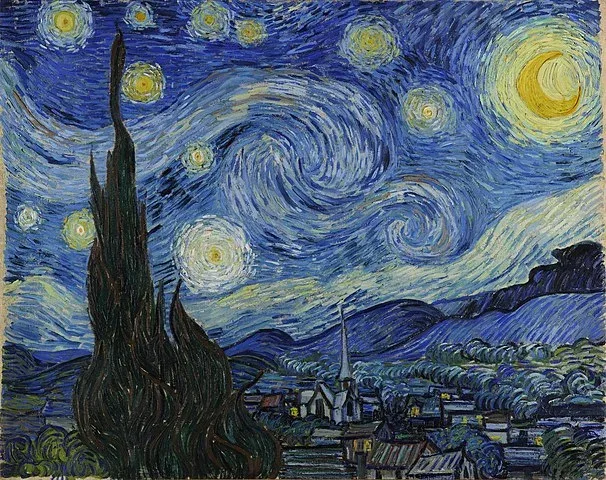
The painting depicts a small village surrounded by hills, with a large cypress tree dominating the foreground. The sky above is a swirling vortex of blue, yellow and white, with stars shining bright against the dark backdrop.
What you see
Inside the painting
- The sky A swirling vortex of blue, yellow and white, with bright stars against the dark backdrop.
- The village A small village surrounded by hills. It is generally described as imagined, not a real place.
- The cypress A large cypress tree dominates the foreground.
- The brushwork Thick, swirling strokes in the sky, and starker, more angular strokes for the trees and buildings.
What makes the style so special?
Van Gogh is known for his use of colour and his bold, expressive brushstrokes. In “The Starry Night” he uses thick, swirling strokes to create a sense of movement and dynamism in the sky, while the trees and buildings are rendered in starker, more angular strokes.
One common reading sees wonder in the swirling sky and bright stars, and something heavier in the dark land below.
Where and why was it painted?
Van Gogh struggled with mental illness for much of his life. “The Starry Night” was painted while he was a patient at the Saint-Paul-de-Mausole asylum in Saint-Rémy-de-Provence, in southern France, and it is often thought to reflect his own inner turmoil and sense of isolation.
He kept working through this difficult period, and The Starry Night is one of several night scenes from his stay.
Why is it still so admired today?
Today “The Starry Night” is often ranked among the greatest paintings ever made, largely for its swirling sky and strong blues and yellows. It is held in a public collection and is not for sale, so it is considered priceless.
Frequently asked questions
Who painted The Starry Night?
Vincent van Gogh painted it in 1889.
When and where was The Starry Night painted?
Van Gogh painted The Starry Night in June 1889 while staying at the Saint-Paul-de-Mausole asylum at Saint-Rémy-de-Provence in southern France. It has belonged to the Museum of Modern Art in New York since 1941. The village in it is generally described as imagined, not a view of a real place.
Where is The Starry Night kept?
It is housed at the Museum of Modern Art (MoMA) in New York City.
Where did van Gogh paint it?
He painted it while he was a patient at the Saint-Paul-de-Mausole asylum in southern France.
What is the painting made of?
It is an oil on canvas painting.
What does the painting show?
A small village surrounded by hills, a large cypress tree in the foreground and a swirling sky of blue, yellow and white with bright stars.
Sources and further reading
The Starry Night, Encyclopaedia Britannica.
Shedding light on The Starry Night, MoMA Inside/Out.
Vincent van Gogh, The Starry Night (MoMA course material), Museum of Modern Art.
- The Starry Night, Museum of Modern Art (in English)
- The Starry Night, Wikipedia (in English)
Related reading
- Krishna Art: The 16 Kalas and 13 Famous Artworks.
- Abstract Art: How Shapes, Colours and Emotions Work
- Raja Ravi Varma: The Master of Indian Art
Image credit: “The Starry Night” by Vincent van Gogh (1889), via Wikimedia Commons, public domain.