Pichwai Paintings
In short: Pichwai paintings are large, finely detailed temple hangings from Nathdwara in Rajasthan. They show the life and legends of Lord Krishna, especially as Shrinathji, and are painted on cloth or paper, often with gold and silver. Hand-made by skilled artists, they are now prized by collectors and museums.
Behind many images of Krishna in a shrine hangs a large painted cloth, and that cloth is a pichwai. These detailed hangings come from Nathdwara in Rajasthan and show Krishna’s life and stories, often as Shrinathji. This article explains where pichwai paintings come from, what the name means, how they are made and used today, and why they can be expensive.
Art historian and curator Dr. Alka Pande has described pichwai paintings as a celebration of Krishna and his many moods.
Pichwai is a traditional form of painting that comes from the town of Nathdwara in Rajasthan, India. It is still practised today by a small number of artists and artisans.
At a glance
Pichwai in brief
- Place Nathdwara, Rajasthan
- What it is A large painted cloth hung behind an image of Krishna in a shrine
- Subject The life and legends of Krishna, especially as Shrinathji
- Made on Cloth or paper, with dyes and pigments
- Highlights Gold and silver foil
- Meaning of the word Pichh means back, wai means hanging
Where do pichwai paintings come from?
A pichwai (also spelled pichhwai) is a large cloth hung behind an image of Krishna in a shrine. The Metropolitan Museum of Art describes such hangings as a backdrop to a Krishna icon and says they are most closely tied to the worship of Krishna as Shrinathji at Nathdwara in Rajasthan. Smarthistory adds that they combine block printing, painting and embroidery, often showing scenes from Krishna’s childhood.
The tradition is connected with Pushtimarg, a devotional path founded in India in the 15th century. According to belief, it began in 1493 when Krishna appeared to Vallabha in a dream and led him to a stone form on Govardhan hill, which is recognised as Shrinathji. Britannica gives a similar traditional account of the image’s later move to Nathdwara, without dates. These are accounts of faith, not records proved by historians.
For dated evidence, museum objects are the safest guide. The Harn Museum of Art lists a pichhwai of Shrinathji made in Nathdwara in the late 19th to early 20th century. The Met holds a 19th-century pichhwai fragment and a painting of Shri Nathji from Nathdwara of about 1840. The Smithsonian’s National Museum of Asian Art says the art and devotion of this tradition reach back centuries.
We have not found two reliable sources that fix when pichwai painting began, so we describe it as an old tradition, with surviving examples from at least the 19th century.
Timeline
Tradition and dated evidence
- 15th century Pushtimarg, the devotional path tied to this tradition, was founded in India.
- Tradition holds, 1493 Krishna is said to have appeared to Vallabha in a dream. This is an account of faith, not a proven record.
- 19th century The Met holds a pichhwai fragment from this century.
- c. 1840 The Met holds a painting of Shri Nathji from Nathdwara from about this date.
- Late 19th to early 20th century The Harn Museum lists a pichhwai of Shrinathji made in Nathdwara.
What does the word Pichwai mean?
The word comes from Sanskrit: pichh means back and wai means hanging. Together they describe a painted cloth that hangs behind the main deity in a Hindu temple.
What do Pichwai paintings depict?
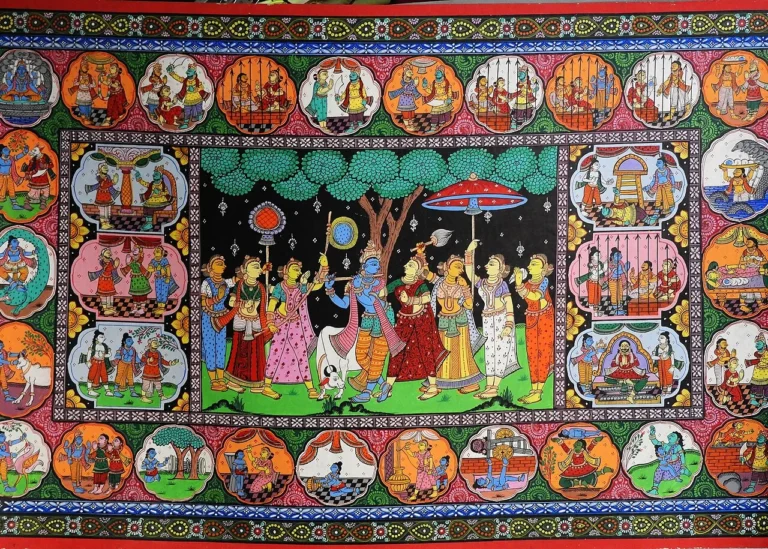
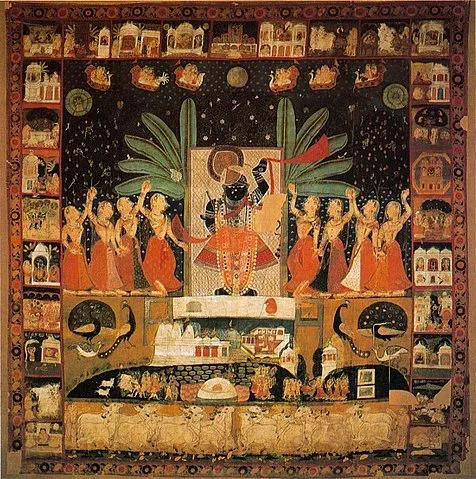
Pichwai paintings are typically large works that depict the life and legends of Lord Krishna, especially his childhood and early adult life. Common figures include:
- Lord Krishna: the central figure, shown in different poses and situations, such as playing the flute or dancing.
- Radha: Krishna’s divine consort, often shown beside him as a beautiful young woman in colourful clothes and jewellery.
- Gopis: the cowherd girls who are Krishna’s companions, often shown in groups, dancing and singing with him.
- Animals: cows, peacocks and elephants, which are associated with Krishna and the natural world.
- Other deities: figures from Hindu mythology, such as Shiva, Vishnu and Brahma, may also appear.
Who appears
Common figures in Pichwai
- Lord Krishna The central figure, shown in different poses, such as playing the flute or dancing.
- Radha Krishna’s divine consort, often a beautiful young woman in colourful clothes and jewellery.
- Gopis The cowherd girls who are Krishna’s companions, often shown in groups, dancing and singing.
- Animals Cows, peacocks and elephants, associated with Krishna and the natural world.
- Other deities Figures such as Shiva, Vishnu and Brahma may also appear.
How are Pichwai paintings made?
The paintings are made on cloth or paper with dyes and pigments. The detail is fine and the colours are bright, and the work takes skill and patience. Gold and silver foil is used to highlight parts of the painting and add depth and texture.
Many of the artists come from families with a long tradition of Pichwai painting and have been trained in the art form from a young age.
What are Pichwai paintings used for today?
Pichwai paintings were originally made to decorate the temples of Nathdwara. Today they are also appreciated as works of art and can be found in galleries and museums around the world.
Contemporary artists also bring Pichwai techniques and motifs into their own work, often in new ways. Collectors outside India buy them too.
Why can Pichwai paintings be expensive?
Traditional Pichwai art is created by hand using natural materials, so it may be relatively expensive compared with mass-produced artwork. When buying, look for hand-painted work from reliable sellers.
Frequently asked questions
Where does Pichwai art come from?
It comes from the town of Nathdwara in Rajasthan, India.
Where do pichwai paintings come from?
Pichwais are cloth hangings placed behind images of Krishna, most closely tied to the worship of Shrinathji at Nathdwara in Rajasthan. Belief traces the tradition to 1493, but that is faith, not proven history. Dated museum examples go back to the 19th century; an exact start date is unknown.
What does Pichwai mean?
From the Sanskrit pichh (back) and wai (hanging): a painting hung behind the main deity in a temple.
What do Pichwai paintings show?
Mainly the life and legends of Lord Krishna, with Radha, gopis, animals such as cows and peacocks, and sometimes other deities.
What materials are used?
Cloth or paper, with dyes and pigments, and gold and silver foil to highlight details.
Where can Pichwai paintings be seen today?
In temples, and in art galleries and museums around the world.
Sources and further reading
Shrine Hanging (Pichhwai) Fragment, The Metropolitan Museum of Art.
Krishna in the Form of Shri Nathji, The Metropolitan Museum of Art.
Pichhwai of Krishna in the Form of Shrinathji, Harn Museum of Art.
From India to America: Pushtimarg as a Global Religion, National Museum of Asian Art, Smithsonian.
- Pichhwai – Wikipedia (in English)
Related reading
- Rich Heritage of Pichvai Paintings: A Journey Through Color, Devotion, and Tradition
- Indian Art Auctions: Why Bid Values Keep Rising
- What Makes A Painting Expensive?
Image credit: Krishna with Dancing Gopis, Pichhavai from the Temple of Nathdwara, Staatliche Museen, Berlin. Public domain.