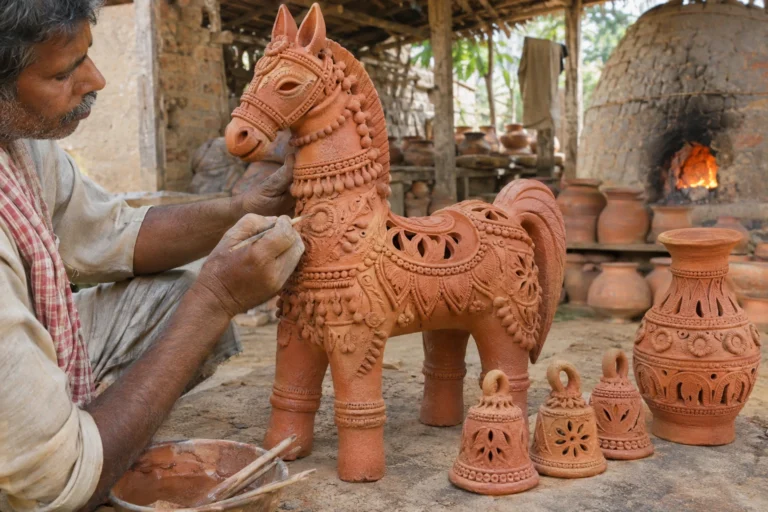

Toys of India
In short: India’s best-known traditional toys come from craft clusters such as Channapatna (Karnataka), Kondapalli and Etikoppaka (Andhra Pradesh), Kinhal (Karnataka), Varanasi (Uttar Pradesh) and Thanjavur (Tamil Nadu). Most are made of local soft wood or terracotta and finished with lac or natural dyes, and several are protected by a Geographical Indication (GI) tag.
Small carts and bird-shaped whistles have been excavated from sites of the Indus Valley Civilisation, so handmade playthings have a very long history in the subcontinent.
This article looks at some of the best-known toy-making clusters of India. It includes only toys and facts that could be checked against reliable sources, so it is not a complete list. India is far too diverse for any single list to cover every doll, top and puppet.
How old are toys in India?
Toys in India go back a very long way. Excavations at Indus Valley sites such as Harappa and Nausharo have turned up small objects that look like children’s playthings. The Government of India’s handicrafts portal places terracotta figurines, whistles and carts around 2500 BCE.
The Harappa Archaeological Research Project describes a terracotta toy cart from about 2300 to 2200 BC, with its two wheels found next to the frame. Holes along the sides suggest wooden bars once held it together, and wood rarely survives. The same project shows hollow terracotta birds with a small hole that turns them into whistles, and notes that similar whistles can still be found in South Asia today. It also describes cattle-head figurines pierced so they could be attached to a body and moved with a cord.
Archaeologists are careful here. Objects that look like toys may have had other uses, and the sources say only that some figurines may reasonably be read as toys. Beyond the Indus period our sources do not give a firm timeline, so it is best to say that making toys from local materials such as clay, wood and cloth is a long tradition that varies from region to region. Pichkaris, the hand-held water sprayers used at Holi, are made from materials like bamboo, metal or plastic, but we found no reliable source for when they began.
What are the most famous traditional toys of India?
These craft toys are among the most widely recognised:
- Channapatna toys (Karnataka): lacquered wooden toys and dolls from Channapatna in Ramanagara district, traditionally coloured with vegetable dyes.
- Kondapalli toys (Andhra Pradesh): carved wooden figures from Kondapalli near Vijayawada, best known for the Dasavataram set showing the ten avatars of Vishnu.
- Etikoppaka toys (Andhra Pradesh): turned and lacquered wooden toys from a village on the Varaha river, coloured with natural dyes.
- Kinhal toys (Karnataka): hand-painted wooden toys and figures from Kinhal village in Koppal district, made by the Chitragar community.
- Varanasi wooden toys (Uttar Pradesh): lathe-turned wooden toys finished with lac.
- Thanjavur dolls (Tamil Nadu): the thalaiyatti bommai, a roly-poly terracotta doll that rocks back and forth because its weight sits at the bottom.
- Kathputli (Rajasthan): the string marionette puppet art of Rajasthan. Puppets are not toys in the strict sense, but they belong to the same tradition of handmade play and storytelling objects.
Craft clusters
Famous toy-making places
- Channapatna, Karnataka Lacquered wooden toys and dolls, traditionally coloured with vegetable dyes.
- Kondapalli, Andhra Pradesh Carved wooden figures, best known for the Dasavataram set showing the ten avatars of Vishnu.
- Etikoppaka, Andhra Pradesh Turned and lacquered wooden toys coloured with natural dyes.
- Kinhal, Karnataka Hand-painted wooden toys and figures, made by the Chitragar community.
- Varanasi, Uttar Pradesh Lathe-turned wooden toys finished with lac.
- Thanjavur, Tamil Nadu The thalaiyatti bommai, a roly-poly terracotta doll that rocks because its weight sits at the bottom.
Which toys have a GI tag?
A Geographical Indication tag recognises that a product comes from a specific place and carries that place’s traditional skills. According to the list of GIs in India, these toy crafts are registered:
- Channapatna Toys and Dolls, Karnataka (2004-05)
- Kondapalli Toys, Andhra Pradesh (2007-08)
- Thanjavur Doll, Tamil Nadu (2008-09)
- Kinhal Toys, Karnataka (2011-12)
- Varanasi Wooden Lacquerware and Toys, Uttar Pradesh (2014-15)
- Etikoppaka Toys, Andhra Pradesh (2017-18)
Which clusters are known for lacquered wooden toys?
Channapatna. Wrightia tinctoria wood (locally aale mara, also called ivory-wood) has been the main material for nearly two centuries, though other woods are now also used. Tipu Sultan’s patronage is credited with giving the craft greater prominence, but the toys existed earlier.
Etikoppaka. Artisans use the soft wood of the Ankudu tree (Wrightia tinctoria) and apply lac colours made from seeds, lac, roots and leaves.
Varanasi. Lac is applied on a spinning lathe: a lac stick pressed against the turning toy softens with friction and bonds to the surface. Craftsmen traditionally used Keria wood, but after a ban on cutting those trees they switched mainly to eucalyptus. Their ancestors were ivory carvers who moved to woodwork when ivory was banned.
Kondapalli. The toys are carved from a soft wood called Tella Poniki found in the Kondapalli hills. Parts are carved separately and joined with makku, a paste of tamarind seed powder and sawdust. The craft is described as a tradition of about 400 years, and the figures were traditionally displayed at home during Sankranti and Navratri in the Bommala Koluvu arrangement.
Kinhal. The craft is said to be at least 500 years old and to have grown under the patronage of the Vijayanagara Empire. Toys are made of soft and hard local woods, hand-painted in bright colours and coated with varnish.
What are traditional toys made of?
The materials follow what is available locally. In the clusters above, they are:
- Soft woods: Wrightia tinctoria in Channapatna and Etikoppaka, Tella Poniki in Kondapalli, and several local woods in Kinhal.
- Terracotta: used for Thanjavur dolls.
- Lac and natural dyes: used for colour and a glossy finish in the lacquered toys, with vegetable dyes in Channapatna.
- Natural binders: for example, the tamarind seed paste used to join Kondapalli figures.
Why are traditional toys making a comeback?
Government schemes in recent years have put the spotlight on India’s toy clusters.
Toycathon 2021, run jointly by several Government of India ministries, was launched on 5 January 2021 to crowdsource toy and game ideas. According to the Press Information Bureau, about 1.2 lakh people registered and more than 17,000 ideas were submitted. The same release quoted the Union Minister as saying that 85 per cent of the toys children play with in India are imported and mostly plastic. A virtual India Toy Fair held from 27 February to 4 March 2021 brought together exhibitors from 26 toy clusters.
Key facts
Toycathon 2021 in numbers
- About 1.2 lakh People registered for Toycathon 2021, per the PIB
- 17,000+ Toy and game ideas submitted
- 26 clusters Exhibitors at the virtual India Toy Fair, 27 Feb to 4 Mar 2021
- 85 per cent Toys in India that are imported, per the Union Minister
Frequently asked questions
What are the most famous traditional toys of India?
Channapatna, Kondapalli, Etikoppaka, Kinhal and Varanasi wooden toys, and the Thanjavur roly-poly doll, are among the best known.
How old are toys in India?
The earliest well-documented toys come from the Indus Valley, around 2500 BCE, including terracotta carts, whistles and figurines. A terracotta toy cart from Harappa is dated to about 2300 to 2200 BC. Experts note that some of these objects may have had other uses. Later periods are less firmly dated.
What is the Thanjavur doll?
The Thanjavur doll, or thalaiyatti bommai, is a terracotta roly-poly doll from Tamil Nadu. Its weight is concentrated at the bottom, so it rocks back and forth in a slow, dance-like motion.
Which Indian toys have a GI tag?
Channapatna, Kondapalli, Thanjavur dolls, Kinhal, Varanasi wooden lacquerware and toys, and Etikoppaka toys are all registered as Geographical Indications.
Are Channapatna toys safe for children?
Channapatna toys are traditionally coloured with vegetable dyes, which is why they are regarded as child-safe. If you are buying for a very young child, check with the seller how a particular toy was finished.
How are Varanasi wooden toys finished?
They are shaped on a lathe, and lac is applied by pressing a lac stick against the spinning toy. Friction heat softens the lac so that it bonds to the surface, after which the toy is painted and lacquered.
Sources and further reading
Terracotta Toys, Development Commissioner (Handicrafts), Government of India.
Toys in the Indus Valley, Harappa Archaeological Research Project (harappa.com).
Mohenjo-daro, Encyclopaedia Britannica.
- List of geographical indications in India (Wikipedia, in English)
- Toycathon 2021 and India Toy Fair, Press Information Bureau (in English)
- Kinhal toys, Incredible India (in English)
- Cluster details: Wikipedia articles on Channapatna toys, Kondapalli toys, Etikoppaka, Wooden Toys of Varanasi and Thanjavur doll
Related reading
- Kathputli: A Traditional Indian Puppetry Art Form
- Block Printing, Batik and Resist Printing: India, Indonesia and Beyond
- Lost-Wax Casting Around the World: Dhokra, Chola, Benin and Greek Bronzes
Image credit: “Wooden toys of women at Odisha Crafts Museum, Bhubaneswar, Odisha, India” by Subhashish Panigrahi, via Wikimedia Commons, licensed under CC BY-SA 4.0.