Maithili Art and Madhubani Painting: Themes, Style and History
In short: Madhubani painting is the best-known form of Maithili art from the Mithila region of Bihar. It is known for vivid colours, dense patterns and bold lines, and it tells stories of gods, nature, weddings and everyday life. Today artists also paint it on paper, apparel and home decor.
In this article
- How did Madhubani painting become known beyond Mithila?
- What is Maithili art?
- What is Madhubani painting?
- What themes and motifs appear in Madhubani paintings?
- How is Madhubani art being preserved and reinvented?
- Why do Maithili art and Madhubani painting matter?
- Frequently asked questions
- Sources and further reading
Madhubani painting comes from the Mithila region of northern Bihar, where women have long painted the inside walls of village homes. It is the best-known form of Maithili art, the wider artistic tradition of the region, and it is recognised by its bold lines, vivid colours and stories of gods, nature and daily life.
At a glance
Madhubani painting in brief
- Region Mithila, northern Bihar
- Also called Mithila or Maithil painting
- Traditionally made by Women, on the inside walls of village homes
- Look Vivid colours, dense detail, bold lines and geometric patterns
- Themes Gods, epics, nature, weddings, festivals and daily life
- Maithili art The wider tradition, with Madhubani as its most famous painted form
How did Madhubani painting become known beyond Mithila?
Madhubani painting, also called Mithila or Maithil painting, comes from the Mithila region of northern Bihar. For generations, women painted the inside walls of village homes with gods and goddesses, and with symbols linked to weddings and seasonal rituals, passing the skill down within families. Nobody knows exactly how old the tradition is, and no firm starting date has been established. Local belief links it to the wedding of Sita, but that is tradition, not documented history.
The wider world heard about it fairly recently. After a major earthquake struck the region in 1934, damaged houses exposed painted interior walls to a British official, William G. Archer, who was working in Madhubani district. He photographed many of them in the 1930s, and his 1949 article in the journal Marg was the first published account of the art.
The next big change came in the 1960s, when the paintings began to be made on paper so they could be sold. Accounts say this effort was encouraged by the All India Handicrafts Board during a drought, to give village families an income. Since then, artists such as Ganga Devi and Sita Devi have won national and international recognition, and Madhubani has become one of India’s best-known folk painting styles.
Timeline
How Madhubani became known
- Age unknown Nobody knows how old the tradition is. Local belief links it to the wedding of Sita, but that is tradition, not documented history.
- 1934 A major earthquake damages houses and exposes painted interior walls to British official William G. Archer.
- 1930s Archer photographs many of the walls.
- 1949 His article in the journal Marg becomes the first published account of the art.
- 1960s Paintings begin to be made on paper to be sold; accounts say the All India Handicrafts Board encouraged this during a drought.
What is Maithili art?
Maithili art is the wider artistic tradition of the Mithila region. Its roots are old, and art there was a way to communicate stories, beliefs and celebrations.
The tradition covers many forms, from wall paintings to music, dance, literature and sculpture.
What is Madhubani painting?
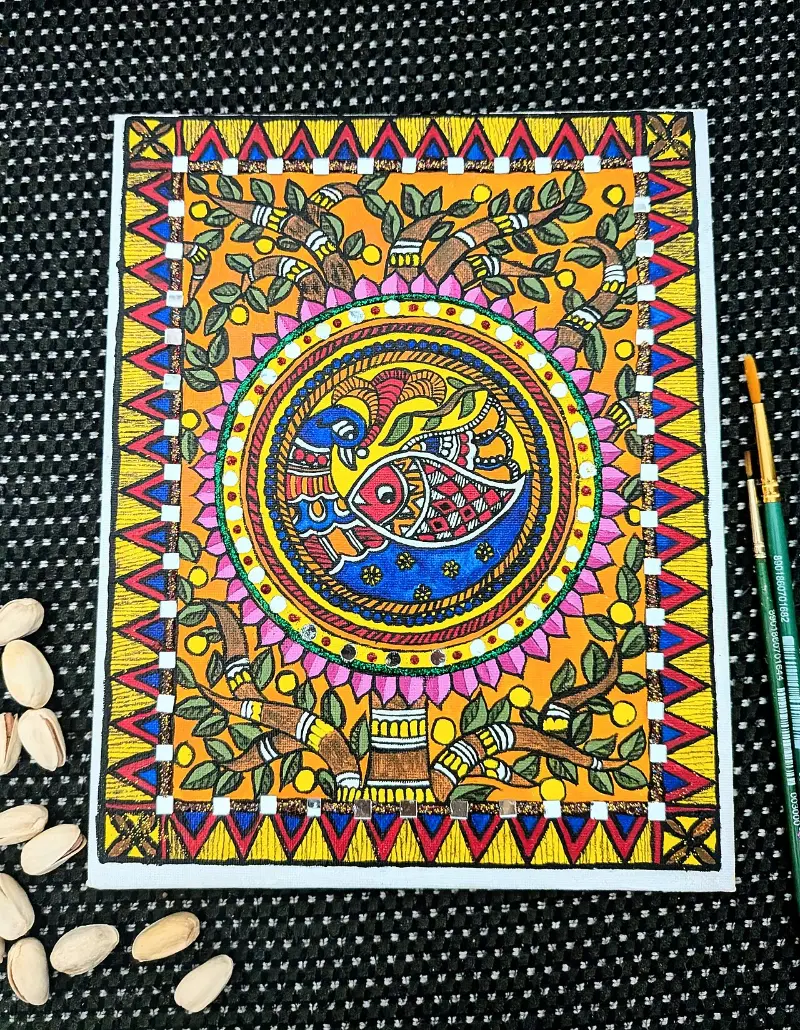
Madhubani painting is the best-known form of Maithili art and has admirers well outside India. It uses vivid colours, dense patterning and a wide range of subjects, and it tells stories of gods and goddesses, nature and human life.
Its bold outlines and geometric patterns take a steady, practised hand.
What themes and motifs appear in Madhubani paintings?
The subjects fall into three broad groups.
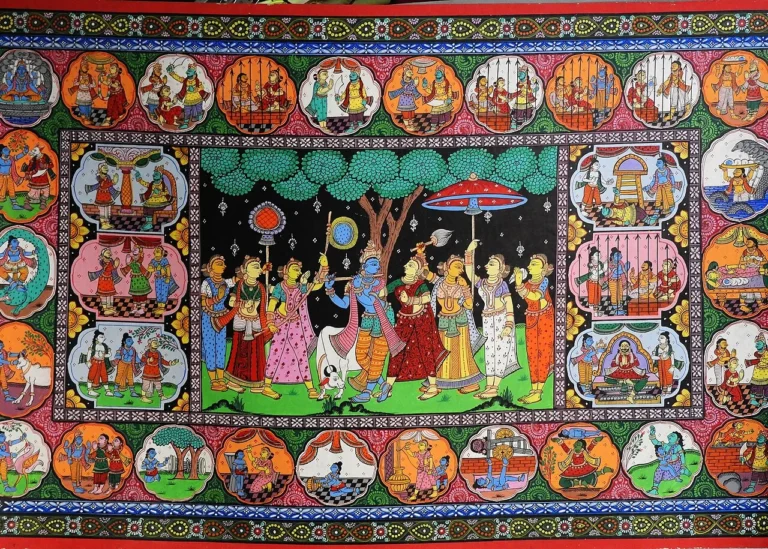
- Gods and epics: Hindu deities such as Krishna and Rama, and scenes from the Ramayana and Mahabharata.
- Nature: Animals, birds and plants woven into the design.
- Life and celebrations: Marriage ceremonies, festivals and scenes from daily life, which make each painting a story in itself.
Themes
What Madhubani paintings show
- Gods and epics Hindu deities such as Krishna and Rama, and scenes from the Ramayana and Mahabharata.
- Nature Animals, birds and plants woven into the design.
- Life and celebrations Marriage ceremonies, festivals and scenes from daily life, which make each painting a story in itself.
How is Madhubani art being preserved and reinvented?
Contemporary artists still work in the Madhubani style, adding modern touches while keeping its traditional look. Workshops, exhibitions and art platforms help younger painters learn from older ones.
Madhubani painting has also moved beyond canvas. It now appears on apparel, home decor and even public spaces.
Why do Maithili art and Madhubani painting matter?
Madhubani paintings record the gods, festivals, weddings and daily life of Mithila, and the skill has been passed down within families for generations. Since the 1960s, when paintings on paper began to be sold, it has also given village families an income.
Frequently asked questions
How did Madhubani painting become known beyond Mithila?
Madhubani painting began as wall art made by women in Mithila, Bihar, and its exact age is unknown. A 1934 earthquake exposed painted walls to British official W. G. Archer, who photographed them and wrote about them in 1949. From the 1960s, paintings on paper were made for sale, which carried the art to wider audiences.
What is the difference between Maithili art and Madhubani painting?
Maithili art is the wider cultural tradition of the Mithila region, covering wall painting, music, dance, literature and sculpture. Madhubani painting is its most famous painted genre.
What are the main features of Madhubani painting?
Vivid colours, dense detail, bold lines and geometric patterns, with a wide range of themes.
What subjects do Madhubani paintings show?
Hindu deities such as Krishna and Rama, scenes from the Ramayana and Mahabharata, animals, birds, nature, marriage ceremonies, festivals and daily life.
How is Madhubani painting kept alive today?
Contemporary artists add modern touches to the traditional style, and workshops, exhibitions and art platforms connect generations. The style now also appears on apparel, home decor and public spaces.
Sources and further reading
Madhubani painting (Mithila painting) collection record, Victoria and Albert Museum.
Mithila painting (collection notes), Sainsbury Centre, University of East Anglia.
Madhubani Painting: A Historical Context, Folkartopedia (supporting only).
- Madhubani art, Wikipedia (in English)
Related reading
- Unsung Art of India: 9 Folk and Tribal Painting Styles
- Warli Painting: Tribal Wall Art of Maharashtra
- Madhubani and Its Cousins: Folk Painting Traditions Around the World
Image credit: “Madhubani painting by Bhuvana Meenakshi” by Bhuvana Meenakshi, via Wikimedia Commons, licensed under CC BY-SA 3.0.