How AI is redefining art
In short: Artificial intelligence is changing art by giving artists new tools such as GANs and neural style transfer, making creation more accessible, helping preserve and restore artworks, and opening up new forms of collaboration between artists and technologists. In this view, AI is a creative partner that empowers artists rather than replacing them.
In this article
- How did computers and AI become part of art?
- How is AI helping artists create?
- Does AI make art accessible to everyone?
- How does AI help preserve artistic heritage?
- How is AI blurring the line between art and technology?
- What new forms of expression does AI open up?
- What is the future of AI and art?
- Frequently asked questions
- Sources and further reading
Artificial intelligence (AI) is already used in fields from healthcare to financial forecasting, and it is now changing how art is made. This article looks at what that means for a field usually seen as a matter of human emotion and intuition.
How did computers and AI become part of art?
Using machines to make art is older than today’s image generators. In February 1965, Georg Nees showed computer-made graphics at a university gallery in Stuttgart, Germany, and the V&A describes him as one of the first people to exhibit computer graphics. In November that year he and Frieder Nake held another Stuttgart show. Early works like these were produced by writing rules for a drawing machine.
In the late 1960s the painter Harold Cohen began using computers too, and built a drawing program that he named AARON in the early 1970s. The Whitney Museum, which has exhibited his work, calls it the earliest AI program for artmaking. Cohen also built machines that followed AARON’s instructions to draw and paint.
The tools people mean by “AI art” today grew from research in the 2010s. Generative adversarial networks (GANs) were introduced in June 2014. In 2015, researchers described a neural method for combining the content of one image with the style of another. In January 2021 OpenAI announced DALL·E, a model that creates images from written descriptions, and a December 2021 paper described latent diffusion models for high-resolution image generation. People still discuss what these tools mean for artists, and the story is still unfolding.
Timeline
From drawing machines to image models
- February 1965 Georg Nees showed computer-made graphics at a university gallery in Stuttgart, Germany.
- Late 1960s Painter Harold Cohen began using computers, later naming his drawing program AARON in the early 1970s.
- June 2014 Generative adversarial networks (GANs) were introduced.
- 2015 Researchers described a neural method for combining the content of one image with the style of another.
- January 2021 OpenAI announced DALL·E, a model that creates images from written descriptions.
- December 2021 A paper described latent diffusion models for high-resolution image generation.
How is AI helping artists create?
Tools such as generative adversarial networks (GANs) and neural style transfer let an artist work with a machine to produce realistic images, music or even text. Artists use them to try styles they would not reach by conventional means.
Does AI make art accessible to everyone?
AI also lowers the cost of starting out. AI-powered software and platforms mean aspiring artists no longer need expensive equipment or formal training to make work. Painting apps and virtual reality art tools let people from many backgrounds try it for themselves.
How does AI help preserve artistic heritage?
AI can also help preserve art. Image recognition and natural language processing can analyse large collections of artworks, historical documents and manuscripts, which supports their digitisation and preservation. Restoration algorithms can also help repair deteriorating artworks.
How is AI blurring the line between art and technology?
Artists and technologists are working together more often. Interactive installations combine traditional art forms with new technology, and joint projects between artists and AI researchers raise questions about who the author of a work is and what counts as creativity.
What new forms of expression does AI open up?
Artists are also using AI to write poems and compose algorithmic music. Some treat it as a creative partner, using it to try ideas and styles that change what people expect art to look like.
What is the future of AI and art?
AI is changing how people make and experience art. The view in this article is that AI is not here to replace artists but to give them new tools. As the technology develops, the line between work made by people and work made by machines may become harder to draw.
What AI does
Ways AI is changing art
- New tools GANs and neural style transfer let artists explore new territory and try unconventional styles.
- Wider access AI software and platforms mean aspiring artists no longer need expensive equipment or formal training.
- Preservation Image recognition and language processing can analyse large collections, and restoration algorithms can help repair deteriorating works.
- Collaboration Artists, technologists and AI researchers work together, challenging conventional ideas of authorship.
- New expression From AI-generated poems to algorithmic music compositions.
Frequently asked questions
How is AI changing art?
AI gives artists new tools, makes creation more accessible, helps preserve and restore artworks, and opens up new kinds of collaboration with technologists.
How did AI art begin?
Artists have used computers since the 1960s. Georg Nees exhibited computer-made graphics in Stuttgart in February 1965, and Harold Cohen began building his AARON drawing program in the late 1960s. Modern AI image tools grew from 2010s research, including GANs in 2014 and text-to-image models such as DALL·E in 2021.
What are GANs?
Generative adversarial networks (GANs) are AI tools that can produce realistic images, music or text, and artists use them to experiment with new styles.
Can anyone create art with AI?
AI-powered software and apps make art creation accessible, so aspiring artists do not necessarily need expensive equipment or formal training.
How does AI help preserve art?
Image recognition and natural language processing can analyse large collections of artworks and documents, and AI-driven restoration algorithms can help restore deteriorating works.
Will AI replace artists?
The article argues that AI is not here to replace artists but to empower them as a creative partner.
Sources and further reading
Georg Nees (artist page), Digital Art Museum (DAM).
Werkstatt Edition Kroll print, Georg Nees, Victoria and Albert Museum.
Harold Cohen: AARON, Whitney Museum of American Art.
Generative Adversarial Networks (arXiv:1406.2661), arXiv / Goodfellow et al..
DALL·E: Creating images from text, OpenAI.
- Generative adversarial network – Wikipedia (in English)
- Neural style transfer – Wikipedia (in English)
Related reading
- Abstract Art: How Shapes, Colours and Emotions Work
- Home decor ideas for your new beginnings
- Raja Ravi Varma: The Master of Indian Art
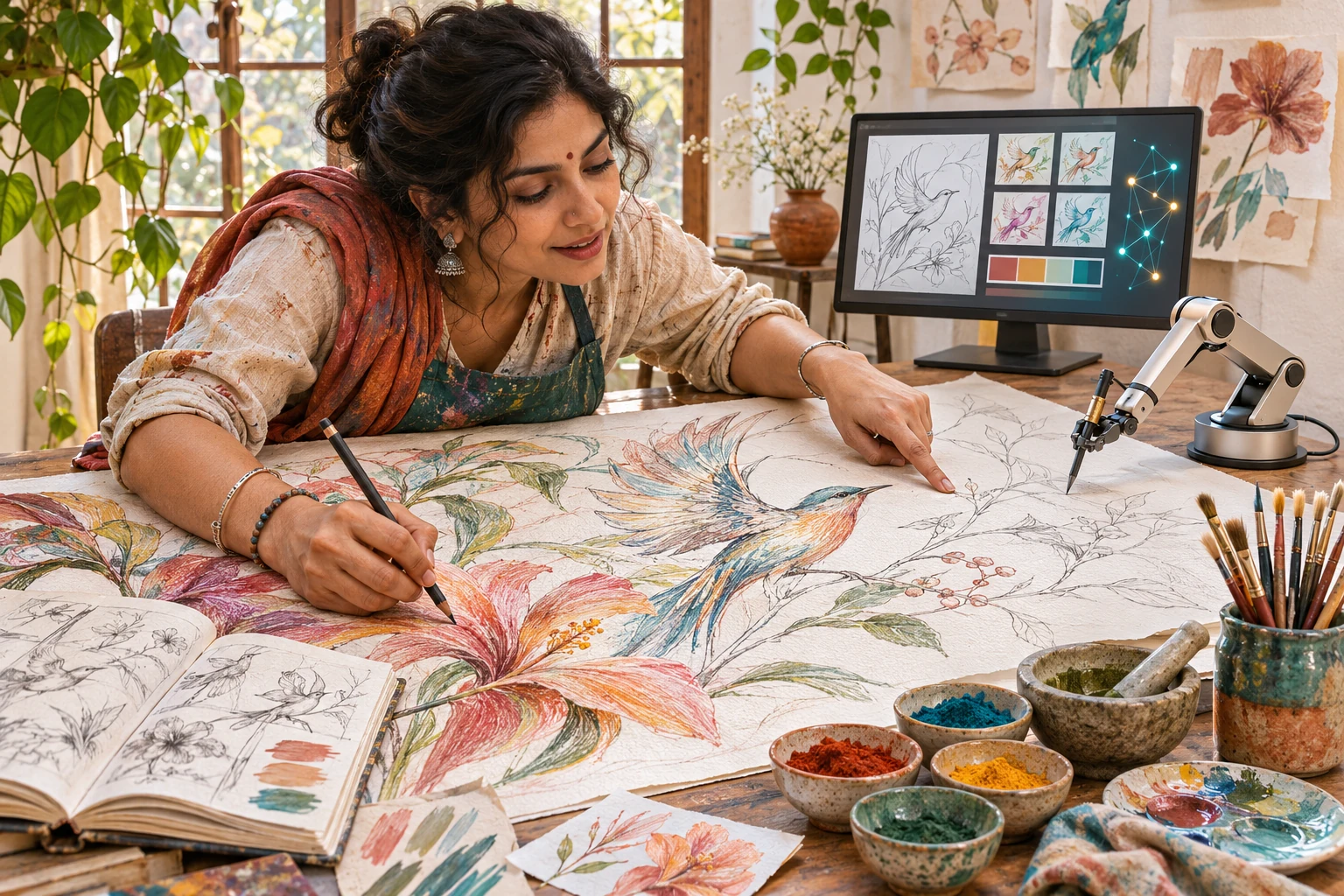
Image credit: AI-generated illustration created for Thigma Art, shown for representation; it is not a photograph of a real person or studio.