Shadanga – Principles of Painting
In short: Shadanga means the “six limbs” of Indian painting: Roopbheda (appearance), Pramana (proportion), Bhava (expression), Lavanya Yojana (aesthetic composition), Sadrishya (resemblance) and Varnikabhanga (use of brush and colour). They are linked to Vatsyayana’s Kamasutra, and mastering all six is part of becoming a true painter.
रूपभेदः प्रमाणानि भावलावण्ययोजनम्।
सादृश्यं वर्णिकाभंग इति चित्रं षडंगकम्॥
This verse names the six principles of painting known as Shadanga (षडंग). They are linked to Vatsyayana’s Kamasutra, which most scholars date to about the 3rd century CE. The verse is usually quoted from Yashodhara’s commentary on the Kamasutra, called Jayamangala.
At a glance
Shadanga in brief
- Meaning The six limbs of Indian painting
- Form A short Sanskrit verse
- Linked to Vatsyayana’s Kamasutra, dated by most scholars to about the 3rd century CE
- Quoted from Yashodhara’s commentary Jayamangala
- Number of limbs Six
- Also discussed in The Vishnudharmottara Purana
Where do the six limbs of painting come from?
The six limbs, or shadanga, are a short Sanskrit verse listing what makes a good painting: knowing forms, correct proportion, emotion, grace in composition, likeness, and skilful use of brush and colour. They are linked to the Kamasutra, a text attributed to Vatsyayana that most scholars date to about the third century CE, though the date is approximate.
The verse is usually quoted from Yashodhara’s commentary on the Kamasutra, called the Jayamangala, rather than from the main text. The standard Oxford translation of the Kamasutra places that commentary in the thirteenth century CE, but some Indian writers give the eleventh or twelfth century, so the exact date is not settled. Another early Sanskrit work on painting, the Vishnudharmottara Purana, also discusses the same principles.
So when was the verse first composed? The honest answer is that nobody knows. It is preserved in a later commentary, and links to older works, such as the paintings at Ajanta, are scholars’ interpretations rather than records. What is clear is that writers in India were thinking about the craft of painting in a systematic way many centuries ago, and the six limbs are still taught to art students today.
Timeline
Where the verse comes from
- c. 3rd century CE Most scholars date the Kamasutra, attributed to Vatsyayana, to about this time, though the date is approximate.
- 11th or 12th century Some Indian writers date Yashodhara’s commentary Jayamangala to this period.
- 13th century The standard Oxford translation of the Kamasutra places the commentary here, so its exact date is not settled.
- Today The six limbs are still taught to art students.
What are the six limbs of painting (Shadanga)?
Shadanga is made of six “limbs” (angas) that together make a complete work of art:
- Roopbheda (रूपभेदः): knowledge of appearance and form
- Pramana (प्रमाणानि): proportion and measurement
- Bhava (भाव): expression and mood
- Lavanya Yojana (लावण्य योजना): aesthetic composition
- Sadrishya (सादृश्य): resemblance
- Varnikabhanga (वर्णिकाभंग): use of brush and colours
The six limbs
What each limb means
- Roopbheda Knowledge of appearance and form.
- Pramana Proportion and measurement, which brings realism to a scene.
- Bhava Expression and mood, called the soul of an artwork.
- Lavanya Yojana Aesthetic composition that balances all the elements.
- Sadrishya Resemblance, in a broader sense and not an exact copy.
- Varnikabhanga Use of brush and colours, considered the peak of Shadanga.
What is Roopbheda?
Roopbheda refers to the appearance and look of something. The term is made of two words, Roop (appearance) and Bheda (difference). It means that the artist should know and understand the different forms of appearance. This understanding goes beyond just seeing, and also involves the artist’s personal connection and insight into the subject. The way an artist interprets and represents the appearance of something is reflected in the artwork.
What is Pramana?
Pramana refers to the accuracy and precision of proportions and measurements in a work of art. If the proportions are wrong, it can detract from the look of the piece, unless the artist has a specific intention, as in surrealism.
Suppose an artist wants to paint a huge mountain with trees in front of him, a river flowing at the foothills, and a shepherd herding sheep along the riverbank. Getting the proportion and measurement right brings realism to the scene.
What is Bhava?
Bhava is the expression in an artwork. It gives life to the painting and helps to set the mood, and the right combination of Bhava is important for the tone of the work. It matters in any composition, whether painting, writing or performing art.
How are anger, beauty, fear, joy or disgust expressed visually? Imagine a painting of an oppressor and the oppressed. How do you bring the sense of joy and fear into the same frame? Bhava is the soul of an artwork.
What is Lavanya Yojana?
Lavanya Yojana represents aesthetic composition. When a dish is prepared, it is made of many ingredients, including spices. If any ingredient goes out of proportion, on the higher or the lower side, it spoils the dish. In the same way, the composition of an artwork has to balance all its elements. Lavanya Yojana defines the overall artistic quality of the work.
What is Sadrishya?
Sadrishya represents resemblance, that is, how similar the subject on paper is to the subject in real life. This is not about an exact copy but about similarity in a broader sense. For example, a warrior is shown riding a horse with a spear in his hand, which creates resemblance. If one wants to show a college professor riding a supercar, does it create Sadrishya? The question helps us think about what resemblance really means.
What is Varnikabhanga?
Varnikabhanga is the use of brush and colours in an artwork. It shows the technical skill of the artist and is considered the peak of Shadanga, which can only be reached through constant practice. It requires a complete understanding of the materials, such as the brush, pigments and canvas, and how they interact.
These are the six main limbs of a painting (इति चित्रं षडंगकम्). A painter learns to handle all six through practice.
Frequently asked questions
What is Shadanga?
Shadanga means the “six limbs” of Indian painting: Roopbheda, Pramana, Bhava, Lavanya Yojana, Sadrishya and Varnikabhanga.
Where do the six limbs of painting come from?
The six limbs (shadanga) are a verse quoted in Yashodhara’s Jayamangala, a commentary on Vatsyayana’s Kamasutra. The Kamasutra is dated to roughly the third century CE and the commentary most often to the thirteenth century, though some give the eleventh or twelfth. Who first composed the verse, and when, is unknown.
Where is Shadanga mentioned?
The verse is usually quoted from Yashodhara’s commentary on the Kamasutra, called Jayamangala, and is linked to the Kamasutra attributed to Vatsyayana. Who first composed it is unknown.
What is Bhava in painting?
Bhava is the expression in an artwork. It gives life to the painting, sets the mood and is called the soul of an artwork.
What is Varnikabhanga?
It is the use of brush and colours, which shows the technical skill of the artist and is considered the peak of Shadanga.
What does Pramana mean?
Pramana is the accuracy of proportions and measurements in a work of art, which brings realism to the scene.
Sources and further reading
Kamasutra (Oxford World’s Classics), introduction by Wendy Doniger and Sudhir Kakar, Oxford University Press.
Arts in the Puranas (study), Wisdom Library (essay, 1973 study).
Artistic Narration, Vol. XIII No. 1 (article on Shadanga), Artistic Narration journal.
History lesson: Cultural development (lecture notes), Deshbandhu College, University of Delhi.
Related reading
- Raja Ravi Varma: The Master of Indian Art
- Guernica by Pablo Picasso: History, Composition and Symbolism
- Krishna Art: The 16 Kalas and 13 Famous Artworks.
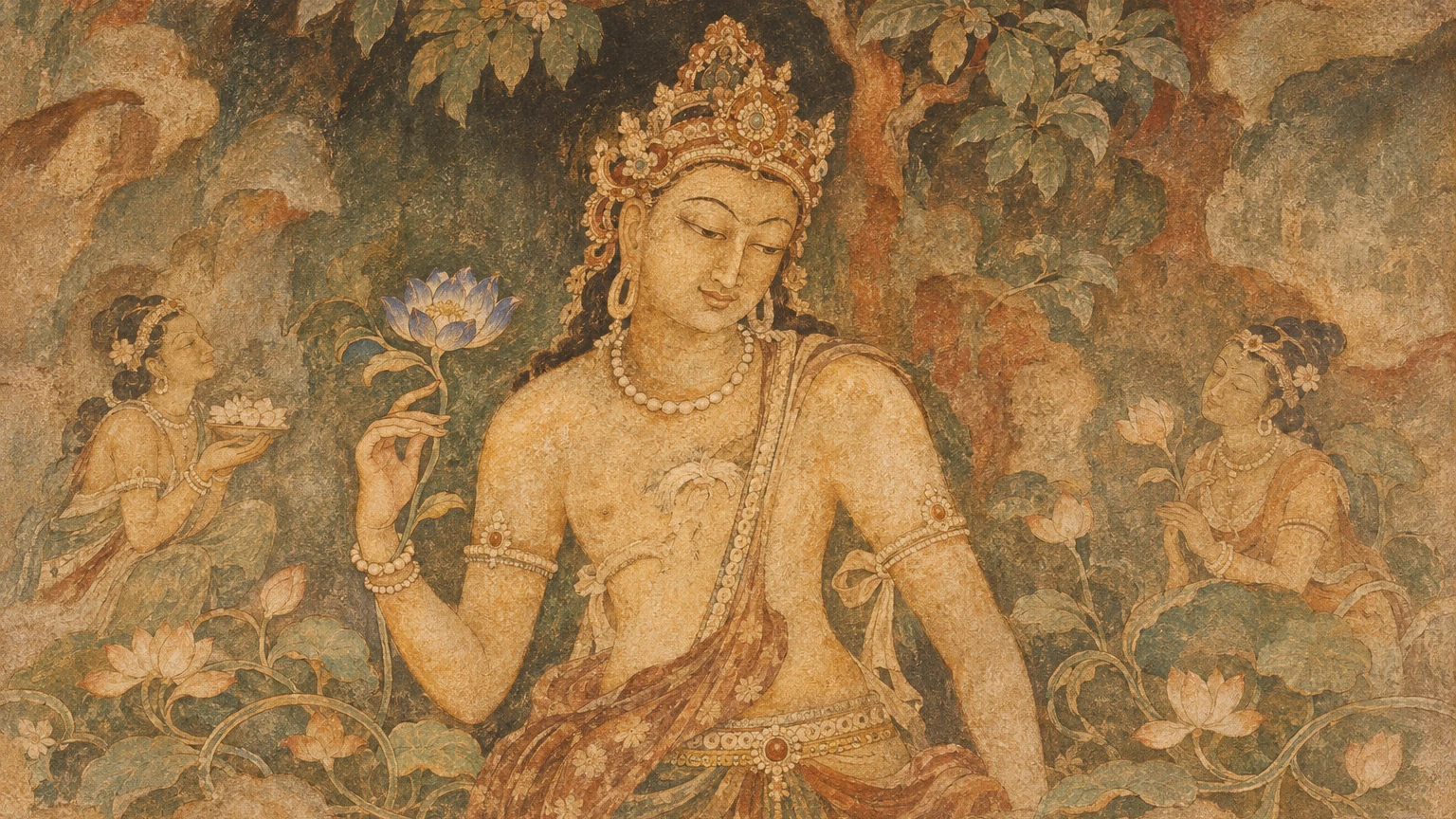
Image credit: AI-generated illustration created for Thigma Art, shown for representation in the style of Ajanta cave paintings; it is not a photograph of an actual fresco.