Bandhani and Shibori: India’s and Japan’s Tie-Dye Traditions Compared
TL;DR: Bandhani, a tie-dye from Gujarat and Rajasthan, and shibori, the Japanese family of resist-dye methods, both keep dye away from parts of the cloth by tying, folding, stitching or clamping it. Their results differ: bandhani is known for tiny tied dots, while shibori covers more than a hundred methods, from dappled spots to folded blocks. Sources describe each as a local tradition with its own history, not a copy of the other.
At a glance
Bandhani and shibori in brief
- Bandhani from Gujarat and Rajasthan, India
- Bandhani known for Tiny tied dots
- Shibori from Japan
- Shibori methods More than 100, from dappled spots to folded blocks
- Shared idea Resist dyeing: keep dye off parts of the cloth
Two cloths, one simple idea
Around the 15th century, someone in Gujarat tucked a small scrap of tie-dyed silk between the pages of a Jain manuscript, probably to protect the painted pages. That scrap, now in the Victoria and Albert Museum in London, is catalogued as one of the earliest surviving examples of Indian tie-dyeing. Japan has its own early trail: woodblock prints by the artist Utagawa Hiroshige, now at the Metropolitan Museum of Art in New York, are titled after the famous shibori of Arimatsu, sold near the post town of Narumi.
Both traditions rest on one idea called resist dyeing: if part of a cloth is kept from touching the dye, it stays its original colour, and the pattern is the contrast. Bandhani, from the Sanskrit word for tying, is a tie-dye from Gujarat and Rajasthan in western India. Shibori is a Japanese word for patterns made by plucking, stitching, folding, binding or clamping cloth before dyeing. Beyond that shared idea, each tradition grew in its own place, with its own tools, cloth and tastes.
How the cloth is worked
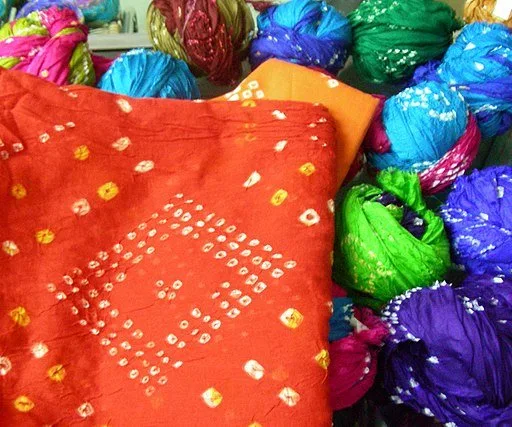
In bandhani, according to MAP Academy, the pattern is first marked on the cloth, often in a folded layout so it repeats. Then small points of fabric are pinched and tied tightly with thread, traditionally by women known as bandhanaras. The cloth is dipped in dye, washed and dried, and when the threads are opened, each tied point shows as a dot with an undyed ring. The RISD Museum in the United States describes the same basic logic for a Gujarati head scarf from the early 1900s.
Shibori is better described as a family. A research paper on Japanese shibori defines it broadly and names methods such as tegumo and miura (binding), itajime (cloth folded and clamped between wooden boards) and nui (stitch resist). A Japanese traditional-crafts website says there are more than 100 such methods, including kanoko, kumo and sekka. So a bandhani dot and a shibori kanoko spot can look alike, but shibori also includes folded-and-clamped geometric blocks and stitched lines that bandhani is not usually known for.
- Bandhani: thread-tied points on cotton or silk, producing rings and dots.
- Shibori kanoko: tied points that give a dappled, fawn-spot look.
- Shibori itajime: folded cloth clamped between boards, giving mirrored geometric shapes.
- Shibori nui: lines of stitching pulled tight before dyeing.
Methods
Four ways to resist the dye
- Bandhani Thread-tied points on cotton or silk, producing rings and dots.
- Shibori kanoko Tied points that give a dappled, fawn-spot look.
- Shibori itajime Folded cloth clamped between boards, giving mirrored geometric shapes.
- Shibori nui Lines of stitching pulled tight before dyeing.
Motifs and dyes
MAP Academy says Gujarati bandhani often repeats motifs such as mango trees, peacocks and elephants, in layouts with names like bavanbagh and rasamandali, while Rajasthani cloths typically show concentric coloured circles and larger dots called dabbi. The same source says colours were once tied to season and occasion and, in Rajasthan, could signal a wearer’s community, work or marital status. That last point comes from one source, so treat it as a general tendency rather than a rule. The RISD scarf adds a lovely detail: its black-tinted dots imitate mirror embroidery.
Japanese shibori is most strongly linked to indigo on cotton. The research paper above calls indigo the main dye of the Arimatsu area, used for yukata (light cotton robes), kimono and tenugui (hand towels), and the craft site describes the contrast of cotton and indigo as the area’s hallmark. Silk shibori also exists: the Met holds an 18th-century silk kosode (kimono-style robe) with tie-dyed patterns. For both countries, the sources I read do not give a firm account of which dyes were used in which century, so any statement that a given old piece used a particular dye needs a lab or a specialist to confirm.
History and the roads that carried them
Tie-dyeing is a technique that people appear to have found in many places. MAP Academy notes that the earliest known tie-dyed examples come from Peru and that the method appeared independently in several regions. For India, it points to a sixth-century cave painting at Ajanta as the earliest evidence and to cloth fragments found in Egypt, traced to Gujarat, from the 15th to 16th centuries. It also says the craft is linked to the Khatri community, originally from Sindh. These details come mainly from one source, so they are best read as often-repeated accounts, not settled facts. The Victoria and Albert Museum’s fragment is firmer evidence for Gujarat in the 15th century.
In Japan, the craft site says shibori itself goes back to the Nara period (710 to 794), and that the Arimatsu tradition took off in the early Edo period, when workers from Bungo came to help build Nagoya Castle around 1610 to 1614. It adds that a woman from Bungo brought the miura technique in 1655. The research paper agrees that a strong shibori trade grew in Arimatsu in the early 1600s along the Tokaido road, where travellers bought cloth as souvenirs. The Nara-period date and the founding legends come from one source each, so they are told here as accounts, not certainties. Nothing I read shows one country’s tie-dye learning from the other, and I make no such claim.
Where to see them
For Japan, the Arimatsu Narumi Shibori area near Nagoya has a Tie-Dyeing Museum (Arimatsu Narumi Shibori Kaikan), and the Met’s online collection includes both shibori garments and the Hiroshige prints of Narumi. For India, the Victoria and Albert Museum’s Gujarat fragment and the RISD Museum’s bandhani scarf can be viewed through their online records, and the Victoria and Albert Museum has a larger South Asian textile collection that can be visited by appointment. Within India, bandhani is made in Gujarat and Rajasthan, among other places, according to MAP Academy, and local museums and textile centres there are good places to ask about current workshops. Opening hours change, so check each museum’s own website before you go.
Related stories
Frequently asked questions
Is bandhani the same as shibori?
No. Both are resist-dye methods, but bandhani is a tradition of western India centred on tied dots, while shibori is a broad Japanese family of more than 100 methods, including binding, stitching and clamping.
Did India or Japan invent tie-dye first?
Neither. MAP Academy notes that tie-dyeing appeared independently in many places, with the earliest known examples from Peru. No reliable source I found says Indian or Japanese makers copied each other.
What is a bandhanara?
It is the term MAP Academy gives for the women who traditionally do the fine tying of bandhani cloth.
Which dye is typical for shibori?
Indigo on cotton is the best-known pairing in the Arimatsu area, according to a research paper and a Japanese craft site. Silk shibori also exists.
How old is the oldest Indian tie-dye?
The Victoria and Albert Museum holds a silk fragment from Gujarat catalogued as possibly 15th century and calls it one of the earliest surviving Indian examples. Older references, such as an Ajanta painting, are reported by a single source.
Sources and further reading
- Victoria and Albert Museum: Tie-dyed silk fragment, Gujarat, possibly 15th century
- MAP Academy: Bandhani
- RISD Museum: Bandhani Odhani (head scarf)
- Research paper on Japanese shibori (CORE)
- Kogei Japan: Arimatsu Narumi Shibori
- The Metropolitan Museum of Art: search results for Shibori
Image credit: “Bandhani (2150279080)” by tommy, via Wikimedia Commons, under the Creative Commons Attribution-Share Alike 2.0 Generic licence.