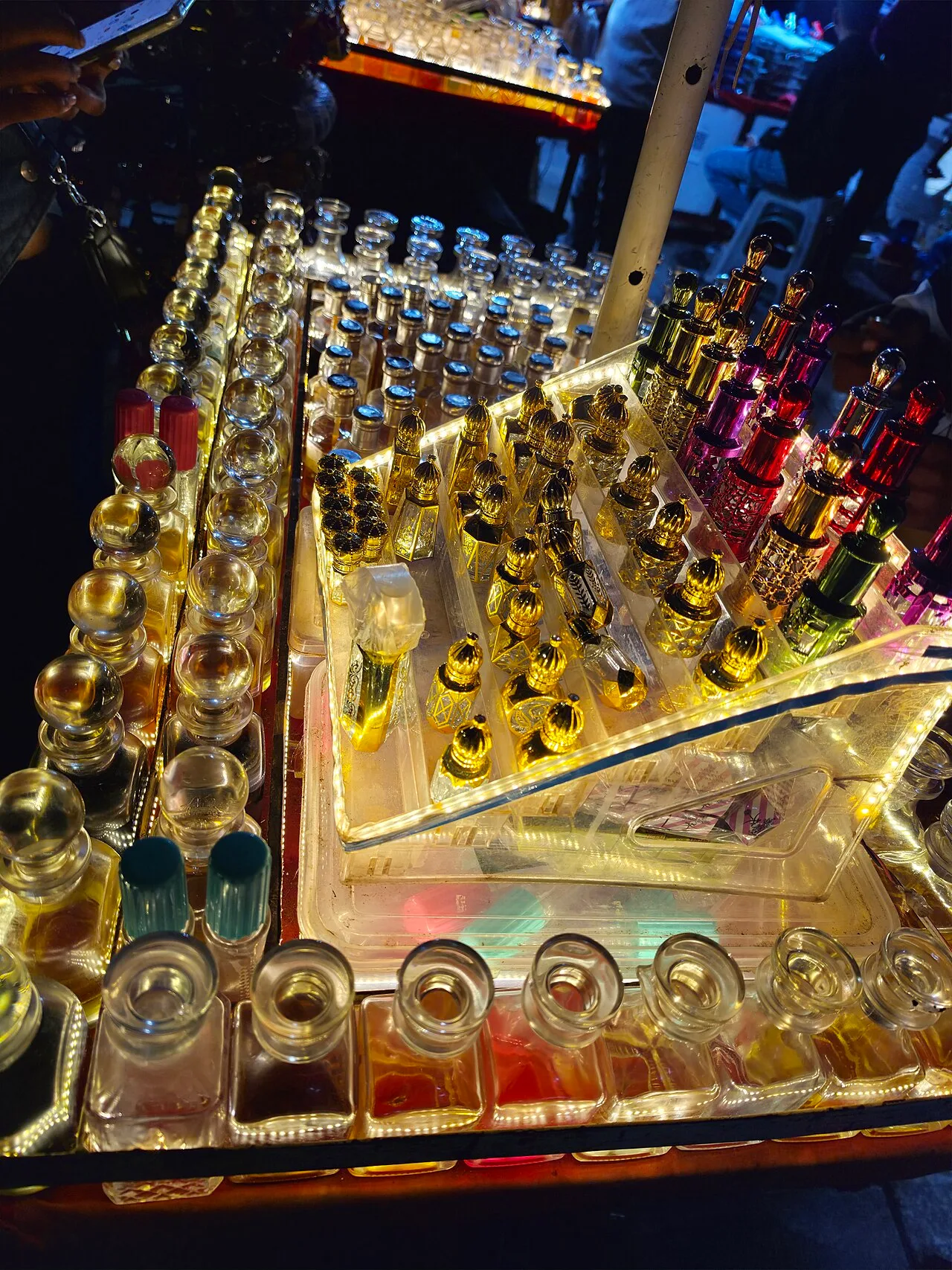
Perfumes of Hyderabad
In short: Hyderabad is known for ittar (attar), a traditional perfume oil made from natural ingredients such as flowers and sandalwood. Hyderabad was a trading capital under the Qutb Shahi and Nizam rulers, and old shop families have stories of serving the Nizams. When ittar-making began in the city is not firmly documented. Ittar is made by distilling flowers in copper stills into a base oil, and it lasts far longer than most synthetic scents. The craft is now declining, as it gives way to canned deodorants and Western perfumes.
“Perfume is the most intense form of memory.” – Jean-Paul Guerlain
At a glance
Hyderabad ittar in brief
- What it is Ittar (attar), a traditional perfume oil
- Ingredients Natural ingredients such as sandalwood, rose, jasmine and other flowers
- Method Distilled in copper stills, then mixed with a base oil
- Base Oil-based, not alcohol-based
- Related product Gulabari, or rose water, made by distilling fresh rose petals in water
- Status Declining, as canned deodorants and Western perfumes replace it
What is the history of ittar in Hyderabad?
Hyderabad was founded in 1591 by Sultan Muhammad Quli Qutb Shah, whose Qutb Shahi dynasty ruled from Golconda from 1518 to 1687. UNESCO notes that Golconda was a lively centre of trade in diamonds and textiles. In 1724 Asaf Jah, the Mughal viceroy of the Deccan, declared independence and began the line of Nizams, whose state lasted until 1948. For about 350 years the city was a trading capital, a setting in which a luxury craft like perfumery could do well.
Ittar itself is much older than the city and is not unique to it. The word comes from Persian, and the craft of distilling flowers with steam into oil is linked to Persian scholars such as Avicenna. In India, Kannauj in Uttar Pradesh is the best-known centre, and local tradition ties its perfumery to the 7th century. One popular story credits Empress Nur Jahan with the method, but Sahapedia calls that story apocryphal.
For Hyderabad specifically, no early documents could be found that confirm when ittar-making began, so older claims should be treated as tradition. What exists is family memory. Shop owners in the Old City say their forefathers arrived or set up in the late 1800s, and one family says it became a supplier to the Nizam in 1920. These are valuable oral histories, but they are not independently documented. Sellers today say deodorants and Western perfumes, and the rising cost of sandalwood oil, are squeezing the trade.
Timeline
Hyderabad’s trading-capital years
- 1518-1687 The Qutb Shahi dynasty ruled from Golconda, a lively centre of trade in diamonds and textiles.
- 1591 Sultan Muhammad Quli Qutb Shah founded Hyderabad.
- 1724 Asaf Jah, the Mughal viceroy of the Deccan, declared independence and began the line of Nizams.
- Late 1800s (family accounts) Old City shop owners say their forefathers arrived or set up shop. These are oral histories, not independently documented.
- 1920 (one family’s account) One family says it became a supplier to the Nizam. This is also not independently documented.
- 1948 The Nizams’ state, begun in 1724, lasted until this year.
How old is the perfume tradition of Hyderabad?
Hyderabad was founded in 1591. Exactly when its perfume trade began is not firmly documented. The Deccan plateau, with its sandalwood, roses, jasmine and other flowers, made it a natural home for perfume making.
What is ittar?
The perfumes of Hyderabad are known for their blend of floral and woody fragrances. The most famous is ittar (also spelt attar), a traditional Indian perfume made from natural ingredients such as sandalwood, rose, jasmine and other flowers. Ittar has a deep, earthy smell.
How is ittar made?
The art of making ittar is closely guarded, and only a handful of families in Hyderabad are known to have the knowledge and skill for it.
- Distillation: Natural ingredients are distilled in copper stills and blended in specific ratios to create a unique fragrance.
- Oil base: The extract is mixed with a base oil to make the perfume. Unlike Western perfumes, ittar is oil-based, not alcohol-based. Making pure rose extract takes a very large quantity of roses, in the order of thousands of kilograms for one kilogram.
- Longevity: Ittar is known for lasting a long time, often for days, whereas many synthetic perfumes fade quickly.
How it’s made
How ittar is made
- Distil Natural ingredients are distilled in copper stills.
- Blend The extracts are blended in specific ratios to create a unique fragrance.
- Add the base oil The extract is mixed with a base oil to make the perfume.
- Let it last Ittar often lasts for days, whereas many synthetic perfumes fade quickly.
What is Gulabari (rose water)?
Apart from ittar, Hyderabad is also known for gulabari, or rose water. It is made by distilling fresh rose petals in water. The liquid is collected and the rose oil is separated from it. The rose oil is then used to make perfumes, while the rose water is used as a natural skin toner.
Is the craft still alive?
Hyderabad’s ittars are still made with traditional techniques and natural ingredients, and the Old City shops are the place to try them if you visit.
In spite of this popularity, the art of fragrance making is dying down as it is being replaced by canned deodorants and high-end Western perfumes.
Frequently asked questions
What is ittar?
Ittar, or attar, is a traditional Indian perfume oil made from natural ingredients such as sandalwood, rose and jasmine.
What is the history of ittar in Hyderabad?
Hyderabad was founded in 1591 and was a trading capital under the Qutb Shahis and then the Nizams. Ittar-making itself is older and widespread in India. When it began in Hyderabad is not firmly documented. Old City shop families share oral histories of serving the Nizams, but these are family accounts.
Since when has Hyderabad been known for perfumes?
Hyderabad was founded in 1591 and was a trading capital under the Qutb Shahis and Nizams. When its ittar trade began is not firmly documented.
How is ittar made?
Natural ingredients are distilled in copper stills and blended in specific ratios, and the extract is mixed with a base oil.
What is gulabari?
Gulabari is rose water, made by distilling fresh rose petals in water. The rose oil separated from it is used in perfumes, and the water is used as a skin toner.
Why is the craft declining?
It is being replaced by canned deodorants and high-end Western perfumes.
Sources and further reading
The Qutb Shahi Monuments of Hyderabad (Tentative List), UNESCO World Heritage Centre.
Hyderabad (India), Encyclopaedia Britannica.
The Art of Aromas: Ittar Industry of Kannauj, Sahapedia.
Four generations later, the art of Ittar is losing its scent in Hyderabad, The News Minute.
- The Ittars of Hyderabad and their Nizami connection, En Route Indian History (in English)
- Attar, Wikipedia (in English)
Related reading
- Bandhani and Shibori: India’s and Japan’s Tie-Dye Traditions Compared
- Home decor ideas for your new beginnings
- Dindigul Locks
Image credit: “Perfume bottles displayed at a shop near Charminar in Hyderabad, India” by Dev Jadiya, via Wikimedia Commons, licensed under CC BY-SA 4.0.