Gorakhpur Terracotta
In short: Gorakhpur terracotta is a GI-tagged clay craft from villages near Gorakhpur in Uttar Pradesh, best known for hand-decorated animal figures such as horses and elephants. According to NABARD, potters use a local pond clay called Kabis, which is available only in May and June, and the pieces keep a lasting reddish-brown colour without added paint.
According to NABARD, the clay behind Gorakhpur terracotta is a local pond clay called Kabis, available only in May and June. Potters in villages near Gorakhpur in Uttar Pradesh turn it into hand-decorated animals such as horses and elephants. This article explains how the craft works, what makes it distinct, and why it holds a GI tag.
At a glance
Gorakhpur terracotta in brief
- Region Villages near Gorakhpur, Uttar Pradesh
- Material Kabis, a local pond clay
- Clay season Available only in May and June, according to NABARD
- Known for Hand-decorated animal figures such as horses and elephants
- Colour Reddish-brown, with no paint added
- GI tag Certificate issued on 20 April 2020
How old is Gorakhpur terracotta?
Terracotta, meaning baked clay, is one of the oldest crafts in South Asia. Britannica gives about 2500 to 1700 BCE as the core dates of the Indus civilization, and excavations at Harappa have turned up terracotta animals, including a bull, a dog, a rhinoceros and an elephant head. That shows clay animals were being made in the subcontinent thousands of years ago. It does not mean the Gorakhpur tradition runs in an unbroken line from then, and no one has documented that.
For Gorakhpur itself there is no firm start date. The GI application, filed by a local terracotta workshop, calls terracotta a traditional art that developed over a thousand years ago and says clay animal figures are made in villages across the district. Aurangabad and Gulriha, both near Gorakhpur, appear in the applicant’s address. The application says potters throw parts on a wheel, join them, dry them, then fire them in a kiln. It says red comes from letting smoke out through the kiln vents, and black from sealing them. NABARD’s GI page describes the red differently, as the result of dipping the clay in a soda and mango-bark solution, so the details of the colouring should be read with care.
What is firmly documented is the recognition. The application was filed on 10 September 2018, and the Geographical Indications Registry issued the certificate on 20 April 2020.
Timeline
Clay animals and the GI record
- c. 2500-1700 BCE Core dates of the Indus civilization, whose Harappa excavations found terracotta animals. No direct line to Gorakhpur is documented.
- Over a thousand years ago The GI application says terracotta developed as a traditional art then. There is no firm start date for Gorakhpur.
- 10 September 2018 The GI application was filed by a local terracotta workshop.
- 20 April 2020 The Geographical Indications Registry issued the certificate.
How is Gorakhpur terracotta made?
The art of terracotta involves moulding clay into shapes and firing it in a kiln at high temperature to make a durable, long-lasting product. According to NABARD, Gorakhpur terracotta is made from a local clay called Kabis, which gives it a distinctive reddish-brown colour.
NABARD says Kabis clay is taken from ponds, and that it is available only in the months of May and June, because for the rest of the year the ponds are filled with water. No paint is added. Sources differ on how the colour arises: NABARD describes a dip in a solution of soda and mango tree bark before baking, while the GI application says red comes from letting smoke out of the kiln and black from sealing it.
- Collect the clayKabis clay is taken from ponds. NABARD says it is available only in May and June, because the ponds are full of water the rest of the year.
- Shape itThe clay is moulded into shapes.
- Treat the colourNo paint is added. NABARD describes a dip in a solution of soda and mango tree bark before baking.
- Fire in the kilnThe pieces are fired in a kiln at high temperature. The GI application says letting smoke out of the kiln gives red, and sealing it gives black.
Where is it made?
The craft is practised by families in villages such as Aurangabad, Gularia, Bharwalia and Budhadih around Gorakhpur. In Aurangabad, more than 200 households are involved, including many women, and the village is being developed as a craft tourism destination.
Key facts
Gorakhpur terracotta in numbers
- May-June The only months Kabis clay is available
- 200+ Households involved in Aurangabad village
- 4 villages Aurangabad, Gularia, Bharwalia and Budhadih
What designs and products is it known for?
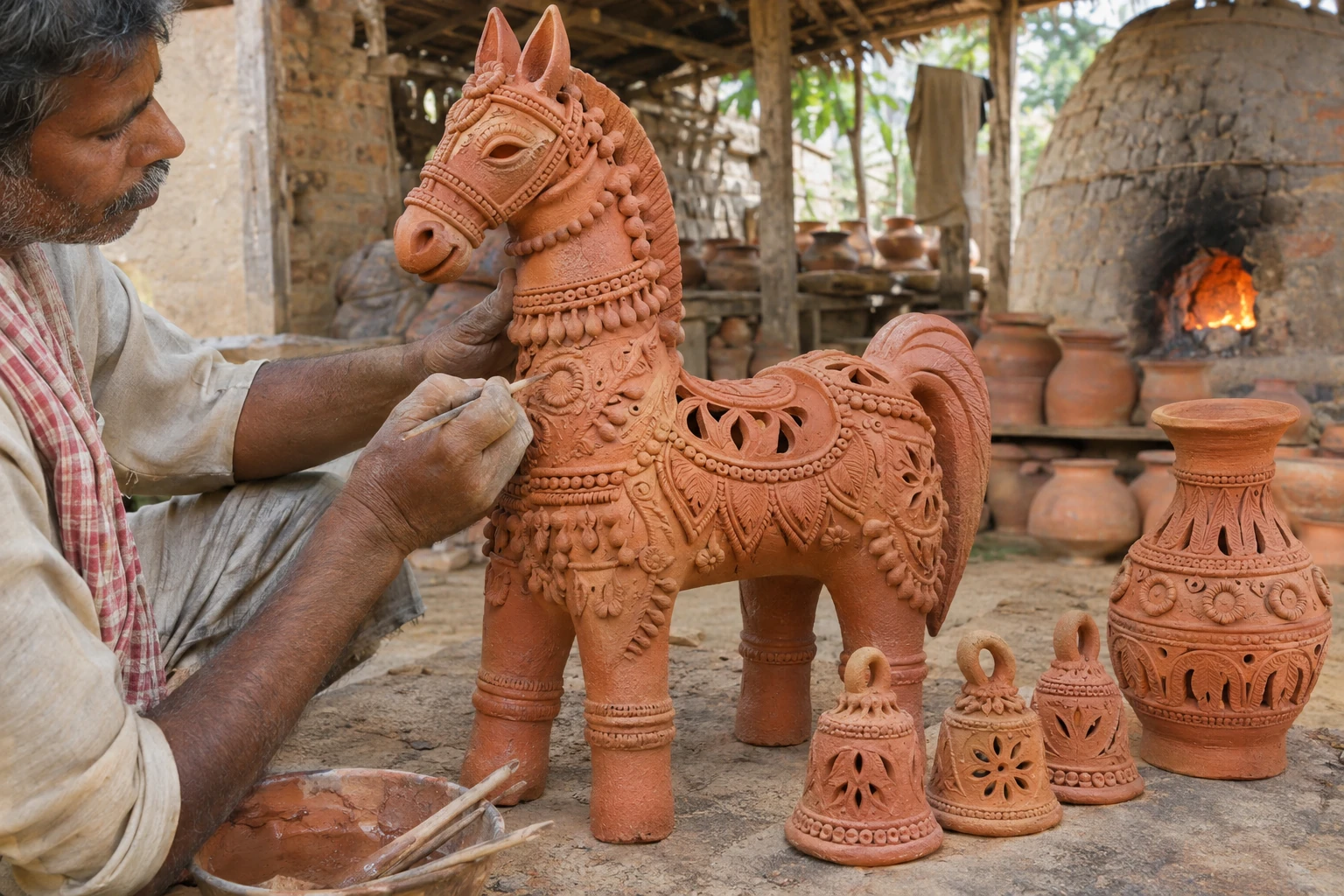
The designs are inspired by local folklore, mythology and nature. Common motifs include animals, birds, flowers and religious figures, and the craftsmen use carving, incising and painting to create fine patterns. The work is especially known for its ornamentation.
Gorakhpur terracotta is used for both decorative and everyday purposes. Well-known pieces are animal figures such as horses, elephants, camels, goats and oxen, as well as religious idols, lamps (diyas), vases and plates.
Frequently asked questions
What is Gorakhpur terracotta?
It is a GI-tagged craft from villages near Gorakhpur in Uttar Pradesh, known for hand-decorated animal figures made of reddish-brown clay.
How old is Gorakhpur terracotta?
There is no firm date for Gorakhpur’s tradition. Clay figures were made in the Indus civilization thousands of years ago, but a direct line to Gorakhpur is not documented. The GI application calls the craft over a thousand years old. It was registered on 20 April 2020.
Which clay is used in Gorakhpur terracotta?
According to NABARD, a local pond clay called Kabis, which is available only in May and June.
Is colour added to Gorakhpur terracotta?
No paint is added. Sources differ on how the colour arises: NABARD describes a soda and mango-bark dip, while the GI application says red comes from letting smoke out of the kiln and black from sealing it.
Which villages make Gorakhpur terracotta?
Aurangabad, Gularia, Bharwalia, Budhadih and nearby villages around Gorakhpur.
Sources and further reading
Gorakhpur Terracotta, GI Application No. 619, Geographical Indications Registry, India.
GI application text for Gorakhpur Terracotta, Geographical Indications Registry (copy hosted on origin-gi.com).
Indus civilization, Encyclopaedia Britannica.
Animal figurines (Harappa excavations), Harappa Archaeological Research Project (harappa.com).
- Gorakhpur Terracotta (NABARD GI database)
- Gorakhpur terracotta village to be developed as craft tourism hub (Outlook Traveller)
Related reading
- Pokharan Pottery: Desert Clay Craft of Rajasthan.
- Chunar Glaze Pottery
- Diya Significance: Diwali Lamps, Tradition and Symbolism
Image credit: AI-generated illustration created for Thigma Art, shown for representation; it is not a photograph of an actual Gorakhpur artisan or workshop.