ONDC – Democratic Digital Commerce
TL;DR: ONDC (Open Network for Digital Commerce) is not an app or a marketplace. It is a set of open specifications that lets buyer apps and seller platforms talk to each other in a standard way. A buyer on one app can then see and buy from sellers hosted on other platforms. Revenue sharing, order tracking and common terminology still need to be sorted out.
Commerce beyond boundaries: that is the idea behind ONDC.
At a glance
ONDC in brief
- Full name Open Network for Digital Commerce
- What it is A set of open specifications, not an app or a marketplace
- What it does Lets buyer apps and seller platforms talk in a standard way
- Initiative of DPIIT, under the Ministry of Commerce and Industry
- Pilot began 29 April 2022, in five cities
- Still open Revenue sharing, order tracking and common terminology
How did ONDC begin?
ONDC is an initiative of the Government of India’s Department for Promotion of Industry and Internal Trade (DPIIT), under the Ministry of Commerce and Industry. According to ONDC’s own account, DPIIT set up an advisory council in mid-2021 to help shape the network. The organisation that runs it was registered as a not-for-profit company in December 2021, with the Quality Council of India and Protean eGov Technologies among its founding members.
The first public test came in 2022. A pilot began on 29 April 2022 in five cities: Bengaluru, New Delhi, Bhopal, Shillong and Coimbatore. It covered groceries and food and beverages. Government information from June 2022 says seven companies took part, building one buyer app, five seller apps and one logistics app that could work together through the shared specifications.
From there the network grew in stages. ONDC’s own timeline lists food and beverage ordering in Bengaluru in 2022, ride-hailing from March 2023, and a rising count of transactions in the following years. The idea throughout has stayed the same as the one in this article: common open rules, so a buyer on one app can reach sellers on others. For current numbers and participants, the ONDC website is the best place to check.
Timeline
How ONDC began
- Mid-2021 According to ONDC, DPIIT set up an advisory council to help shape the network.
- December 2021 The organisation that runs ONDC was registered as a not-for-profit company.
- 29 April 2022 A pilot began in Bengaluru, New Delhi, Bhopal, Shillong and Coimbatore, covering groceries and food and beverages.
- June 2022 Government information says seven companies took part, building one buyer app, five seller apps and one logistics app.
- March 2023 ONDC’s own timeline lists ride-hailing from this month.
What is ONDC?
The first thing to understand about ONDC is that it is not another application or platform, but a set of specifications. So ONDC is not a competitor in the ecommerce landscape. It is the custodian of an open architecture that lets buying and selling go beyond individual ecommerce applications and platforms.
How does an ONDC transaction work?
Let us understand this with an example of a complete transaction.
Hrithik wants a sculpture of a tiger, around 6 ft in length and 3 ft in height at most. He registers with one of the ecommerce or marketplace applications and enters his requirement. Let us say the application is BuyZ.
Step 1: Discovery across platforms
BuyZ may well try to find a matching seller in its own ecosystem. The real power of ONDC is unlocked when BuyZ sends a query to multiple other platforms that host sellers. As every platform implements the same interface, it is the same type of call going to all platforms in a loop.
Say SellP and SellQ respond. SellP says that Shahrukh of Chennai can provide such a sculpture, and SellQ says that Sachin of Mumbai has one. On his BuyZ screen, Hrithik sees both choices without realising that they come from two different platforms. Suppose he chooses Sachin from SellQ. To keep the idea simple, we ignore for now Hrithik’s need to talk to Sachin and Shahrukh to understand their work and to be sure he will get what he is looking for.
Step 2: Order and logistics
Now Hrithik places the order. SellQ may handle the logistics itself, or it may go to multiple logistics providers that also support the ONDC protocol and get a quote.
We have kept this narrative very simple to bring out the core idea: different platforms can talk to each other through a standard protocol at different stages of an ecommerce transaction.
How it works
One ONDC purchase, step by step
- Buyer asks Hrithik enters his need for a tiger sculpture on the buyer app, BuyZ.
- Query goes out BuyZ sends the same type of query to many platforms, because all of them use the same interface.
- Sellers respond SellP and SellQ reply, and Hrithik sees both choices on one BuyZ screen.
- Order placed Hrithik picks Sachin from SellQ and places the order.
- Logistics SellQ may handle delivery itself, or get quotes from logistics providers that support ONDC.
What issues still need to be sorted out?
Some open questions remain.
- Revenue sharing: The usual model is to charge the seller a percentage of the selling price, but here a single transaction involves multiple platforms and will need many bilateral agreements. This is similar to the interconnect charges telecom providers pass to each other when a call starts on one operator and ends on another.
- A more complex lifecycle: UPI and telecom transactions are short and involve two parties, and they either succeed or fail. Ecommerce is more complicated. There is a discovery phase before the transaction, transactions are not short-lived and may be aborted midway, and more parties are involved, including logistics and insurance providers.
- Clear specifications: Since ONDC is only a protocol-level play and does not hold the interactions itself, the specifications must outline these nuances clearly. Otherwise platforms will have to go through lengthy agreement cycles before they are ready to be partners.
- Common terminology: Terms need to be unified for a seamless experience, otherwise one-to-one mapping between platforms is needed. One platform may say “order” and another “transaction”, so a buyer might see “Your transaction is on the way” from one and “Your order will reach you soon” from the other.
Frequently asked questions
What does ONDC stand for?
ONDC stands for Open Network for Digital Commerce.
How did ONDC begin?
ONDC is an initiative of the Government of India’s DPIIT. An advisory council was set up in mid-2021, a not-for-profit company was registered in December 2021, and a pilot began on 29 April 2022 in five cities: Bengaluru, New Delhi, Bhopal, Shillong and Coimbatore, covering groceries and food and beverages.
Is ONDC an ecommerce app or marketplace?
No. It is not an application or platform but a set of specifications, so it does not compete with ecommerce platforms.
How can a buyer see sellers from other platforms?
Because every platform implements the same interface, the buyer’s app can send the same query to many platforms and show all the responses on one screen.
What is the main challenge of revenue sharing in ONDC?
A single transaction can involve several platforms, so it needs many bilateral agreements, much like interconnect charges between telecom operators.
Why does common terminology matter?
Without unified terms, platforms need one-to-one mapping and buyers may see different messages for the same step, such as “order” versus “transaction”.
Sources and further reading
ONDC: Our journey, Open Network for Digital Commerce.
Advisory Council meeting on ONDC (press release), Press Information Bureau, Government of India.
- Open Network for Digital Commerce (ONDC) (in English)
- Open Network for Digital Commerce, Wikipedia (in English)
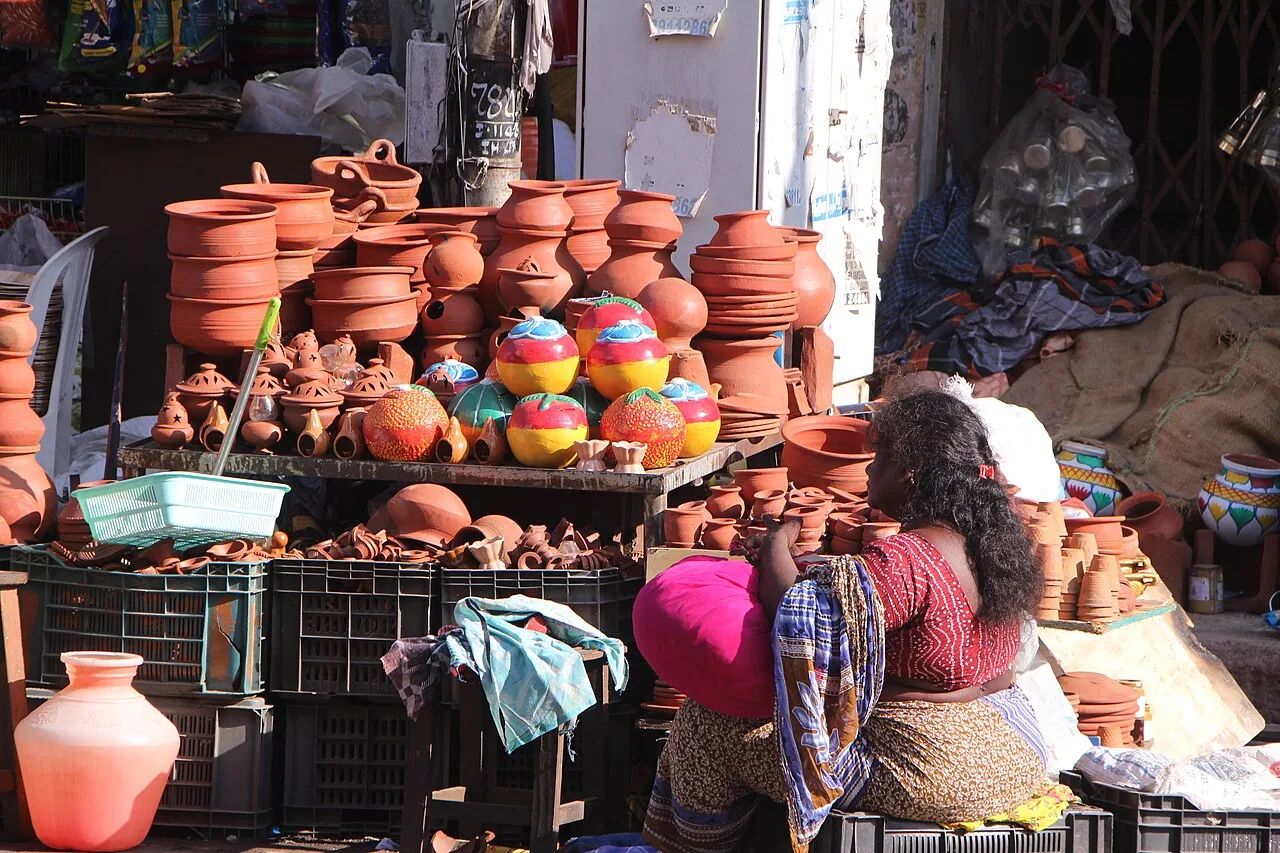
Image credit: “Indian Street Vendor” by UnknownCopy, via Wikimedia Commons, licensed under CC BY-SA 4.0.