Rogan Painting of Kutch: The Craft of Castor-Oil Paint on Cloth
In short: Rogan painting is a craft from Kutch, Gujarat, in which thick, castor-oil-based paint is drawn onto dark cloth with a stylus. It is closely tied to the Khatri community, and the village of Nirona is its best-known home today. The craft holds a Geographical Indication (GI) status and gained wide attention after two rogan paintings were gifted to US President Barack Obama in 2014.
In this article
- Where does Rogan painting come from?
- What is rogan painting?
- How is rogan paint made?
- How is a rogan design painted on cloth?
- What are the common rogan motifs?
- Where is rogan painting practised today?
- How did rogan painting reach the world stage?
- Why is rogan painting under threat?
- Frequently asked questions
- Sources and further reading
On dark cloth, the artist draws with a stylus and a thick, castor-oil-based paint, and the finished designs look almost embroidered. This is rogan painting of Kutch, Gujarat, closely tied to the Khatri community and best known today from the village of Nirona. Here is a plain guide to how it is made and why it matters.
At a glance
Rogan painting in brief
- Place Kutch, Gujarat; best known today from Nirona village
- Technique Thick castor-oil paint drawn on dark cloth with a stylus
- Colours White, orange, yellow, blue and green
- Associated with The Khatri community
- Best-known motif The tree of life
- GI tag Kutch Rogan Craft, registered 1 March 2024
Where does Rogan painting come from?
Rogan painting is a cloth-painting craft from Kutch in Gujarat. Thick paint made from castor oil and pigments is drawn onto fabric with a stylus. The word rogan is explained in government craft and tourism pages, and in a magazine feature, as a Persian word meaning oil-based. Today the craft is centred on Nirona village. A government craft page says it has been practised there for over a century and was earlier found in places such as Baroda and Patan, though that page gives no dates.
Where it began is not documented. A common account, repeated by local artists and some writers, is that the craft came from Iran and was brought to Kutch by the Khatri family of Nirona about 300 years ago, and that the family has kept it for around eight generations. One magazine feature says almost 400 years. These figures come from family and local tradition, and no archive or study could be found that confirms them. It was traditionally used to decorate bridal clothes and household textiles.
By 1980, according to master artist Abdulgafur Khatri, only four families in Nirona were still practising it, as slow work, low earnings and machine-made cloth pushed people away. Since then a few families have revived it, and paintings were given as gifts to visiting leaders, including a Tree of Life painting to US President Barack Obama in 2014. The Kutch Rogan Craft was registered as a Geographical Indication (GI) on 1 March 2024, on an application from the Rogan Hastkala Charitable Trust of Nirona.
Timeline
Rogan, tradition and records
- Said to be about 300 years ago Local tradition says the Khatri family of Nirona brought the craft from Iran. It is not documented; one magazine says almost 400 years.
- Over a century A government craft page says it has been practised in Nirona this long, though it gives no dates.
- 1980 According to master artist Abdulgafur Khatri, only four families in Nirona still practised it.
- 2014 Two rogan paintings were gifted to US President Barack Obama, including a tree of life.
- 2019 Abdul Gafur Khatri received the Padma Shri.
- 1 March 2024 The Kutch Rogan Craft was registered as a Geographical Indication.
What is rogan painting?
Rogan painting is a cloth-painting craft from the Kutch region of Gujarat, India. It is associated with the Khatri community. The name rogan is a Persian word meaning oil-based.
The craft is often described as about 300 years old and as having come from Persia, but this origin is a local tradition rather than an established historical fact, so it is best read as “said to”.
How is rogan paint made?
The paint is the heart of the craft. Castor oil is boiled for about two days until it turns into a thick base. Vegetable pigments and a binding agent are then added to make a heavy, sticky paint. Some artists also use linseed, walnut or poppy seed oil instead of castor oil.
Traditional rogan uses five colours: white, orange, yellow, blue and green. They are usually shown against dark cloth, which makes them stand out.
How is a rogan design painted on cloth?
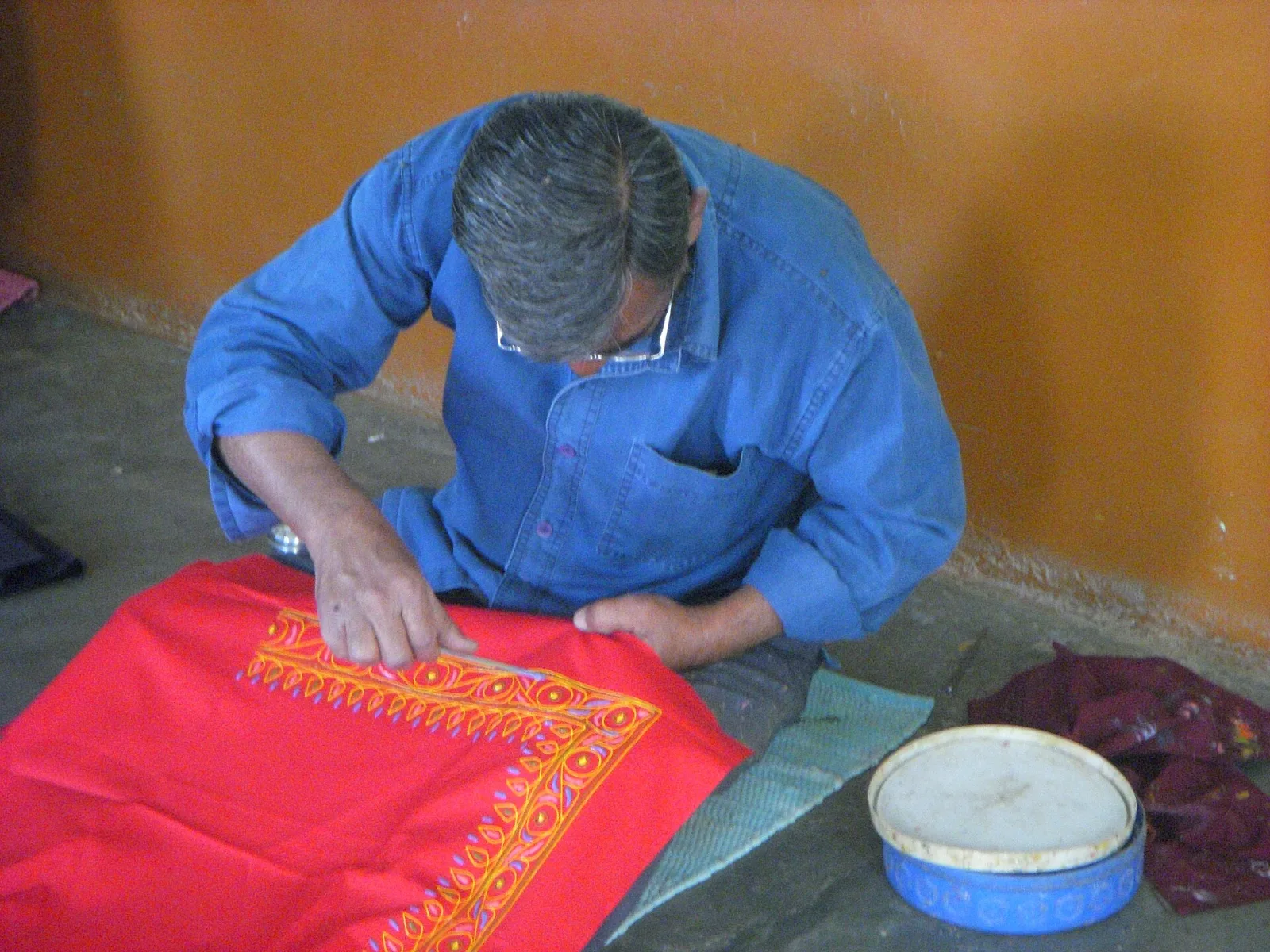
The artist does not use a brush for the main outline. A thick strand of paint is lifted on a stylus, called a tulika, and then drawn out in fine, thread-like lines without the stylus touching the cloth. Many designs are painted on only one half of the fabric. The cloth is then folded so that the paint prints onto the other half, giving a mirror image.
Three styles are usually described:
- Rogan (freehand): the design is drawn with the stylus and, often, folded to create a mirror image.
- Nirmika: patterns are pressed onto the cloth using carved brass blocks.
- Varnika: a freehand base design is made in one colour, and further colours are added with fine brushes, sometimes with glitter or mica.
How it’s made
From castor oil to mirror image
- Boil the oil Castor oil is boiled for about two days until it turns into a thick base.
- Mix the paint Vegetable pigments and a binding agent are added to make a heavy, sticky paint.
- Lift the strand A thick strand of paint is lifted on a stylus called a tulika.
- Draw the lines The strand is drawn out in fine, thread-like lines without the stylus touching the cloth.
- Fold the cloth Many designs are painted on one half, then the cloth is folded so the paint prints on the other half.
What are the common rogan motifs?
Flowers, animals and local folk-art designs are common. The best-known motif is the tree of life, which appears again and again in rogan work from Kutch.
Where is rogan painting practised today?
Nirona, a village in Kutch about 40 km from Bhuj, is the place most visitors associate with rogan. It is also known for leatherwork and lacquerwork. The Khatri family of Nirona, which is said to have practised rogan for eight generations, is the best-known rogan family.
Abdul Gafur Khatri, born in Kutch in 1965 and based in Nirona, learned the craft from his father and grandfather. He received the Padma Shri in 2019.
How did rogan painting reach the world stage?
In 2014, Prime Minister Narendra Modi gave US President Barack Obama two rogan paintings during a visit to the White House. One of them was a tree of life painted by Abdul Gafur Khatri and his younger brother Sumar Khatri. The gift, reported by the Times of India on 3 October 2014, brought new attention to the craft.
Kutch rogan craft has since been given Geographical Indication status, announced in March 2024 along with several other Indian products. A GI tag identifies a product with its place of origin and helps protect it from imitation.
Why is rogan painting under threat?
Machine-made textiles hurt the craft, and it is now practised by only a small number of families. According to master artist Abdulgafur Khatri, only four families were still practising it in Nirona in 1980, years before the 2014 gift to Barack Obama. Training new artists, including women, matters for its future.
Frequently asked questions
What is rogan painting?
Rogan painting is a cloth-painting craft from Kutch, Gujarat, in which a thick paint made from boiled castor oil and pigments is drawn onto cloth with a stylus.
Where does Rogan painting come from?
Rogan is a cloth-painting craft of Kutch, Gujarat, now centred on Nirona village. The word is Persian for oil-based. Local tradition says it came from Iran about 300 years ago, but this is not documented. It received a GI registration on 1 March 2024.
How is rogan paint made?
Castor oil is boiled for about two days, then vegetable pigments and a binding agent are added to make a thick paint. Other oils such as linseed, walnut or poppy seed are sometimes used.
Which colours are used in traditional rogan?
Traditional rogan uses five colours: white, orange, yellow, blue and green, usually on dark cloth.
Why are rogan designs often symmetrical?
Many artists paint one half of the design and then fold the cloth so the paint prints onto the other half, which creates a mirror image.
Who is Abdul Gafur Khatri?
Abdul Gafur Khatri is a rogan artist from a Khatri family in Nirona, Kutch. He received the Padma Shri in 2019, and he and his brother Sumar Khatri painted the tree of life gifted to Barack Obama in 2014.
Sources and further reading
Kutch Rogan Craft (GI Application 718), Geographical Indications Registry, Government of India.
Kutch Rogan Craft, Development Commissioner (Handicrafts), Ministry of Textiles.
Nirona (Rogan art), Gujarat Tourism.
Colours of Kutch, Open magazine.
- Rogan painting – Wikipedia (in English)
- Abdul Gafur Khatri – Wikipedia (in English)
- Visit Kutch’s colourful craft village Nirona – Village Square (in English)
Related reading
- Unsung Art of India: 9 Folk and Tribal Painting Styles
- Rich Heritage of Pichvai Paintings: A Journey Through Color, Devotion, and Tradition
- Underrated Indian Arts: 13 Paintings and Crafts You Should Know
Image credit: “Rogan painting” by Rick Bradley, Wikimedia Commons, licensed CC BY 2.0; resized and converted to WebP.